- Mandatory Two Witnesses: Section 63(c) requires at least two adult, sane witnesses who physically see the testator sign or receive personal acknowledgment.
- Section 67 Void Bequest Rule: For Christian and Parsi Wills, if a beneficiary or their spouse signs as a witness, their entire inheritance is void.
- Hindu Schedule III Nuance: For Hindu, Sikh, Jain, and Buddhist Wills, Section 67 does not apply statutorily. However, having a beneficiary witness creates a grave suspicious circumstance in probate court.
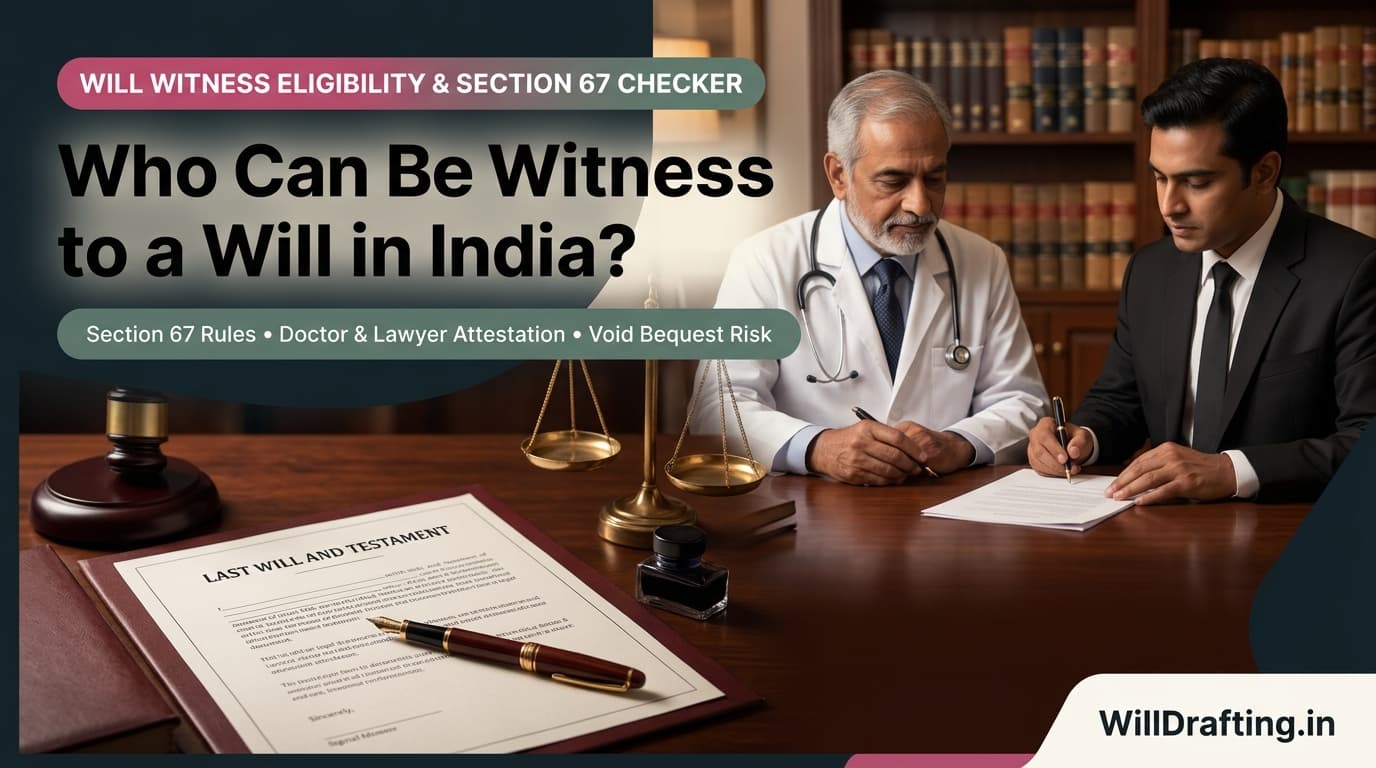
- Doctor & Lawyer Gold Standard: Having an independent MBBS doctor and an advocate sign provides rock-solid defense against claims of dementia or undue influence.
1. Section 67 Explained: Who Can Witness a Will in India
Executing a Will requires strict adherence to statutory formalities. Under Section 63(c) of the Indian Succession Act, 1925, a Will must be attested by two or more witnesses. Each witness must see the testator sign, or receive personal acknowledgment of the signature.
The most perilous pitfall in Indian testamentary drafting is choosing the wrong witnesses. Section 67 of the Act addresses gifts made to attesting witnesses. It provides that if a person attests a Will, any bequest given to that person, or to their spouse, is completely void.
Importantly, the Will itself does not fail. The attestation remains valid to prove the Will. However, the witness and their spouse lose every rupee and parcel of land bequeathed to them. Understanding who can safely witness your Will protects both your estate and your loved ones.
2. Interactive Witness Eligibility & Section 67 Checker
Select your religion and configure the profile of both proposed witnesses below. Get an instant statutory evaluation, void bequest risk analysis, and Court-Defensibility Score.
Optimal & 100% Court-Defensible
Your proposed witnesses satisfy all statutory requirements under Section 63(c) and Section 67 of the Indian Succession Act, 1925, and Section 67 of the Bharatiya Sakshya Adhiniyam, 2023.
3. Hindu vs Christian Wills: The Schedule III Distinction
Most online guides make a dangerous legal error by applying Section 67 indiscriminately to all Indian citizens. The Indian Succession Act, 1925 creates a profound structural distinction between different communities under Section 57 read with Schedule III.
Section 67 applies in full force. If an attesting witness, or the husband or wife of an attesting witness, is named as a beneficiary, the bequest is void. The witness cannot take the property, though the Will remains validly executed.
Schedule III of the Act enumerates the sections of Part VI that apply to Hindus. Section 67 is omitted from Schedule III. Statutorily, a bequest to a witness is not void automatically. However, it creates a massive suspicious circumstance in court under the Supreme Court's ruling in H. Venkatachala Iyengar.
Therefore, even though Hindu law does not automatically forfeit the bequest by statute, probate courts view a beneficiary witness with acute suspicion. If disinherited children challenge the Will, the propounder must prove beyond doubt that the testator was not coerced.
4. Can Beneficiaries, Spouses, or Heirs Be Witnesses?
A frequent question asked during Will drafting is: "Can my wife, son, or daughter sign as a witness?"The practical answer is an emphatic NO, unless they receive zero assets under the Will.
Here is how the law treats different family scenarios:
- Wife or Husband as Witness: If the spouse inherits the matrimonial home or bank accounts, having them sign as a witness triggers Section 67 for Christians and Parsis, voiding their life estate. For Hindus, it invites immediate challenges from excluded children.
- Favored Child as Witness: If one child receives a larger share of ancestral or self-acquired property and attests the Will, courts presume undue influence. The Supreme Court in Kavita Kanwar v. Pamela Mehta (2021) held that active participation by a major beneficiary in the execution process vitiates the probate petition if unexplained.
- Son-in-law or Daughter-in-law as Witness: While Section 67 explicitly names only the witness's husband or wife, bequests to a son-in-law or daughter-in-law whose spouse attests the Will are routinely challenged as indirect spousal fraud.
- Disinherited Child as Witness: If a child who receives nothing signs as a witness, the attestation is legally valid. However, in probate litigation, that disinherited child can easily turn hostile and refuse to depose under Section 67 BSA 2023.
5. Doctors & Lawyers as Witnesses: Evidentiary Value
The most effective strategy to create a challenge-proof Will in India is selecting independent professional witnesses. Indian courts give immense evidentiary weight to medical practitioners and legal professionals.
A doctor acts as both an attesting witness and an expert witness under Section 39 of BSA 2023. By certifying the testator's testamentary capacity at the exact moment of signing, the doctor extinguishes future allegations of senile dementia, Alzheimer's, or medication-induced delirium.
An advocate understands procedural law and maintains contemporaneous office records. When subpoenaed in a probate suit, their testimony carries high credibility because they have no financial interest in the estate and can confirm the testator gave voluntary instructions.
6. Executor as Witness: Section 68 Competency Rules
Can the person appointed to distribute your estate also attest your Will? Under Section 68 of the Indian Succession Act, 1925, the statute explicitly protects the competence of executors:
This means being named as an Executor does not disqualify a witness. An executor is a fiduciary who manages probate and asset transmission. However, if the Executor is also a primary beneficiary (for example, the eldest son who inherits 80% of the estate and is named executor), the suspicious circumstance doctrine applies fully.
7. Section 67 BSA 2023: Proving a Will in Probate Court
Effective July 1, 2024, the Indian Evidence Act, 1872 was replaced by the Bharatiya Sakshya Adhiniyam, 2023 (BSA). Section 67 of the BSA (corresponding to former Section 68 of the Evidence Act) governs how a Will is proven in court.
Under Section 67 BSA, if a document is required by law to be attested, it cannot be used as evidence until at least one attesting witness is examined in court, provided that witness is alive, capable of giving evidence, and subject to the process of the court.
- Choose Younger Witnesses: If you are 70, do not choose 75-year-old friends. If both witnesses die before you, Section 68 BSA requires proving their handwriting, which demands forensic examination and delays probate by years.
- Keep Verified Contact Details: Record Aadhaar numbers, residential addresses, and professional registration numbers of your witnesses in your Will dossier.
8. Disqualified Witnesses: Minors, Blind Persons & More
The following individuals are legally disqualified from being attesting witnesses in India:
Under Section 3 of the Indian Majority Act, 1875, minors lack contractual and legal capacity. A minor cannot depose competently in court as an attesting witness.
Section 63(c) requires the witness to "see" the testator sign. Established precedents (including In the Estate of Gibson) confirm blind witnesses are legally incompetent.
Under the First Schedule of the Information Technology Act, 2000, Wills cannot be signed electronically. E-Sign or DocuSign attestation is completely invalid in India.
The witness must be physically present in the same room. Signing over Zoom or WhatsApp video call does not satisfy Section 63(c) physical presence mandates.
9. Witness Category Comparison: Risk & Legal Standing
| Witness Category | Statutory Eligibility | Section 67 Void Risk | Suspicious Circumstance | Recommended Action |
|---|---|---|---|---|
| MBBS / MD Doctor | 100% Eligible | None (if non-beneficiary) | Zero Risk | Highly Recommended (Gold Standard) |
| Practicing Advocate | 100% Eligible | None (if non-beneficiary) | Zero Risk | Ideal for Legal Scrutiny |
| Independent Colleague | 100% Eligible | None | Low Risk | Safe Choice |
| Executor (Non-Beneficiary) | Eligible (Sec 68) | None | Low Risk | Permitted under Section 68 |
| Beneficiary Child / Spouse | Technically Eligible | 100% Void (Non-Hindus) | Severe Suspicion (Hindus) | STRICTLY AVOID |
| Minor Under 18 | Incompetent | N/A | Fatal Defect | Disqualified by Law |
10. Step-by-Step SOP: Executing a Challenge-Proof Will
Ensure neither witness nor their spouse receives any asset, cash, or life interest under the Will. Ideal combination: 1 Doctor + 1 Advocate or Long-standing Colleague.
Have the Registered Medical Practitioner examine the testator on the day of execution. Obtain a signed fitness certificate endorsed directly on the Will.
Seat the testator, Witness 1, and Witness 2 at the same conference table. Do not allow signing in separate rooms or at different times.
The testator must confirm: 'This is my Last Will and Testament, drafted according to my instructions, and I understand all bequests.'
The testator signs or places their thumb impression on each page and at the foot of the Will in full view of both witnesses.
Each witness writes their full name, father's/spouse's name, age, address, and government ID number directly beneath the attestation clause.
Record a 2-minute video of the signing ceremony and store it with the original Will in a fireproof safe or Sub-Registrar deposit.
11. Landmark Supreme Court Rulings on Attesting Witnesses
The 3-judge bench established the universal test of suspicious circumstances. When a person who benefits substantially participates in the execution or attests the Will, a heavy burden lies on the propounder to dispel all suspicion. If unresolved, the court must refuse probate.
The Supreme Court reaffirmed that where the major beneficiary took a leading role in arranging the witnesses and execution, without convincing explanation for disinheriting other natural heirs, the Will cannot be accepted as genuine.
The Court held that attestation requires animus attestandi. Merely putting signatures on paper is not enough; the witness must sign with the explicit intention of verifying the testator's execution.
12. Standard Attestation Clauses & Certificate Templates
Copy and incorporate these statutory clauses into your Will draft to ensure full compliance with Section 63(c) of the Indian Succession Act, 1925.
"Signed and acknowledged by the Testator, [Full Name of Testator], as and for his/her Last Will and Testament, in the joint physical presence of us, who at his/her request, in his/her presence, and in the presence of each other, have hereunto subscribed our names as attesting witnesses, after satisfying ourselves that the Testator is in sound disposing state of mind, memory, and understanding, and that he/she has executed this instrument freely, voluntarily, and without any coercion, fraud, or undue influence whatsoever.

1. FIRST ATTESTING WITNESS:
Signature: __________________________
Full Name: [Witness 1 Name]
Father's / Husband's Name: [Parent/Spouse Name]
Occupation / Qualification: [Doctor / Advocate / Professional]
Age: [Age] Years | Address: [Full Residential Address]
Aadhaar / Voter ID No: [Govt ID Proof Number]

2. SECOND ATTESTING WITNESS:
Signature: __________________________
Full Name: [Witness 2 Name]
Father's / Husband's Name: [Parent/Spouse Name]
Occupation / Qualification: [Advocate / Colleague / Neighbor]
Age: [Age] Years | Address: [Full Residential Address]
Aadhaar / Voter ID No: [Govt ID Proof Number]"
"I, Dr. [Doctor's Full Name], holding qualification [MBBS / MD / MS], registered with the State Medical Council / National Medical Commission under Registration No. [Reg Number], practicing at [Clinic / Hospital Name & Full Address], do hereby certify that:

1. I have this day, the [Date] of [Month, Year], examined [Mr. / Mrs. / Ms. Testator Name], aged about [Age] years, residing at [Testator's Full Address], immediately prior to the execution of his/her Last Will and Testament.
2. Based on clinical examination and cognitive assessment, I certify that the Testator is in full possession of sound disposing mental faculties, lucid memory, coherent speech, and rational understanding.
3. The Testator is fully conscious, oriented to time, place, and person, and capable of understanding the nature, effect, and testamentary consequences of the bequests made in the attached Will.
4. I have signed this certificate and the said Will in the physical presence of the Testator and the second attesting witness.

Date: [Date of Execution] | Place: [City, State]
Doctor's Signature: __________________________
Doctor's Name & Seal: [Official Stamp with Reg No.]"
13. Advocate Verification & Legal Scrutiny Process
Every Will template and diagnostic checker on WillDrafting.in is authored and reviewed by seasoned estate planning advocates. Our team verifies witness affidavits, ensures full compliance with Section 63(c) and Section 67, and prepares clients for probate defense under the Bharatiya Sakshya Adhiniyam, 2023.
14. Frequently Asked Questions: Will Witnesses in India
15. Statutory References & Official Legislative Portals
- Indian Succession Act, 1925: Section 57 (Application of Part VI), Section 63(c) (Execution of unprivileged Wills), Section 67 (Effect of gift to attesting witness), Section 68 (Witness not disqualified by being executor), and Schedule III.
- Bharatiya Sakshya Adhiniyam, 2023: Section 67 (Proof of execution of document required by law to be attested) & Section 68 (Proof where no witness found).
- Indian Majority Act, 1875: Section 3 (Age of majority).
- Information Technology Act, 2000: First Schedule, Entry 1 (Exclusion of Wills from electronic signatures).