- Plain-Paper Wills Are Valid: A Will does not need stamp paper or compulsory registration under Section 18(e) of the Registration Act, 1908. However, it must strictly satisfy Section 63 of the Indian Succession Act, 1925.
- Two-Witness Rule Is Mandatory: Under Section 63(c), every civilian Will (even if handwritten or notarized) must be attested by at least two adult witnesses who sign in the physical presence of the testator.
- Never Use a Beneficiary or Spouse as Witness: Under Section 67, if an attesting witness or their spouse is a beneficiary, their inheritance becomes void (for Christian/Parsi Wills) or triggers a major court suspicion (for Hindu Wills).
- Aadhaar eSign & Video-Only Wills Are Void: The Information Technology Act, 2000 First Schedule explicitly excludes Wills. Only a physical paper document signed in wet ink or thumb mark is valid in court.
1. How to Check If a Will Is Valid in India Under Law
Every week, thousands of Indian families ask whether a plain-paper or homemade Will is legally valid. The short answer is yes, provided it complies with the statutory execution rules. A fatal defect in a Will is rarely discovered while the testator is alive. It surfaces only after death, when a bank, housing society, Tehsildar, or Probate Court rejects the document.
To check if a Will is valid in India, courts apply a two-tier legal test under the Indian Succession Act, 1925. First, the Will must pass the mandatory statutory execution checklist under Sections 59, 61, 63, and 67. If a Will fails Section 63 (for example, having only one witness or being signed via Aadhaar eSign), no judge can save it.
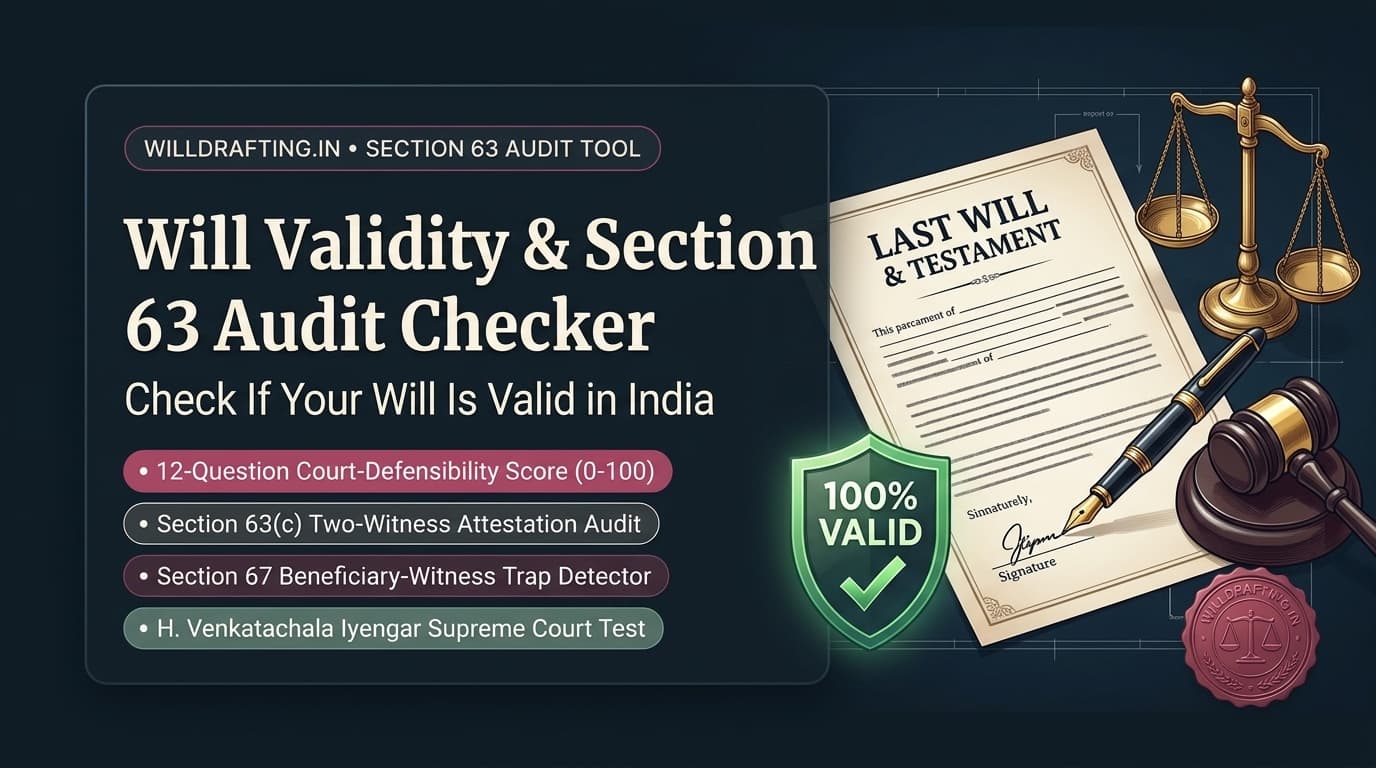
Second, even if a Will is properly signed and witnessed, it must survive the Supreme Court’s Suspicious Circumstances Test established in H. Venkatachala Iyengar v. B.N. Thimmajamma (AIR 1959 SC 443). Our interactive audit tool below checks your draft against both statutory validity and courtroom defensibility in 60 seconds.
2. Interactive Section 63 Will Validity Audit Checker
Answer the 12 statutory questions below based on your current draft or existing Will. The tool instantly computes your 0 to 100 Court-Defensibility Score and flags every legal vulnerability.
The testator must understand the nature of the act, the extent of their property, and the family members being included or excluded.
Indian law requires physical execution on paper. Digital signatures and standalone videos are excluded by statute.
Even a notarized or handwritten Will requires the statutory minimum number of attesting witnesses.
Many DIY Wills fail because someone takes the signed paper to a neighbor's house or office in another room to get witness signatures.
For example: Did your wife, son, daughter, or son-in-law (whose spouse inherits) sign as one of the two witnesses?
Under Section 67 of the Bharatiya Sakshya Adhiniyam, 2023, at least one witness must testify in court after the testator's death.
An attestation clause explicitly records that the testator signed in the presence of the witnesses and the witnesses signed in the testator's presence.
Unsigned intermediate pages or handwritten corrections without full countersignatures are prime targets for probate objections.
A Residuary Clause covers any bank account, mutual fund, or property you forgot to list or acquired after making the Will.
In Hindu/Muslim/Christian families, disinheriting a child or spouse without mentioning why triggers intense court scrutiny.
Highly recommended for testators above age 65, or anyone with chronic illness, hospitalization, or unequal asset distribution.
Active participation by the main beneficiary during drafting or signing is the #1 ground for 'undue influence' under Section 61.
Ironclad & Court-Defensible Will
Excellent Compliance: Your Will satisfies all mandatory pillars of Section 59, Section 63(a)-(c), and Section 67, and incorporates proactive safeguards against Supreme Court suspicious circumstances.
While Section 63(c) states no particular form of attestation is mandatory, omitting the attestation paragraph removes the legal presumption of due execution (omnia praesumuntur rite esse acta) if witnesses later forget details during cross-examination.
While not mandatory by statute, 80% of Indian probate caveats allege that an elderly parent was on heavy medication, senile, or mentally unfit on the date of signing.
Do not leave your family exposed to a 10-year Probate Court battle. Replace a defective DIY draft with a 100% Section 63 compliant Will or book Sub-Registrar registration support.
3. Section 63 Indian Succession Act: 3 Mandatory Rules
Section 63 of the Indian Succession Act, 1925 is the backbone of testamentary validity in India. It applies to all unprivileged Wills made by Hindus, Buddhists, Sikhs, Jains, Christians, Parsis, and persons married under the Special Marriage Act. Every valid Will must satisfy three non-negotiable clauses:
The testator must sign or affix their thumb mark to the Will, or another person must sign it in the testator’s physical presence and strictly by their direction.
The signature or mark must be placed so that it clearly appears the testator intended to give legal effect to the writing as a Last Will and Testament.
At least two witnesses must see the testator sign (or receive personal acknowledgment) and each witness must sign the Will in the physical presence of the testator.
In Janki Narayan Bhoir v. Narayan Namdeo Kadam (2003) 2 SCC 91, the Supreme Court clarified how Section 63(c) interacts with Section 68 of the Indian Evidence Act (now Section 67 of the Bharatiya Sakshya Adhiniyam, 2023). Even though only one attesting witness needs to be called to court to prove the Will, that witness must testify that both witnesses attested the document in the testator’s presence.
4. Section 67 Witness Disqualification and Void Bequests
When families write a DIY Will at home, the testator often asks their wife, son, daughter, or son-in-law to sign as one of the two attesting witnesses. This triggers the notorious Section 67 Trap of the Indian Succession Act, 1925.
Under Section 67, a Will is not invalid merely because a witness is a beneficiary. However, any bequest, legacy, or property gift made to an attesting witness (or to the wife or husband of that attesting witness) is utterly void! In other words, the witness remains competent to prove the Will in court, but they and their spouse lose the inheritance given to them in that Will.
Under Section 57 and Schedule III of the Indian Succession Act, Section 67 is omitted for Hindu, Buddhist, Sikh, and Jain Wills, whereas it applies with full statutory force to Christian, Parsi, and Special Marriage Act Wills. However, even in a Hindu Will, having a beneficiary or their spouse sign as a witness is treated by High Courts as a major suspicious circumstance proving active interference. Always use two neutral, non-beneficiary witnesses!
5. Supreme Court Suspicious Circumstances Checklist
In the landmark judgment H. Venkatachala Iyengar v. B.N. Thimmajamma (AIR 1959 SC 443), reaffirmed in Kavita Kanwar v. Pamela Mehta (2020) 11 SCC 209 and Shivakumar v. Sharanabasappa (2020) 11 SCC 277, the Supreme Court held that a Will speaks from the death of the testator, when the author can no longer be called to verify it.
Therefore, if a Will is surrounded by “suspicious circumstances,” the burden lies heavily on the beneficiary (propounder) to satisfy the judicial conscience of the court. The top red flags that cause Indian courts to strike down even signed Wills include:
- Active Participation of the Propounder: The main beneficiary hired the typist, dictated the clauses, brought their own personal friends as witnesses, or sat in the room while the parent signed.
- Unexplained Exclusion of Natural Heirs: A wife, minor child, or daughter is completely disinherited without a single sentence explaining why.
- Abnormal Signature Placement: Cramped text on the last page or a signature floating far below the text, suggesting the testator signed a blank paper earlier.
- Contradictory Asset Descriptions: Listing HUF coparcenary property as 100% self-acquired property, or failing to check whether court probate is mandatory in your city.
6. Plain Paper, Handwritten, eSign, and Video Will Rules
Modern technology and foreign movies have created widespread confusion in India regarding digital Wills, video Wills, and handwritten notes. Here is the exact statutory position for each format:
A typed or handwritten Will on plain A4 paper is 100% valid if signed by the testator and attested by two witnesses under Section 63. In Joyce Primrose Prestor v. Vera Marie Vas (1996 SC), the Supreme Court noted that a cleanly written holographic Will carries a strong presumption of genuineness, provided it is duly witnessed.
Under Section 1(4) read with Entry 3 of the First Schedule to the Information Technology Act, 2000, Wills are excluded from electronic signatures. Similarly, a standalone spoken video without a signed, two-witness paper Will is void. However, recording a video while signing the paper Will is admissible as corroborative evidence under Section 63 of the Bharatiya Sakshya Adhiniyam, 2023.
7. Section 59 Sound Mind and Medical Fitness Proof
Under Section 59 of the Indian Succession Act, 1925, every person of sound mind who is not a minor can dispose of their property by Will. Importantly, Explanations 1, 2, and 3 to Section 59 clarify that a person who is deaf, dumb, or blind can make a valid Will if they understand what they do by it, and a person who is ordinarily unwell can make a valid Will during a lucid interval.
However, when a senior citizen (above 65 or 70 years) executes a Will, disgruntled relatives almost always allege age-related cognitive decline, Alzheimer’s, or heavy hospital medication. Having a registered MBBS or MD physician append a short clinical fitness certificate on the Will itself (or on the same date) neutralizes capacity challenges in court.
If an elderly testator cannot climb stairs or visit the Sub-Registrar Office due to illness, Section 31 of the Registration Act, 1908 empowers the Sub-Registrar to attend the testator’s private residence or hospital bedside to register the Will officially. Book AMA Legal Solutions Will Registration Assistance.
8. Comparison Table: Fatal Defects vs Curable Errors
Use this quick statutory reference table to distinguish mistakes that make a Will completely void from errors that create litigation risk or remain legally valid:
| Scenario / Defect in Will | Governing Statute | Legal Status in Court | Required Action |
|---|---|---|---|
| Signed by only 1 witness (or 0 witnesses) | Section 63(c) ISA | 100% VOID | Re-execute immediately with 2 adult witnesses |
| Signed via Aadhaar eSign, DSC, or DocuSign | IT Act 2000 Sch. I Entry 3 | 100% VOID | Print on physical paper & sign in wet ink |
| Standalone video recording without written Will | Section 63 ISA | 100% VOID | Execute written Will; use video only as support |
| Beneficiary or spouse signed as witness | Section 67 ISA | Bequest Void (Sec 67) / High Risk | Re-execute with 2 independent neutral witnesses |
| Uninitialed crossings or handwritten edits | Section 71 ISA | Alteration Ignored / Void | Print clean fresh Will or execute formal Codicil |
| Written on plain paper (No stamp paper / Unregistered) | Registration Act s. 18(e) | 100% LEGALLY VALID | Optional SRO registration recommended for high value |
| No Doctor Certificate attached | Section 59 ISA | Valid (Vulnerable if age 65+) | Attach MBBS/MD fitness certificate for seniors |
9. Step-by-Step SOP: How to Fix a Defective DIY Will
Do Not Cross Out or Overwrite Your Old Will
Under Section 71 of the Indian Succession Act, striking out names or squeezing in handwritten lines after signing has zero legal effect unless countersigned by the testator and both witnesses. Overwriting also triggers forensic tampering objections.
Draft a Fresh Will With an Express Revocation Clause
Under Section 62 and Section 70, the cleanest way to cure any defect in an earlier unregistered or registered Will is to execute a brand-new Will that explicitly revokes all prior testamentary dispositions.
Include a Family Tree, Exclusion Rationale, and Residuary Clause
List all Class I legal heirs clearly. If any natural heir is receiving a smaller share, state a calm, non-defamatory reason. Add a Residuary Clause under Section 102 so no bank account or future asset is left in intestacy.
Select Two Younger, Non-Beneficiary Witnesses
Choose two adult witnesses (friends, neighbors, colleagues, or professionals) who are younger than you and who are neither beneficiaries nor married to any beneficiary in the Will.
Sign Every Page in One Sitting With Doctor Endorsement
Sign at the bottom of every page in wet ink in the physical presence of both witnesses, and have both witnesses sign the Section 63(c) attestation block in your presence. Have a doctor sign the mental fitness certificate on the same day.
Destroy the Defective Unregistered Draft or Register at SRO
Once the new Will is signed and witnessed, physically shred the old defective unregistered draft under Section 70 so two conflicting versions never surface after your lifetime.
10. Real Case Studies: Valid vs Invalid Wills in Court
A Christian widow in Bandra drafted a DIY Will leaving her ₹4.5 Crore apartment to her daughter. To save time, she asked her neighbour (Witness 1) and her daughter’s husband (Witness 2) to sign as witnesses.
A 72-year-old retired engineer printed his Will on plain white A4 paper, signed every page in front of two 45-year-old colleagues, attached an MBBS doctor fitness note, and included a clear reason for unequal distribution.
11. Copy-Paste Section 63(c) Attestation and Doctor Clauses
"SIGNED, EXECUTED, AND DECLARED by the above-named Testator, [Full Name of Testator], as and for his/her Last Will and Testament, consisting of [Total Pages] pages (each page having been individually signed by the Testator), in our joint physical presence, who at his/her request, in his/her physical presence, and in the physical presence of each other, have hereunto subscribed our respective names and signatures as Attesting Witnesses on this [Day] day of [Month], [Year] at [City, State]. We further affirm that at the time of execution, the Testator appeared to be of sound, alert, and disposing mind, memory, and understanding, and executed this Will voluntarily of his/her own free agency without any coercion or undue influence.

WITNESS 1:
Signature: _______________________
Full Name: [Name of Witness 1] | Age: [Age] Years
Address: [Full Residential Address with PIN Code]
ID Proof (Aadhaar/PAN): [ID Number]

WITNESS 2:
Signature: _______________________
Full Name: [Name of Witness 2] | Age: [Age] Years
Address: [Full Residential Address with PIN Code]
ID Proof (Aadhaar/PAN): [ID Number]"
"I, Dr. [Full Name of Doctor], holding Medical Registration No. [MCI/SMC Registration Number], practicing at [Hospital/Clinic Name & Address], hereby certify that I have personally examined [Full Name of Testator], aged [Age] years, residing at [Address], today on [Date] at [Time AM/PM].

Based on my clinical examination, I confirm that the Testator is fully conscious, well-oriented to time, place, and person, and is of sound and disposing state of mind. He/she suffers from no cognitive impairment, delusion, or mental incapacity that would affect his/her ability to understand the nature and effect of executing this Last Will and Testament.

Signature of Doctor: _______________________
Name: Dr. [Full Name], [MBBS / MD]
Registration No.: [Reg. No. & State Medical Council] | Official Stamp"
12. Institutional Profile: Testamentary Legal Practice
WillDrafting.in is India’s premier estate planning and succession platform, backed by AMA Legal Solutions. Our High Court testamentary litigators have audited, registered, and defended over 15,000 Wills across Mumbai, Delhi NCR, Bengaluru, Chennai, Kolkata, Pune, and Hyderabad. Every Will generated on our platform automatically embeds Section 63(c) attestation blocks, Section 67 witness safeguards, and Supreme Court compliant exclusion clauses.
13. Frequently Asked Questions: Will Validity in India
Direct plain-English answers to common questions on how to check if a Will is valid in India:
14. Statutory Citations and Official Legal Portals
- Section 59, Indian Succession Act, 1925: Testamentary capacity, adult age requirement, and sound disposing mind rules.
- Section 61, Indian Succession Act, 1925: Invalidity of Wills obtained by fraud, coercion, or importunity taking away free agency.
- Section 63(a), (b) & (c), Indian Succession Act, 1925: Mandatory signature, placement, and two-witness attestation rules.
- Section 67, Indian Succession Act, 1925: Disqualification of gifts to attesting witnesses and their spouses.
- Section 67, Bharatiya Sakshya Adhiniyam, 2023 (formerly Sec 68 IEA): Proof of execution of document required by law to be attested.
- H. Venkatachala Iyengar v. B.N. Thimmajamma (AIR 1959 SC 443): Supreme Court benchmark on proving Wills and dispelling suspicious circumstances.