- Nominee 15-Day Direct Release: Under RBI circulars, if a valid nominee is registered on bank records, the branch manager must release funds within 15 calendar days. Banks are prohibited from demanding legal heir certificates or indemnity bonds from nominees.
- Simplified Claim Threshold (₹5L - ₹10L): When an account lacks a nominee, banks cannot routinely demand court succession certificates for balances up to Board-approved thresholds (SBI, PNB, BoB: ₹5,00,000; ICICI: ₹10,00,000). Settlement is done against an Indemnity Bond with two solvent sureties.
- Nominee is Trustee, Not Owner: The Supreme Court has repeatedly confirmed that a nominee receives funds merely as a custodian for the legal heirs. The money remains subject to the laws of succession under the Hindu Succession Act or Indian Succession Act.
- Right to Ombudsman Remedy: If a branch manager delays settlement beyond 15 days or unlawfully demands a court order for claims below ₹5 Lakhs, claimants can file an instant complaint with the RBI Banking Ombudsman under the Integrated Ombudsman Scheme, 2021.
1. RBI Master Directions: Settlement of Deceased Claims
Every year, thousands of grieving Indian families encounter bureaucratic roadblocks when attempting to access bank accounts, fixed deposits, and lockers left behind by deceased family members. Branch managers frequently confuse claimants by asking for court succession certificates, even when clear regulatory mechanisms exist for swift settlement.
To eliminate harassment of surviving family members, the Reserve Bank of India issued clear directives in its Master Direction on Customer Service in Banks (updating landmark circular DBOD.No.Leg.BC.95/09.07.005/2004-05). Under these statutory directions, banks must follow a simplified, time-bound protocol to settle claims of deceased depositors.
The RBI guidelines divide deceased depositor settlements into two distinct categories: accounts with a registered nomination or survivorship clause, and accounts without nomination. For accounts without nomination, the RBI explicitly directs banks not to insist on succession certificates or letters of administration in claims up to a threshold limit fixed by the bank’s Board of Directors.
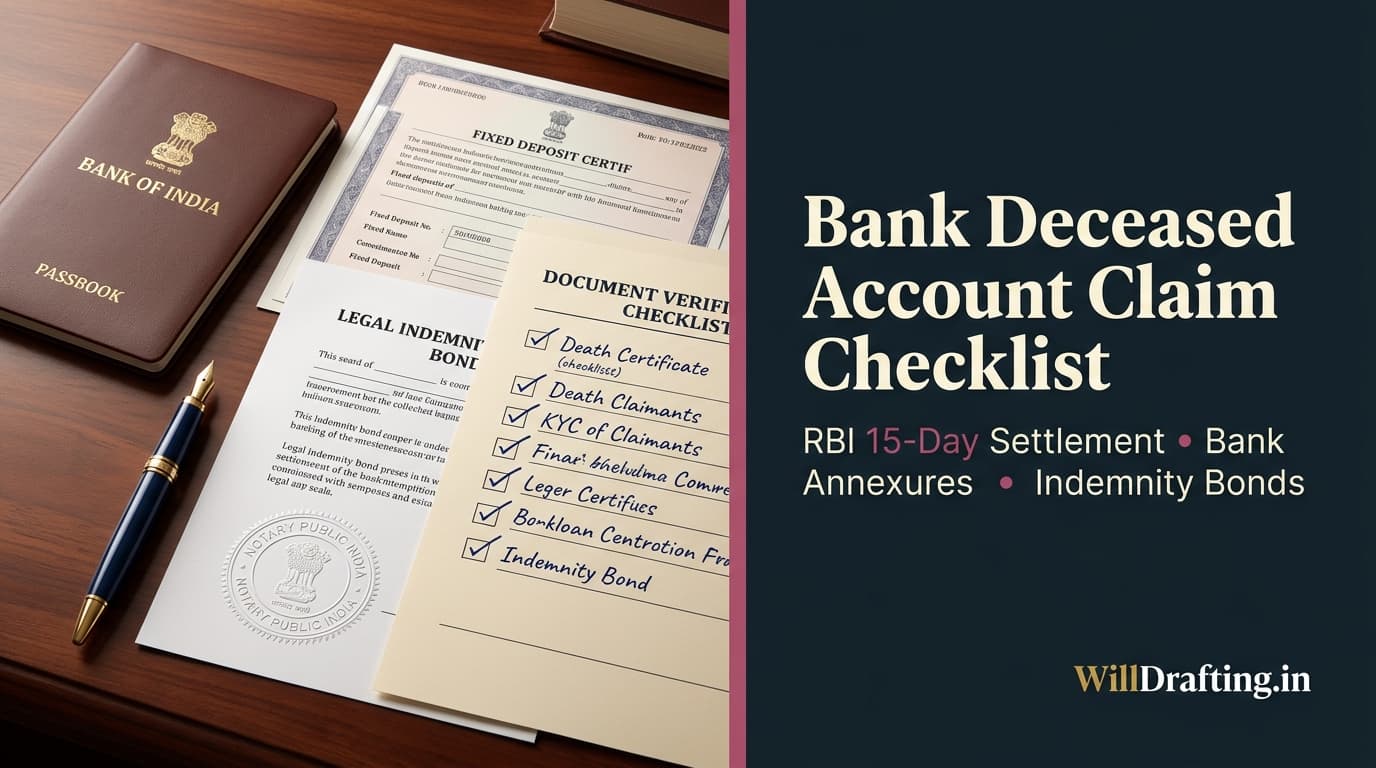
2. Bank Deceased Claim Document Checklist Generator
Select the bank, account type, claim balance, and nominee status below. Our legal engine will diagnose whether your claim qualifies for simplified settlement, display exact bank annexures, calculate required stamp duty, and produce an instant printable document checklist.
The deposit amount of ₹4,50,000 is within SBI's Board-approved threshold (₹5,00,000). As per RBI directions, the branch CANNOT insist on a court order and must settle the claim against an Indemnity Bond with two solvent sureties.
Customized Document Checklist (9 Items)
Tick the items as you assemble your dossier for SBI branch submission.
Computerized Municipal Corporation or Registrar of Births and Deaths certificate. Carry original for branch verification plus self-attested copies.
If passbook or FDR is misplaced, submit a formal indemnity for lost instrument along with police non-cognizable (NC) report.
Self-attested PAN Card and proof of address (Aadhaar Card, Passport, or Voter ID) of all claiming individuals, along with passport photographs.
Complete application prescribed by State Bank of India (SBI), duly signed by ALL surviving legal heirs of the deceased depositor.
Official certificate issued by the Revenue Tahsildar, Sub-Divisional Magistrate (SDM), or Municipal Authority establishing family tree.
Signed by all non-claiming legal heirs relinquishing their share and authorizing one heir to receive the proceeds on their behalf.
Declaration on non-judicial stamp paper from 2 neighbors, gazetted officers, or community members confirming the deceased's family members.
Binding legal undertaking executed by the claimant heir and 2 solvent sureties, notarized under Indian law.
Proof of solvency for 2 sureties (latest ITR V, salary slips, municipal property tax receipt, or chartered accountant certificate).
For non-nominee claims requiring an Indemnity Bond (Annexure D / Form 8B), purchase ₹500 Non-Judicial Stamp Paper. The bond must be attested before a First-Class Judicial Magistrate or an Advocate Notary Public registered with the Government of India.
3. Nominee vs Legal Heir Rights: Banking Regulation Act
A widespread misconception among Indian citizens is that a nominee inherits absolute ownership of the bank deposit upon the account holder’s death. This belief is legally incorrect. Section 45ZA of the Banking Regulation Act, 1949 explicitly clarifies that payment made by the bank to a nominee constitutes a valid discharge of the bank’s liability.
In the landmark case of Smt. Sarbati Devi v. Smt. Usha Devi (1984 1 SCC 424), the Supreme Court of India held that nomination does not operate as a third-party Will. The nominee is merely an authorized agent or trustee empowered to receive the proceeds from the bank and give a legal discharge.
This principle was reaffirmed for banking deposits in Ram Chander Talwar v. Devender Kumar Talwar (2010 10 SCC 671), where the Supreme Court confirmed that the money belongs to the legal heirs according to the deceased’s personal succession law (such as the Hindu Succession Act or Indian Succession Act). If the nominee refuses to distribute the money among legal heirs, the heirs can initiate a civil suit for recovery and partition.
| Parameter | Nominee (Sec 45ZA) | Legal Heir (Succession Law) |
|---|---|---|
| Legal Status | Statutory Custodian / Trustee | Beneficial Absolute Owner |
| Right to Bank Payout | Direct 15-Day Payout from Branch | Can claim through nominee or court |
| Bank Discharge | Bank fully discharged under Sec 45ZA(2) | Cannot hold bank liable after payment to nominee |
| Overridden by Will? | Yes, a valid registered Will overrides nominee | Legatee named in Will inherits funds |
| Dispute Jurisdiction | Bank Ombudsman / Branch Grievance | Competent Civil Court / District Judge |
4. Top 12 Indian Banks Deceased Claim Threshold Limits
While bank websites often bury Annexures inside 40-page PDF guidelines, the table below aggregates the Board-approved simplified claim limits, required sureties, and applicable forms across India’s 12 major public and private sector banks:
| Bank Name | Simplified Limit (Without Court) | Sureties | Primary Claim Forms | Court Order Trigger |
|---|---|---|---|---|
| State Bank of India (SBI) | ₹5,00,000 | 2 Solvent Sureties | Annexure-A (Application for Settlement of Claim) | Above ₹5,00,000 |
| HDFC Bank | ₹5,00,000 | 2 Solvent Sureties | Form 8 (Deceased Claim Application Form) | Above ₹10,00,000 |
| ICICI Bank | ₹10,00,000 | 2 Solvent Sureties | Form D2 (Deceased Claim Form without Nominee) | Above ₹10,00,000 |
| Punjab National Bank (PNB) | ₹5,00,000 | 2 Solvent Sureties | PNB Form 1093 (Settlement Claim Form without Nominee) | Above ₹5,00,000 |
| Bank of Baroda (BoB) | ₹5,00,000 | 2 Solvent Sureties | Form 237 (Deceased Claim Form Non-Nominee) | Above ₹5,00,000 |
| Axis Bank | ₹5,00,000 | 2 Solvent Sureties | Form DA (Deceased Depositor Settlement Form) | Above ₹5,00,000 |
| Canara Bank | ₹5,00,000 | 2 Solvent Sureties | NF 745 (Claim Application without Nomination) | Above ₹5,00,000 |
| Union Bank of India | ₹5,00,000 | 2 Solvent Sureties | Form CD-2 (Settlement Application for Legal Heirs) | Above ₹5,00,000 |
| Kotak Mahindra Bank | ₹5,00,000 | 2 Solvent Sureties | Form KMBL-DC2 (Deceased Claim Application Form) | Above ₹5,00,000 |
| IndusInd Bank | ₹5,00,000 | 2 Solvent Sureties | IB-DC Form 2 (Claim Form for Heirs without Nominee) | Above ₹5,00,000 |
| Bank of India (BoI) | ₹5,00,000 | 2 Solvent Sureties | Form L-2 (Application for Settlement without Nominee) | Above ₹5,00,000 |
| Central Bank of India | ₹5,00,000 | 2 Solvent Sureties | Annexure A (Settlement Form for Deceased Depositors) | Above ₹5,00,000 |
5. Indemnity Bond & Surety Requirements for Bank Claims
When settling a deceased depositor claim without a registered nominee or court order, the bank assumes legal risk. If an estranged child, a subsequent spouse, or an undisclosed creditor appears later with claims against the estate, the bank could face litigation.
To protect against this financial exposure, banks require the claimant to execute anIndemnity Bond (usually Annexure D or Form 8B). Under this contract, the claimant agrees to indemnify and hold harmless the bank against any future claims, losses, or legal costs arising from releasing the funds.
Banks also mandate two solvent sureties (guarantors) who sign the indemnity bond. The sureties must possess a combined net worth equal to or greater than the claim amount. Acceptable proof of solvency includes recent Income Tax Return (ITR-V) acknowledgments, employer salary certificates, or municipal property tax receipts.
6. Safety Locker & Safe Custody Claim Rules After Demise
Claiming the contents of a bank safety locker follows specialized statutory protocols underSections 45ZC to 45ZF of the Banking Regulation Act, 1949. Unlike savings deposits, banks do not own or hold title to locker contents; they act strictly as bailees.
Locker With Nomination: Under Section 45ZE, if a sole hirer dies with a registered nominee, the branch manager must grant locker access to the nominee. Before handing over contents, an inventory is prepared in the presence of the branch manager, nominee, and two independent witnesses. The bank does not demand a succession certificate from the nominee.
Locker Without Nomination: All legal heirs must jointly attend the branch to open the locker, conduct inventory, and receive contents. If one heir cannot attend in person, they must execute a registered Power of Attorney or formal Letter of Relinquishment in favor of the attending heir.
7. When Is a Court Succession Certificate Truly Mandatory?
Branch managers sometimes unlawfully demand court orders for small balances. Claimants should know exactly when a Succession Certificate under Section 372 of the Indian Succession Act, 1925 is legally required:
- Aggregate Balance Exceeds Board Limit: When the deceased’s total balances across all accounts in that bank exceed the threshold (e.g. > ₹5 Lakhs in SBI or > ₹10 Lakhs in ICICI).
- Active Legal Dispute Among Heirs: If any family member submits a written objection or legal notice to the branch asserting a conflicting claim.
- Absence of Solvent Sureties: If the legal heirs cannot produce two acceptable guarantors with income tax proof to sign the bank’s indemnity bond.
- Doubtful Title or Conflicting Wills: When multiple unprobated Wills or conflicting testamentary documents are submitted to the bank.
In presidential towns (Mumbai, Kolkata, and Chennai), if the deceased left a Will, Section 213 of the Indian Succession Act may require probate before the bank releases substantial balances.
8. Step-by-Step SOP: Claiming Bank Balance of Deceased
Inform Branch & Freeze Debit Operations
Submit a written notice of demise along with a photocopy of the death certificate. The bank freezes debit mandates, standing instructions, and auto-debits to prevent fraudulent withdrawals.
Check Nomination Registration Status (Form DA-1)
Ask the branch operations manager to verify whether a nominee exists in the core banking system. Request an official copy of the deceased depositor claim form kit.
Obtain Revenue Legal Heir / Surviving Member Certificate
If no nominee is recorded, apply to the local Revenue Tahsildar or Municipal Corporation for a formal Legal Heir Certificate or Surviving Member Certificate establishing the family tree.
Execute Non-Judicial Stamp Paper Indemnity & NOC
Purchase non-judicial stamp paper in accordance with state stamp duty. Have the indemnity bond and co-heir disclaimer letters executed and attested by a Notary Public.
Submit Complete Dossier with Acknowledgment Slip
Submit all original forms, death certificate, and KYC proofs at the home branch. Obtain a stamped duplicate acknowledgment slip with the branch inward date.
Enforce RBI 15-Day Settlement Deadline
Under RBI Master Directions, the bank must credit proceeds to the claimant's account within 15 days. If delayed, submit an escalation letter to the Principal Nodal Officer.
9. Practical Case Studies: SBI, HDFC & ICICI Bank Claims
A father in Lucknow passed away leaving ₹4.20 Lakhs in an SBI savings account without a nominee. The branch manager initially demanded a court succession certificate.
Mother left fixed deposits worth ₹18 Lakhs across 3 accounts without nomination. Because the sum exceeded HDFC’s ₹10 Lakh discretionary ceiling, succession certificate was mandatory.
10. Copy-Paste Bank Deceased Claim Affidavits & Bonds
"LETTER OF INDEMNITY (NON-JUDICIAL STAMP PAPER):
To: The Branch Manager, [Bank Name], [Branch Address].
WHEREAS late [Deceased Depositor Name] held Account No. [Account Number] with balance Rs. [Claim Amount]/-;
AND WHEREAS the deceased expired on [Date of Death] leaving behind the undersigned as surviving legal heirs;
NOW THEREFORE, in consideration of the Bank paying the deposit balance to [Claimant Name], WE, the Claimant and Sureties, jointly and severally agree to indemnify and hold harmless the Bank against all future claims, suits, or demands from any person whatsoever."
"FORMAL NOTICE UNDER RBI MASTER DIRECTION (CLAUSE 4.2):
To: The Branch Manager, [Bank Name].
Sub: Delayed Deceased Claim in Account No. [Account No.] beyond 15 days.
Please take notice that failure to disburse funds within 15 days violates RBI Master Direction DBR.No.Leg.BC.21/09.07.006/2015-16. Unless disbursed within 48 hours, this matter will be escalated to the RBI Banking Ombudsman on the CMS Portal."
11. Institutional Profile: Legal Excellence & Trust
WillDrafting.in is India’s premier estate planning and succession technology platform, powered by AMA Legal Solutions. Our multidisciplinary legal bench specializes in testamentary disputes, District Court succession certificate petitions, Banking Ombudsman escalations, and deceased depositor transmissions across all 12 major public and private banks. We have assisted over 15,000 Indian families in drafting challenge-proof Wills and expediting asset transmissions.
12. Frequently Asked Questions: Bank Deceased Claims
Clear, legally verified answers to common questions about bank account claims, indemnity bonds, nomination rules, and RBI timelines:
13. Statutory Citations & Official Banking Portals
- Banking Regulation Act, 1949: Sections 45ZA to 45ZF (Nomination and safe custody).
- RBI Master Direction on Customer Service in Banks: DBR.No.Leg.BC.21/09.07.006/2015-16.
- Reserve Bank - Integrated Ombudsman Scheme, 2021: Redressal of bank claim delays.
- Indian Succession Act, 1925: Sections 370 to 389 (Succession Certificate for bank debts).
- Supreme Court Landmark Precedents: Smt. Sarbati Devi (1984) and Ram Chander Talwar (2010).