Essential Rules Every Indian Family Should Know
- No stamp paper needed: Writing or typing your Will on ordinary white A4 paper is 100% legal. You do not need to buy costly stamp paper.
- Two adult witnesses are compulsory: Two people above 18 years must watch you sign the Will and then sign it themselves in front of you (Section 63).
- Heirs must NOT sign as witnesses: If your son, daughter, or spouse gets anything in the Will, they should never sign as a witness. If they do, they legally lose their share (Section 67).
- Registration is optional: You do not have to visit a government office. A Will made and signed at home is fully enforceable in court.
1. Is a Will on Plain Paper Really Legal in India?
Yes, absolutely. Many people in India believe that a Will is only valid if it is bought on expensive green or blue court stamp paper, notarized, or registered. That is completely untrue.
Under the Indian Stamp Act, 1899, the government stamp duty on a Will is exactly zero. Under Section 63 of the Indian Succession Act, 1925, the law only requires three simple things: (1) You write down your wishes clearly on plain paper, (2) You sign it yourself, and (3) Two adult witnesses watch you sign and sign in front of you. That is all it takes to make a legally binding Will.
What the Supreme Court of India Says
The Supreme Court has confirmed in multiple landmark rulings (such as Ishwardeo Narain Singh v. Kamta Devi) that an informal handwritten or typed document on ordinary paper has full legal force as long as your intention is clear and two witnesses signed it.
2. Interactive Checklist: Section 63 Legal Requirements
Before printing your Will, review these essential statutory criteria. Check each item to verify that your document complies with Indian law.
3. Clause-Annotated Will Format: Free Downloadable Template
Below is a comprehensive, advocate-approved Will format tailored for Indian properties and financial assets. You can copy it directly or print it for execution.
Clause-by-Clause Legal Rationale (Why Each Clause Exists)
Plain words: You confirm you are thinking clearly and know what you own. This stops unhappy relatives from falsely claiming later in court that you were confused, ill, or manipulated.
Plain words: Makes it 100% clear that this new Will replaces any older drafts or verbal promises, so your family only follows your latest wishes without any confusion.
Plain words: You pick a trusted person to carry out your wishes (like visiting the bank or transferring the flat). Naming a backup ensures things don't get stuck if your first choice is unwell or unavailable.
Plain words: Writing clear details (like flat number, bank account number, or demat ID) prevents arguments among family members and helps offices transfer the name easily.
Plain words: A safety net for anything you forgot to list, or any new savings or home you buy later. It automatically gives them to your chosen person so your family never has to fight in court over missing items.
Plain words: Two adults must see you sign and sign in front of you. Under Indian law, a Will signed without two witnesses is not valid in court.
4. Who Should NOT Sign as a Witness (Section 67 Warning)
Never ask your son, daughter, spouse, or anyone who is receiving property in your Will to sign as a witness. Under Section 67 of the Indian Succession Act, if someone getting property signs as a witness, they legally lose their entire inheritance!
The Will remains valid for others, but the person who signed as a witness gets nothing by law. To keep your family members safe, always choose two independent adult witnesses who have no financial share in your property.
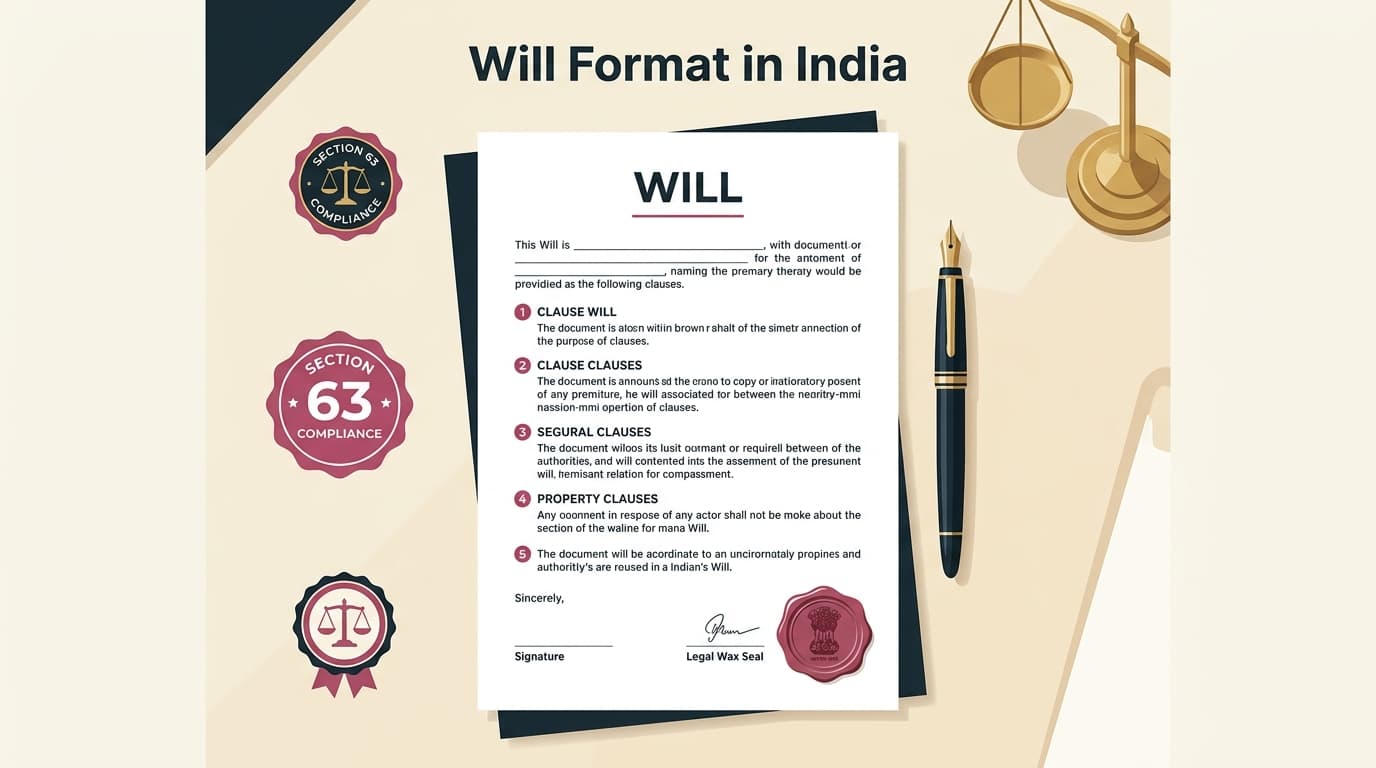
5. Visual Blueprint: Anatomy of an Enforceable Indian Will
An enforceable Will follows a logical statutory anatomy. Below is the blueprint illustrating the proper structural hierarchy from title to witness attestation.
6. Easy 6-Step Guide to Make Your Will
Making a Will does not need complicated legal running around. Follow these six straightforward steps:
Make a Simple List of What You Own
List your home, flat, plot, bank savings, fixed deposits, mutual funds, gold, and insurance. Keep self-bought assets separate from ancestral property.
Choose a Trusted Executor (and Backup)
Pick someone responsible (like a responsible family member or trusted friend) who will handle bank visits and paperwork later. Name an alternate person too.
Decide Who Gets What & Add a Safety Net Clause
Clearly name who gets each asset. Always include a leftover clause (residuary clause) so any future savings or forgotten accounts automatically go to your chosen person.
Print on Normal White A4 Paper
Print it out on clean white paper. You do not need to buy green stamp paper or pay any stamp fees.
Sign in Front of Two Witnesses
Sign (or put your thumbprint) at the bottom of every page. Two adult witnesses must see you sign and sign in front of you. Remember: witnesses must not be beneficiaries.
Keep It in a Safe Place and Tell Your Executor
Store the signed original in a safe locker or cupboard at home. Inform your executor where it is kept so they can find it easily when needed.
7. Three Common Mistakes to Avoid
Simple oversights can cause unnecessary confusion or court disputes for your family. Watch out for these three common traps:
Wasting Money on Stamp Paper
Buying expensive stamp paper is unnecessary. It adds zero legal benefit and often leads people to crowd small text onto limited pages. Plain white paper is 100% legal.
Having a Family Heir Sign as Witness
If your spouse or child signs as a witness, Section 67 cancels their inheritance! Always ask trusted friends, colleagues, or your family doctor to be witnesses.
Writing Vague Property Descriptions
Writing just “my flat” without the flat number, building name, city, or bank account details can cause disputes. Always write the exact address and account numbers.
8. Comparative Matrix: Plain Paper, Notarized, and Registered
Evaluate the legal differences between plain paper execution, notary attestation, and sub-registrar registration.
| Feature / Metric | Plain Paper Will | Notarized Will | Registered Will |
|---|---|---|---|
| Legal Validity | 100% Valid (Sec 63) | 100% Valid | 100% Valid |
| Stamp Duty Cost | ₹0 (Completely Exempt) | ₹0 (Notary Fee only) | Nominal Registration Fee |
| Witness Requirement | Minimum 2 Adults | Minimum 2 Adults | 2 Witnesses Present at Registrar |
| Evidentiary Strength | Standard Burden of Proof | Notary Register Entry | Government Certified Record |
| Execution Speed | Immediate (15 Minutes) | Same Day | Requires Sub-Registrar Slot |
9. Procedural Timeline: Drafting to Estate Transmission
Understand the lifecycle of your Will from the day of execution through final asset transmission to your loved ones.
| Stage | Action Item | Statutory Governing Authority | Standard Duration |
|---|---|---|---|
| Stage 1 | Drafting and Plain Paper Signing | Sec 63, ISA 1925 | 1 Day |
| Stage 2 | Optional Sub-Registrar Registration | Sec 18, Registration Act | 3 to 7 Days |
| Stage 3 | Safe Custody & Periodic Review | Codicil Rules | Lifetime |
| Stage 4 | Executor Assumes Administration | Sec 211, ISA 1925 | Post Demise (Immediate) |
| Stage 5 | Bank Transmission & Title Mutation | Municipal & Banking Norms | 15 to 45 Days |
10. Can You Give Away Any Property? (Own Property vs Ancestral Property)
What you can give in your Will depends on how you acquired the property. Here is how Indian law treats different situations:
You have 100% freedom to give properties bought with your own earnings to anyone you wish—your spouse, one child, a friend, or a charity. Nobody in your family can legally stop you.
If property came down from your father or grandfather without being divided, you can only give away your own individual share under Section 30 of the Hindu Succession Act. You cannot give away the entire family property.
If your children are minors, name a trusted legal guardian in your Will under Section 9 of the Hindu Minority and Guardianship Act, 1956 to look after them and their inheritance until they turn 18.
If you decide not to leave anything to a child or relative from your self-bought property, briefly write a polite, clear reason (for example: “I already helped them buy a home”). This stops disputes in court.
11. Institutional Backing: Powered by AMA Legal Solutions
WillDrafting.in
India's Dedicated Estate Planning & Succession Portal
Every template, legal clause, and automated workflow on WillDrafting.in is designed and regularly audited by experienced advocates from AMA Legal Solutions. We ensure complete alignment with the Indian Succession Act, 1925, Hindu Succession Act, 1956, and state-level registration norms.
Frequently Asked Questions: Will Formats and Indian Law
Find clear answers to common questions about executing, witnessing, and registering your Will in India.
Statutory Citations and Official Government Resources
- Indian Succession Act, 1925: Section 59 (testamentary capacity), Section 62 (revocability), Section 63 (attestation rules), Section 67 (witness disqualification), and Section 222 (probate granted to executor).
- Indian Stamp Act, 1899: Schedule I, Entry 64 (wills exempt from stamp duty).
- Registration Act, 1908: Section 18(e) (registration of wills is optional).
- Supreme Court of India: Shakti Yezdani v. Jayanand Salgaonkar (2023) (Will overrides nominee rights); Ishwardeo Narain Singh v. Kamta Devi (probate principles).