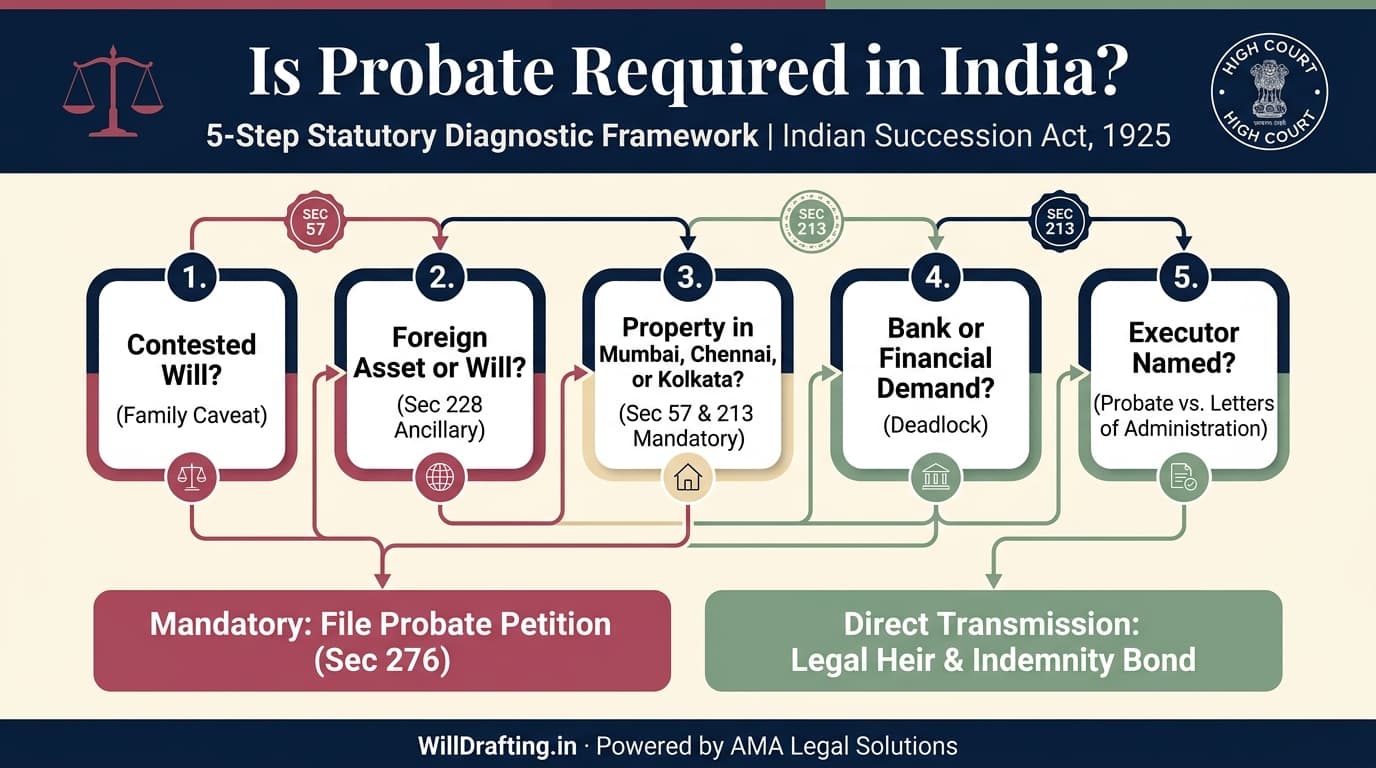
- Presidency Towns Mandate: Probate is legally compulsory ONLY for Hindu, Sikh, Jain, and Buddhist Wills made in Mumbai, Chennai, and Kolkata, or concerning immovable property situated within those 3 cities (Section 57 & 213).
- Non-Presidency Exemption: Outside Mumbai, Chennai, and Kolkata (e.g., Delhi NCR, Bengaluru, Pune, Hyderabad, UP), probate is NOT legally mandatory. An unprobated Will is fully valid under Supreme Court precedent.
- The Named Executor Rule: Under Section 222, probate can be granted ONLY to an executor explicitly named in the Will. If no executor is named, the court issues Letters of Administration with Will Annexed under Section 232.
- Foreign Wills & NRIs: Overseas Wills probated abroad cannot be used directly in India. Beneficiaries must obtain ancillary Letters of Administration under Section 228 from an Indian court.
1. Statutory Framework: Definition & Evidentiary Value
In Indian estate law, probate is the formal certificate issued by a court of competent jurisdiction confirming that a Will was genuinely executed by a testator of sound mind. Under Section 2(f) of the Indian Succession Act, 1925, probate is defined as “the copy of a Will certified under the seal of a court of competent jurisdiction with a grant of administration to the estate of the testator.”
A probate order has extraordinary legal weight because it operates as a judgment in rem under Section 41 of the Indian Evidence Act, 1872. Unlike normal civil court decrees that bind only the parties to a suit (judgment in personam), a probate decree establishes the validity of the Will against the whole world. Once probate is granted, no disgruntled legal heir can file a separate civil suit alleging forgery or coercion.
Under Section 211 of the Indian Succession Act, the executor named in the Will becomes the legal representative of the deceased for all purposes. Furthermore, Section 216 provides statutory indemnity to any bank, tenant, or debtor who pays money to an executor holding a court probate.
2. Interactive Diagnostic Tool: Check Probate Requirement
Select Yes or No for the 5 statutory criteria below. The diagnostic engine applies Sections 57, 213, 222, and 228 of the Indian Succession Act to determine if your estate requires court probate.
Is the Will contested or likely to be challenged by any legal heir?
Disputes regarding mental capacity, forged signatures, or unequal asset shares among children or siblings.
Was the Will executed abroad, or does it cover overseas NRI assets?
Wills made in the USA, UK, Canada, UAE, Australia, or Singapore concerning assets located in India.
Does the estate include immovable property in Mumbai, Chennai, or Kolkata?
Flats, plots, houses, or commercial shops located within the municipal limits of these three cities.
Is any bank, housing society, or registrar demanding a court probate?
Situations where banks, mutual funds, or housing societies freeze asset transfer until you produce a court order.
Is an executor named in the Will who is alive, competent, and willing to act?
Check whether a specific person was named in the Will to distribute your property.
Complete the 5 Diagnostic Questions Above
Select Yes or No for each statutory question to instantly determine your court probate necessity, applicable High Court rules, and cost-effective alternatives.
3. Presidential Towns Rule: Section 57 & 213 Jurisdictions
A common point of confusion among Indian families is why probate is required in Mumbai or Kolkata but completely optional in Delhi or Bengaluru. The answer lies in the colonial statutory architecture preserved in Section 57 and Section 213 of the Indian Succession Act, 1925.
Section 213(1) establishes the general principle that no executor or legatee can establish any right in court under a Will without obtaining probate. However, Section 213(2) creates a massive statutory carve-out for Hindus, Buddhists, Sikhs, and Jains. Under Section 213(2), this requirement applies ONLY to Wills specified in Section 57, clauses (a) and (b):
In the landmark judgment Clarence Pais v. Union of India (2001) 4 SCC 325, the Supreme Court affirmed that Section 213 does not apply to Wills executed outside these three historic presidential cities unless the Will affects immovable property located inside them.
This position was reaffirmed in Kanta Yadav v. Om Prakash Yadav (2020) 14 SCC 102, where the Supreme Court held that in Delhi, Haryana, and Punjab, probate of a Hindu Will is not mandatory, and beneficiaries can establish rights directly in court without prior probate certification.
4. Diagnostic Matrix: Legal Triggers & Practical Impact
Review the 5 primary factors that govern whether a Will must go to court in India.
| Diagnostic Trigger | Condition Tested | Statutory Section | Legal Consequence |
|---|---|---|---|
| 1. Contested Will | Caveat filed or heirs dispute validity | Sec 276 & 284 ISA | Probate judgment in rem required |
| 2. Foreign Will / NRI | Executed abroad with Indian property | Sec 228 ISA | Ancillary Letters of Admin required |
| 3. Property in Mumbai / Chennai / Kolkata | Immovable property in presidency towns | Sec 57 & 213 ISA | Statutorily mandatory for Hindus |
| 4. Institutional Demands | Bank or housing society freezes asset | Sec 216 ISA | Probate or Legal Heir Indemnity Bond |
| 5. Unnamed Executor | No executor appointed or executor died | Sec 222 & 232 ISA | Letters of Admin with Will Annexed |
5. State-by-State Guide: Where Probate is Mandatory in India
Court probate rules vary dramatically across Indian states. The table below details the practical and statutory requirements enforced by High Courts and revenue authorities across India:
| State / Union Territory | Probate Status | Governing Precedent / Rule | Practical Advice |
|---|---|---|---|
| Mumbai (Maharashtra) | Mandatory | Sec 57(a)/(b) & Bombay HC Rules | Co-op housing societies and SRO insist on Bombay HC probate. Capped at ₹75k court fee. |
| Rest of Maharashtra (Pune, Nagpur) | Not Mandatory | Outside Bombay HC original jurisdiction | Direct mutation permitted with death cert, Will copy, and heir affidavits. |
| Kolkata (West Bengal) | Mandatory | Fort William original jurisdiction | Calcutta High Court or City Civil Court probate required for Kolkata properties. |
| Chennai (Tamil Nadu) | Mandatory | Madras High Court original jurisdiction | Madras High Court probate required for property within Chennai city limits. |
| Delhi NCR | Not Mandatory | Kanta Yadav v. Om Prakash Yadav (SC 2020) | DDA, MCD, and banks process transfer via registered Will, NOC, and indemnity bond. |
| Karnataka (Bengaluru) | Not Mandatory | Karnataka HC rulings on Sec 213 | BBMP khata transfer requires registered Will, family tree affidavit, and death cert. |
| Telangana & Andhra Pradesh | Not Mandatory | Hyderabad HC precedents | GHMC and registration departments accept unprobated Wills with legal heir consent. |
| Punjab & Haryana | Not Mandatory | Behari Lal Ram Charan (AIR 1968 P&H 108) | Section 213 has no application in Punjab or Haryana. Unprobated Will is binding. |
6. Visual Blueprint: Indian Probate Assessment Architecture
An authoritative roadmap illustrating how the 5 statutory criteria direct an estate toward mandatory probate, Letters of Administration, or seamless direct transfer.
7. Step-by-Step SOP: High Court Probate Petition Protocol
When probate is required, the named executor must follow a strict statutory procedure under the Indian Succession Act, 1925, and relevant High Court Original Side Rules.
Stage 1: Petition Drafting & Jurisdiction Check (Section 270)
Verify that the deceased had a fixed place of abode or left immovable property within the court jurisdiction. The named executor prepares the formal probate petition along with Schedule of Assets (movable and immovable) and list of all Class I legal heirs.
Stage 2: Verification of Original Will & Filing (Section 276 & 280)
The original Will is deposited in the court registry. The petition is verified by the executor, declaring that the Will is the testator’s last testament and that it was executed with full mental competence.
Stage 3: Attesting Witness Affidavit (Section 281 ISA & Section 68 Evidence Act)
At least one attesting witness must submit a sworn affidavit under Section 281, confirming that they personally saw the testator sign the Will and signed in the testator’s physical presence. This step is statutorily mandatory.
Stage 4: Citations & Newspaper Publication (Section 283)
The court issues formal citations to all surviving legal heirs. Additionally, a public notice is published in two prominent daily newspapers (one English, one regional language) inviting any objections within 30 to 45 days.
Stage 5: Asset Valuation & Ad Valorem Court Fee Payment
The court refers property details to the Collector / Superintendent of Stamps to verify property valuation. The executor deposits the applicable ad valorem court fee (capped at ₹75,000 in Maharashtra).
Stage 6: Court Examination & Final Grant of Probate (Section 289)
If no caveat is lodged within the notice window, the Judge grants the formal decree under Section 289. The certified copy of the Will with the official High Court seal is handed to the executor.
8. Legal Instruments Compared: Probate vs LOA vs Succession
Indian law provides three distinct court instruments to administer or clear title to an estate. Choosing the wrong document leads to dismissals and wasted court fees:
| Instrument | Governing Sections | Will Exists? | Eligible Petitioner | Scope of Assets |
|---|---|---|---|---|
| Probate | Sec 222 & 276 ISA | Yes (Mandatory) | Named Executor ONLY | All Movable & Immovable assets |
| Letters of Administration (With Will) | Sec 232 & 234 ISA | Yes | Beneficiary / Universal Legatee | All Movable & Immovable assets |
| Letters of Administration (Without Will) | Sec 218 ISA | No (Intestate) | Class I Legal Heirs | All Movable & Immovable assets |
| Succession Certificate | Sec 370–390 ISA | Either | Legal Heirs or Beneficiaries | Debts & Securities ONLY (No Real Estate) |
9. Court Fees & Realistic Timelines: State-Wise Breakdown
Court fees for probate petitions are calculated on an ad valorem percentage based on state Court Fees Acts. Here is the realistic cost and timeline breakdown across major High Courts:
| Jurisdiction / Forum | Ad Valorem Court Fee | Statutory Maximum Cap | Average Uncontested Duration |
|---|---|---|---|
| Bombay High Court (Original Side) | 2% to 7.5% in progressive slabs | Capped at ₹75,000 maximum | 6 to 10 Months |
| Calcutta High Court (Original Side) | Approx 5.5% on higher asset brackets | No ceiling cap (Variable) | 9 to 15 Months |
| Madras High Court / City Civil Court | Approx 3% under TN Court Fees Act | Subject to valuation schedule | 6 to 12 Months |
| Delhi High Court / District Courts | Approx 4% ad valorem | Graduated schedule | 8 to 14 Months |
10. Defensive Estate Planning: Avoiding Court Friction
If your property is outside Mumbai, Chennai, and Kolkata, you can completely avoid expensive court probate by following 4 defensive estate drafting rules:
Under Section 63, use two witnesses who are younger than you and receive zero bequests under the Will. This avoids the Section 67 beneficiary witness forfeiture trap and ensures they can depose in court if ever questioned.
Under Section 59, having a registered medical practitioner certify sound mental disposing capacity on the date of execution destroys allegations of cognitive decline, dementia, or undue influence by disgruntled relatives.
As held by the Supreme Court in Sarbati Devi and Shakti Yezdani, nominees are merely trustees. Align your bank FD and demat nominations to match your Will beneficiaries so institutions release funds without court friction.
While optional under Section 18 of the Registration Act, registering your Will at the Sub-Registrar Office creates a public record under Section 114 of the Indian Evidence Act, making allegations of post-death forgery nearly impossible.
11. Specialized Scenarios: Foreign Wills, NRI Assets & CHS
Certain estate scenarios involve unique legal hurdles that demand specialized statutory compliance:
If an NRI executes a Will in the US, UK, or UAE covering Indian property, foreign probate decrees cannot directly transfer Indian real estate. Under Section 228 of the Indian Succession Act, an ancillary petition for Letters of Administration with an authenticated copy of the Will must be filed in India.
When an excluded child or relative files a caveat in court, the probate petition is automatically converted into a regular civil testamentary suit. The propounder of the Will must examine attesting witnesses and prove testamentary capacity under stringent scrutiny.
If the named executor dies before the testator, or formally renounces executorship under Section 230, the beneficiaries cannot obtain probate. They must petition the court for Letters of Administration with Will Annexed under Section 232 to distribute the estate.
Under Bye-Law 35 of the Maharashtra Cooperative Societies Bye-Laws, housing societies in Mumbai require Bombay High Court probate or a court succession order before transferring share certificates and membership to a legatee, despite nominee provisions.
12. Institutional Profile: Legal Excellence & Trust Signals
WillDrafting.in is India’s premier estate planning and succession technology platform, powered by AMA Legal Solutions. Our senior testamentary bench possesses over a decade of trial and appellate experience across the Supreme Court of India, Delhi High Court, Bombay High Court, Calcutta High Court, and District Courts nationwide. We have structured over 15,000 challenge-proof Wills and successfully navigated hundreds of complex probate petitions and Letters of Administration.
Frequently Asked Questions: Probate of Will in India
Plain-English answers to the most common legal questions about court probate, jurisdiction rules, timelines, and costs in India:
Statutory Citations: Acts, Rules & Authoritative Portals
This diagnostic tool is calibrated under the following statutory provisions:
- Indian Succession Act, 1925 (Sections 2(f), 57, 211, 213, 216, 222, 228, 232, 276, 281 & 289)
- Indian Evidence Act, 1872 (Section 41 & Section 68)
- Registration Act, 1908 (Section 18(e) optional registration of Wills)
- Supreme Court of India: Clarence Pais & Ors v. Union of India (2001) 4 SCC 325
- Supreme Court of India: Kanta Yadav v. Om Prakash Yadav (2020) 14 SCC 102
- Bombay High Court Original Side Rules & Maharashtra Court Fees Act, 1959