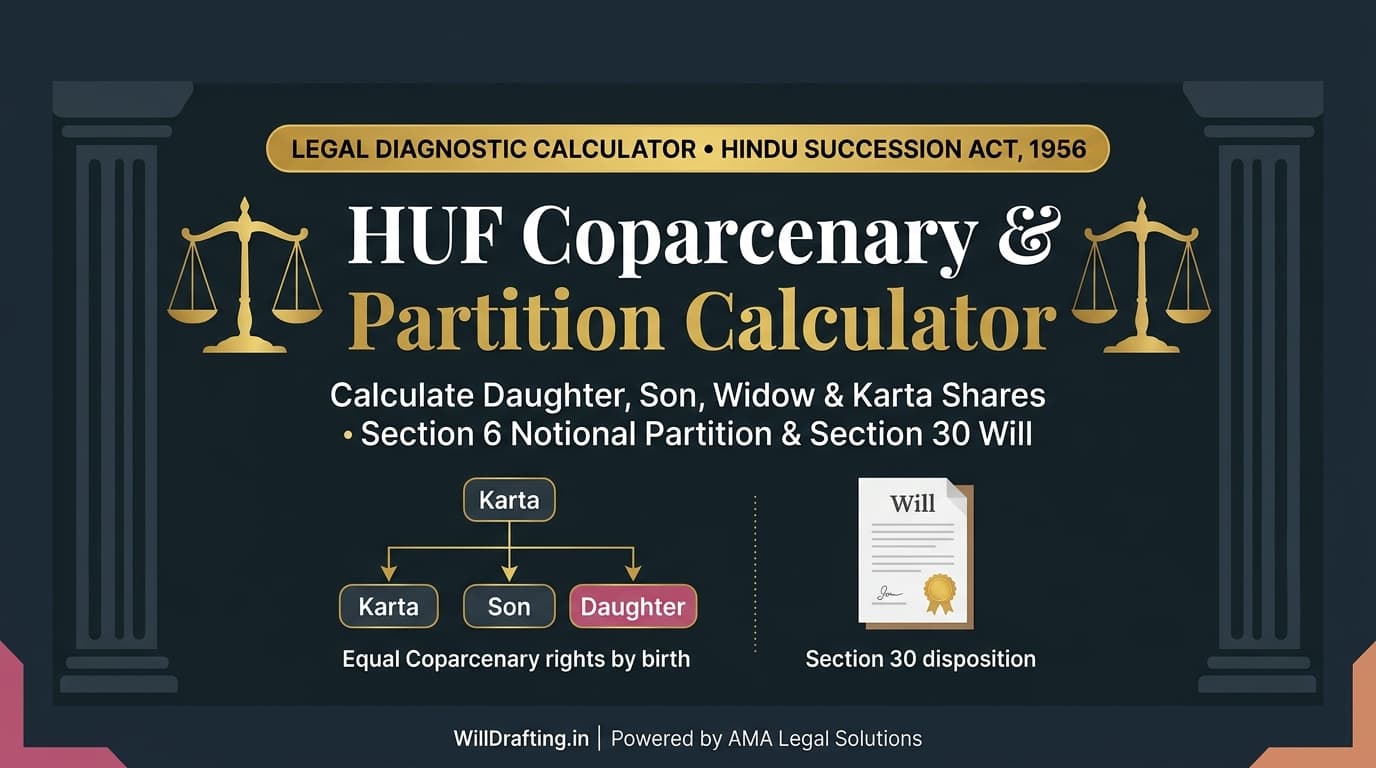
- Daughters are Equal Coparceners by Birth: Following the landmark Supreme Court judgment in Vineeta Sharma (2020), daughters hold identical coparcenary rights to sons by birth, regardless of when they were born.
- Section 6(3) Notional Partition Fiction: Upon the death of a coparcener, the law presumes a partition occurred immediately prior to death. Each coparcener gets 1/N share. The surviving widow receives 0% in this stage.
- Section 30 Testamentary Bequest Right: A coparcener can bequeath their undivided 1/N share in a Will. Bequeathing this share to the surviving widow protects her financial autonomy and prevents family eviction.
- Intestate Dilution Hazard: If no Will exists, the Karta's share is divided equally among all Class I heirs under Section 8, diluting the widow to a tiny fraction (e.g. 1/12 or 1/16) and sparking partition disputes.
1. Statutory Rules: HUF Ancestral Property in India
In Hindu jurisprudence, a Hindu Undivided Family (HUF) is an organic family entity descended from a common ancestor. While all family members belong to the HUF, not all members are coparceners.
A coparcener is a specific member who acquires a vested joint ownership interest in the ancestral estate immediately upon birth. Under the Mitakshara school of Hindu law, only coparceners have the right to demand a partition of family assets.
Who is a Coparcener?
- Sons and daughters born into the joint family.
- Possess joint ownership and right to partition by birth.
- Can become Karta of the family (Sujata Sharma ruling).
- Can bequeath their undivided share by Will under Section 30.
Who is an HUF Member (Non-Coparcener)?
- Spouses who join the family through marriage (wives and widows).
- Entitled to maintenance, residence, and support from HUF income.
- Cannot demand a physical partition on their own initiative.
- Inherit under Section 8 intestacy if no Will is executed.
2. Interactive HUF Coparcenary & Partition Calculator
Enter your ancestral estate valuation and family coparcenary composition below to compute statutory Stage 1 notional partition shares and compare Section 30 Will bequest versus intestate succession.
Birthright coparcener under Mitakshara law.
Equal coparcener by birth (Vineeta Sharma 2020).
Representation under Section 6(3) proviso.
Choose between testamentary disposition by Will under Section 30 or intestate succession under Section 8.
Optimal Choice: Valid Will under Section 30 HSA
Under Section 30 of the Hindu Succession Act, the Karta can bequeath his full 1/3 undivided share (33.3% = ₹33.33 Lakh) directly to his surviving spouse. This guarantees she holds ₹33.33 Lakh of ownership in the ancestral home, ensuring dignity and absolute protection from partition suits.
| Family Member | Stage 1 Coparcenary | Stage 2 Inherited | Total Final Share | Value (INR) |
|---|---|---|---|---|
Surviving Widow (Wife) Spouse of Deceased Karta | 0% | +33.33% | 33.33% | ₹33.33 Lakh |
Son Birthright Birth Coparcener | 1/3 (33.3%) | 0% | 33.33% | ₹33.33 Lakh |
Daughter Birthright Birth Coparcener (Vineeta Sharma 2020) | 1/3 (33.3%) | 0% | 33.33% | ₹33.33 Lakh |
3. Section 6 Notional Partition: The 2-Stage Formula
When an HUF coparcener passes away, the law does not immediately dissolve the family. Instead, Section 6(3) of the Hindu Succession Act mandates a two-stage devolution process established in Gurupad Khandappa Magdum v. Hirabai (1978 SC).
In Stage 1, a deemed notional partition is carved out among all living coparceners. In Stage 2, the deceased's carved-out share devolves either through a valid Section 30 Will or via Section 8 intestate succession among all Class I heirs.
4. Daughter Coparcenary Rights: Vineeta Sharma Precedent
Prior to 2005, daughters were excluded from Mitakshara coparcenary property. The Hindu Succession (Amendment) Act, 2005 substituted Section 6 to provide that a daughter becomes a coparcener by birth with the exact same rights as a son.
Conflicting High Court rulings were permanently resolved by the Supreme Court of India in the historic ruling Vineeta Sharma v. Rakesh Sharma (2020) 9 SCC 1.
5. Section 30 Wills: Bequeathing Undivided HUF Shares
A widespread myth across India suggests that HUF ancestral property cannot be willed away. This is inaccurate. While a coparcener cannot will away the entire family estate, Section 30 of the Hindu Succession Act explicitly allows a coparcener to dispose of their undivided coparcenary share in a Will.
By executing a Will under Section 30 on WillDrafting, the Karta can bequeath 100% of his notional share to his wife. This guarantees her full dignity, independent ownership, and protection from eviction.
6. Comparison: HUF Ancestral vs Self-Acquired Property
Before drafting your Will, it is essential to distinguish between HUF coparcenary assets, self-acquired assets, and a woman's Stridhan.
| Parameter | HUF Ancestral Property | Self-Acquired Property | Stridhan Property |
|---|---|---|---|
| Origin of Title | Inherited across 4 generations (Father, Grandfather, Great-grandfather) | Purchased with personal earnings, salary, business profits | Gifts, jewelry, cash received by a woman before/at/after marriage |
| Right by Birth? | YES (Sons & Daughters acquire right immediately at birth) | NO (Children have zero legal right during owner's lifetime) | NO (Absolute property of the woman under Section 14 HSA) |
| Will Bequest Scope | Restricted strictly to testator's undivided 1/N share (Sec 30) | Unrestricted (100% can be willed to anyone without family consent) | Unrestricted (Woman can will 100% of Stridhan as she pleases) |
| Partition Rights | Any coparcener (son or daughter) can demand partition at any time | No family member can demand partition during owner's life | Husband or in-laws have zero right to partition or claim Stridhan |
7. Visual Flowchart: Step-by-Step HUF Partition Blueprint
The statutory visual blueprint below illustrates the two-stage partition mechanism, highlighting the critical divide between executing a Section 30 Will versus dying intestate under Section 8.
8. How to Avoid Family Disputes: Registered Partition Deeds
Civil partition lawsuits in India often take 15 to 30 years to reach final decree. Families can avoid bitter court litigation through two primary mechanisms:
Registered Partition Deed
Under Section 17 of the Registration Act, 1908, a formal partition dividing immovable property by metes and bounds must be executed on appropriate stamp paper and registered with the Sub-Registrar. Once registered, title mutates directly into individual names.
Family Settlement Agreement (FSA)
As recognized in Kale v. Deputy Director of Consolidation (1976 SC), a memorandum of family settlement recording an anterior oral partition does not require compulsory registration if it merely records existing arrangements to maintain family peace.
9. Practical Case Studies: Delhi, Jaipur & Mumbai HUFs
A father in Greater Kailash, Delhi held an ancestral bungalow valued at ₹12 Crore in his HUF with 1 son and 1 daughter. Without a Will, his widow would get only 1/9th share (11.11% = ₹1.33 Cr). By executing a Section 30 Will on WillDrafting, he bequeathed his entire 1/3rd share to his wife.
A married daughter in Jaipur was denied a share in ancestral commercial properties by her two brothers claiming she was married before 2005. Invoking Vineeta Sharma (2020), she claimed her full 1/3rd coparcenary share, securing a registered family settlement.
10. Copy-Paste Legal Clause: Section 30 Will Bequest Format
TESTAMENTARY DISPOSITION OF UNDIVIDED COPARCENARY SHARE UNDER SECTION 30 OF THE HINDU SUCCESSION ACT, 1956:

"WHEREAS I, the Testator herein, am a coparcener and Karta in the Hindu Undivided Family (HUF) known and styled as [Insert HUF Name, e.g., 'Shri Rajesh Sharma HUF'], holding an undivided coparcenary interest and share in the ancestral movable and immovable properties of the said family;

AND WHEREAS under Section 30 of the Hindu Succession Act, 1956, I am fully competent and statutorily empowered to dispose of my undivided interest in the Mitakshara coparcenary property by testamentary disposition;

NOW THIS WILL WITNESSETH that upon my demise, my undivided notional coparcenary share in all the ancestral properties of the aforesaid HUF (as determined upon a notional partition under Section 6 of the Hindu Succession Act, 1956 immediately prior to my death) shall devolve upon, vest in, and belong absolutely and forever to my wife, Smt. [Insert Wife's Full Name], for her sole use, maintenance, enjoyment, and absolute ownership without any claim, objection, or obstruction by any other legal heir or coparcener."
11. Institutional Profile: Legal Excellence & Trust Signals
WillDrafting.in is India’s premier succession technology and estate planning platform, powered by AMA Legal Solutions. Our multidisciplinary bench includes senior High Court testamentary litigators, chartered property valuation experts, and Hindu law advocates. We have structured over 15,000 challenge-proof Wills and assisted hundreds of family HUFs in partition deeds, coparcenary share computations, and dispute-free ancestral property distributions.
12. Frequently Asked Questions: HUF Property Partition
13. Statutory Authorities & Landmark Judicial Precedents
- Section 6(1): Devolution of coparcenary interest granting daughters equal birthright.
- Section 6(3): Statutory notional partition deeming fiction upon death of coparcener.
- Section 8: General rules of succession in case of Hindu male dying intestate.
- Section 14: Property of a female Hindu to be her absolute property (Stridhan).
- Section 30: Statutory power to dispose of undivided coparcenary interest by Will.
- Vineeta Sharma v. Rakesh Sharma (2020) 9 SCC 1: 3-judge bench ruling confirming daughter coparcenary right from birth.