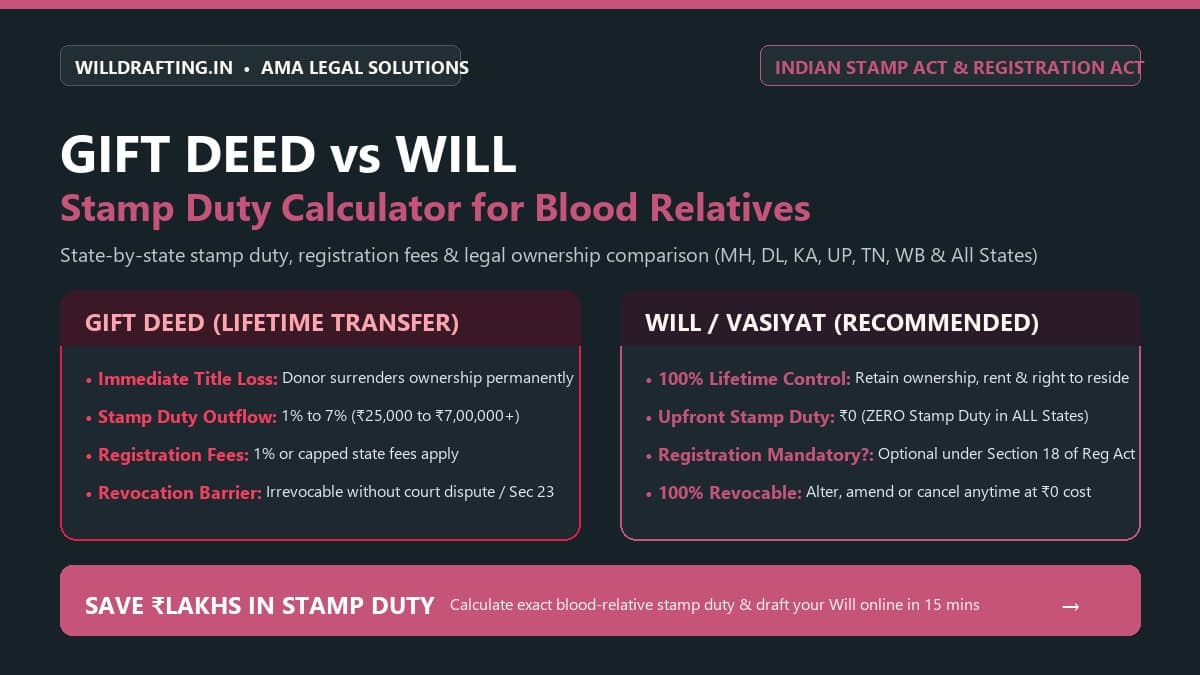
- Zero Stamp Duty on Wills: Under the Indian Stamp Act, 1899, drafting and executing a Will attracts exactly ₹0 stamp duty in all 28 states. Registration is also completely optional under Section 18 of the Registration Act.
- Immediate Loss of Ownership with Gift Deeds: Under Section 122 of the Transfer of Property Act, 1882, a registered gift deed transfers title immediately. The donor permanently loses all ownership rights and cannot revoke the gift unilaterally.
- Blood-Relative Concessions: While standard gift deeds attract 5% to 7% stamp duty, states like Maharashtra (₹200 flat under Art. 34), Uttar Pradesh (₹5,000 flat under Art. 33), and Tamil Nadu (₹25,000 cap) offer huge family concessions.
- Supreme Court Senior Citizen Protection: In Urmila Dixit v. Sunil Sharan Dixit (2025 INSC 20), the Supreme Court ruled that a senior citizen can revoke a gift deed under Section 23 of the MWPSC Act only if an express maintenance condition was inserted into the registered deed.
1. Statutory Foundation: Gift Deed vs Release Deed vs Will
When Indian parents contemplate passing family real estate to their children, they frequently confuse three distinct legal instruments: a Gift Deed, a Release Deed (also known as a Relinquishment Deed), and a Will (Vasiyat). While property portals frequently show generic stamp duty percentages, choosing the wrong instrument can cost your family lakhs in needless government duties and strip senior citizens of their constitutional right to shelter.
A Gift Deed is an inter-vivos transfer governed under Section 122 of the Transfer of Property Act, 1882. It takes effect immediately during the donor's lifetime, requires mandatory registration under Section 17 of the Registration Act, 1908, and attracts state stamp duty ranging from ₹200 up to 7% of circle value.
Conversely, a Will is a testamentary declaration governed under Section 2(h) and Section 63 of the Indian Succession Act, 1925. It takes effect strictly after the testator's demise. Under the Indian Stamp Act, 1899, a Will is subject to ₹0 Stamp Duty across all Indian states and Union Territories, and registration is entirely optional under Section 18(e).
Governed by: Section 122, Transfer of Property Act, 1882.
Timing: Transfers title immediately while the donor is alive.
Stamp Duty: 1% to 7% state stamp duty + 1% registration.
Irrevocable: Donor immediately loses all ownership rights.
Governed by: Indian Succession Act, 1925 (ss. 2(h) & 63).
Timing: Operates only after the demise of the testator.
Stamp Duty: ₹0 (ZERO across all 28 Indian States).
100% Control: Testator retains full ownership & can revoke.
Governed by: Registration Act, 1908 (Section 17(1)(b)).
Timing: Immediate release of pre-existing co-ownership share.
Stamp Duty: Concessional flat duty (₹200 to ₹5,000).
Sole Owner Trap: CANNOT be used for 100% self-acquired property.
2. Interactive Stamp Duty & Registration Fee Calculator
Select your property state, family relationship, and property valuation to instantly calculate exact stamp duty, registration fees, and compare your financial outflow against a ₹0 Stamp Duty Will.
Maharashtra Stamp Act, 1958 (Article 34 Proviso)
Blood relative exemptions depend strictly on degree.
Release deeds only apply to joint coparceners.
Optimal Choice: Last Will & Testament (Vasiyat)
Under the Indian Stamp Act, 1899, a Will is 100% exempt from stamp duty in all 28 states, saving your family ₹30,200 in government outflow compared to an immediate Gift Deed. Most importantly, you retain 100% absolute ownership, living rights, and control over your home for life, with complete freedom to revoke or alter your Will anytime under Section 62 of the Indian Succession Act.
Not Applicable for Sole Owner: A Release Deed can only be executed between existing co-owners or coparceners who already hold a pre-existing share in ancestral property. A sole owner cannot release self-acquired property.
3. State Stamp Duty Schedules: Blood Relative Concessions
Under the Indian Constitution (Seventh Schedule, Entry 63 of the State List), stamp duties on instruments other than bills of exchange are enacted by individual state legislatures. Consequently, stamp duty on family gift deeds varies dramatically across India. Below is the verified statutory breakdown for high-volume states.
If residential or agricultural property is gifted to a spouse, son, daughter, grandson, granddaughter, or the wife of a deceased son, the stamp duty is a flat ₹200. Registration fee is 1% of market value, capped at a maximum of ₹30,000. However, commercial properties gifted to blood relatives attract 2% stamp duty plus 1% metro cess/LBT (total 3%). Gifts to brothers, sisters, or parents do not qualify for the ₹200 concession and attract 3% duty.
Under the landmark notification issued by the UP Government, gift deeds executed between blood relatives (parents, spouse, children, siblings, grandchildren, and daughter-in-law) for residential or agricultural property attract a flat stamp duty of ₹5,000. Registration fee is 1%, subject to a maximum ceiling of ₹10,000. For a ₹1 Crore property in Noida or Lucknow, total government outflow is just ₹15,000, compared to ₹8 Lakhs for a non-relative!
Delhi does NOT offer flat-fee concessions for blood relatives. The stamp duty on a gift deed in Delhi is 2% of circle rate if the donee is female and 3% if the donee is male. Additionally, 1% municipal transfer duty is charged by MCD, plus 1% registration fee (plus ₹100 pasting charges). Gifting a ₹3 Crore house in South Delhi to a son costs over ₹12 Lakhs in government fees, whereas a Will costs ₹0.
For family members (spouse, children, parents, grandchildren, and siblings), Tamil Nadu charges 1% stamp duty subject to a strict maximum ceiling of ₹25,000, plus a 1% registration fee capped at ₹4,000. Total government charges for a ₹1 Crore or ₹5 Crore home in Chennai are capped at just ₹29,000! For non-family, the duty is an exorbitant 7% stamp duty + 4% registration (total 11%).
Under Article 28, gifts among immediate family members (spouse, children, parents, grandchildren) within BBMP or city corporations attract a flat stamp duty of ₹5,000 (and ₹1,000 in village/gram panchayat areas), plus a 1% registration fee capped at ₹1,000. Non-family gifts attract 5.5% stamp duty (with cess) + 2% registration fee.
Both the Haryana and Punjab state governments have completely exempted stamp duty on the transfer of immovable property between direct blood relatives (parents to children, grandparents to grandchildren, and between spouses). Only nominal computerization processing charges (₹1,000 to ₹2,000) apply.
4. Landmark Precedents: Senior Citizens Act & Revocation
The most severe risk of executing a Gift Deed is legal finality. Under Section 126 of the Transfer of Property Act, 1882, a registered gift deed cannot be revoked unilaterally by the donor unless an express revocation condition was agreed upon in writing before execution. Once the deed is registered, the child becomes the sole absolute owner and the parent legally becomes a licensee in their own home.
Enforceability of Maintenance Conditions Under Section 23 of MWPSC Act
In January 2025, the Supreme Court of India delivered a landmark judgment in Urmila Dixit v. Sunil Sharan Dixit (2025 INSC 20). The Apex Court reiterated that under Section 23 of the Maintenance and Welfare of Parents and Senior Citizens Act, 2007, where a senior citizen transfers property by gift subject to the condition that the transferee shall provide basic amenities and physical needs, and the child fails or refuses to do so, the transfer of property shall be deemed to have been made by fraud, coercion, or undue influence and may be declared void by the Maintenance Tribunal.
Earlier Supreme Court rulings, including Sudesh Chhikara v. Ram Tiwary (2022), established that if the Gift Deed does NOT contain an express maintenance condition clause in writing, the Tribunal cannot declare the gift deed void. If you gift without this exact recital, your property is lost forever.
5. Income Tax Treatment: Section 56(2)(x) & Capital Gains
Both Gift Deeds and Wills enjoy favorable income tax exemptions at the moment of transfer, but their downstream capital gains tax rules when the property is subsequently sold differ significantly under Finance (No. 2) Act, 2024.
Under Section 56(2)(x) of the Income Tax Act, 1961, receiving property without consideration from defined relatives (spouse, siblings, lineal ascendants, and lineal descendants) is 100% exempt from income tax in the hands of the recipient. However, if gifted to a non-relative, the ready reckoner value is added to the recipient's income and taxed at slab rates (up to 39%).
Under Section 47(iii), any transfer of a capital asset under a Will or an irrevocable trust is not regarded as a transfer for capital gains tax. The beneficiary pays zero tax when inheriting under a Will.
When your child eventually sells the gifted or inherited property, their capital gains tax is computed using Section 49(1). The cost of acquisition is deemed to be the cost paid by the parent. Under the landmark Bombay High Court ruling in CIT v. Manjula J. Shah, the holding period includes the period during which the parent held the property. Under Budget 2024 rules, for properties acquired by parents before July 23, 2024, the seller can compare 12.5% flat tax vs 20% with indexation.
6. Structural Comparison Table: Gift Deed vs Will vs Release
Compare all three instruments side-by-side across statutory parameters, costs, revocability, and operational timing.
| Parameter | Gift Deed (TP Act s.122) | Will / Vasiyat (ISA s.63) | Release Deed (Reg Act s.17) |
|---|---|---|---|
| Effective Timing | Immediate upon registration | Only after demise of testator | Immediate upon execution |
| Stamp Duty Outflow | 1% to 7% (₹200 to ₹10L+) | ₹0 (ZERO across India) | Flat ₹200 to ₹5,000 for family |
| Registration Mandatory? | Yes, strictly mandatory (Sec 17) | No, optional (Sec 18(e)) | Yes, strictly mandatory |
| Donor Living Rights | Surrendered permanently | 100% full ownership retained | Relinquishes co-owner share |
| Revocability | Irrevocable (except MWPSC s.23) | 100% revocable anytime for free | Irrevocable once registered |
| Applicable Property | Self-acquired or sole share | Self-acquired or coparcenary share | Ancestral / Joint co-owned ONLY |
| Witness Attestation | 2 witnesses mandatory | 2 witnesses mandatory (Sec 63) | 2 witnesses mandatory |
7. Step-by-Step SOP: Choosing the Right Property Transfer Mode
Follow this verified 5-step protocol prepared by AMA Legal Solutions senior estate advocates before signing any deed or executing a property transfer.
Check your title deed. If the property is 100% self-acquired, a Release Deed is legally prohibited. You can only choose between a Gift Deed and a Will. If the property is ancestral or jointly inherited with siblings, a Release Deed can be used to surrender shares.
Ask yourself: Does your child urgently require immediate legal title to obtain a bank construction loan, or can the title pass peacefully upon demise? If there is no urgent commercial necessity, executing a Gift Deed surrenders your roof needlessly.
Use our interactive calculator above. Check if your state provides a flat concession (e.g. Maharashtra ₹200, UP ₹5,000, TN ₹25,000 cap) or charges percentage duty (e.g. Delhi 4%). Compare this outflow against a ₹0 Stamp Duty Will.
If you must execute a Gift Deed as a senior citizen, you MUST insert an express Section 23 MWPSC maintenance recital. If you draft a Will, ensure strict Section 63 attestation by two independent witnesses who are not beneficiaries.
For a Gift Deed, visit the Sub-Registrar Office (SRO) for biometric registration. For a Will, store the signed original securely, register it if desired under Section 18, and inform your appointed executor.
8. Real Family Scenarios: Maharashtra, UP, Delhi & Karnataka
₹1.5 Crore 3BHK Flat Gifted to Married Daughter vs Will
Mr. Deshmukh (68) wanted to transfer his Pune flat to his married daughter. A local agent advised a Gift Deed, estimating ₹30,200 total cost (₹200 stamp duty + ₹30,000 registration cap). However, after signing, marital friction arose between the daughter and son-in-law, who demanded the flat be mortgaged for his business. Mr. Deshmukh was forced to file a police complaint. Had Mr. Deshmukh drafted a Will, he would have paid ₹0, kept complete ownership, and bequeathed the flat exclusively to his daughter upon his demise without any risk from the son-in-law.
Availing UP ₹5,000 Concession with Mandatory Section 23 Clause
Mrs. Sharma (72) decided to gift her Noida villa (market value ₹2 Crore) to her younger son under UP's ₹5,000 blood-relative scheme. On AMA Legal Solutions' advice, she insisted on including the statutory maintenance recital under Section 23 of the Senior Citizens Act. Total fees paid: ₹15,000 (₹5,000 stamp + ₹10,000 reg). Two years later, when the son attempted to sell the house without her consent, the Maintenance Tribunal promptly declared the gift void because of the explicit condition clause.
Saving ₹20 Lakhs in Delhi Stamp Duty by Opting for a Will
A family in Greater Kailash, Delhi, owned a bungalow valued at ₹5 Crore. Gifting the property to their two sons would have attracted 4% duty (3% stamp + 1% municipal) + 1% registration, requiring an upfront cash outflow of ₹25 Lakhs! By consulting an estate advocate and executing a registered Will, the family paid ₹0 in stamp duty, saved ₹25 Lakhs in capital, and clearly demarcated each floor between both brothers.
9. Legal Clause Templates: Senior Citizen Gift vs Will Clause
Use these verified statutory clauses drafted by AMA Legal Solutions senior advocates to protect your legal rights.
"AND WHEREAS the Donor is a Senior Citizen within the meaning of the Maintenance and Welfare of Parents and Senior Citizens Act, 2007 (Act No. 54 of 2007); AND WHEREAS this Gift of the Schedule Property is made subject to the EXPRESS AND ESSENTIAL STATUTORY CONDITION that the Donee shall, during the natural life of the Donor, continuously provide all basic amenities, medical expenses, boarding, lodging, and physical needs to the Donor; AND IT IS EXPRESSLY AGREED that in the event of any neglect, refusal, or failure by the Donee to provide such basic amenities and maintenance, this Deed of Gift shall be deemed to have been made by fraud, coercion, or undue influence and shall be voidable at the option of the Donor before the Maintenance Tribunal under Section 23 of the said Act."
"I HEREBY DECLARE that during my natural life, I shall remain the absolute and exclusive owner of all my movable and immovable properties described in the Schedule hereunder, with full and unrestricted powers to sell, mortgage, gift, lease, or otherwise dispose of the same as I may deem fit; AND I FURTHER DECLARE that this is my Last Will and Testament, and I reserve my absolute right under Section 62 of the Indian Succession Act, 1925, to alter, amend, codify, or revoke this Will at any time during my lifetime, and that no beneficiary named herein shall derive any right, title, or interest in any asset until after my demise."
10. Advocate Profile: AMA Legal Solutions Estate Advisory
WillDrafting.in is India's premier succession technology and estate planning platform, powered by AMA Legal Solutions. With over 10,000+ Wills, family settlements, and gift deeds structured across Maharashtra, Delhi NCR, Karnataka, Tamil Nadu, and Uttar Pradesh, AMA Legal Solutions protects family wealth from crippling stamp duties, unnecessary litigation, and elder vulnerability.
11. Frequently Asked Questions: Gift Deed vs Will Stamp Duty
Clear layman explanations for the most common questions raised by Indian families and senior citizens regarding property transfer duties.
12. Statutory Citations & Official State Stamp Duty Portals
• Indian Stamp Act, 1899 (Schedule I) & Respective State Stamp Amendments • Registration Act, 1908 (Section 17, Section 18) • Transfer of Property Act, 1882 (Sections 122–129) • Indian Succession Act, 1925 (Sections 2(h), 59, 62, 63) • Income Tax Act, 1961 (Sections 47(iii), 49(1), 56(2)(x)) • Maintenance and Welfare of Parents and Senior Citizens Act, 2007 (Section 23).