- PAN Is Your Master Key: You do not need to visit 50 bank branches. A single PAN number unlocks Consolidated Account Statements (CAS) across CDSL, NSDL, and MFCentral, tracing 100% of mutual funds, shares, and Demat accounts.
- Section 159 Legal Heir AIS: Register as a Representative Assessee on the Income Tax portal under Section 159. Download the deceased parent's AIS/TIS to see all banks paying interest, fixed deposits, and dividend records.
- RBI UDGAM for Dormant Bank Deposits: Accounts inactive for 10+ years are moved to the RBI DEA Fund. The centralized UDGAM portal searches over 30 public and private banks instantly.
- IEPF Shares Recovery: Shares with 7 consecutive years of unpaid dividends are transferred to the MCA IEPF Authority. Legal heirs can reclaim them via Form IEPF-5 and an RTA Entitlement Letter.
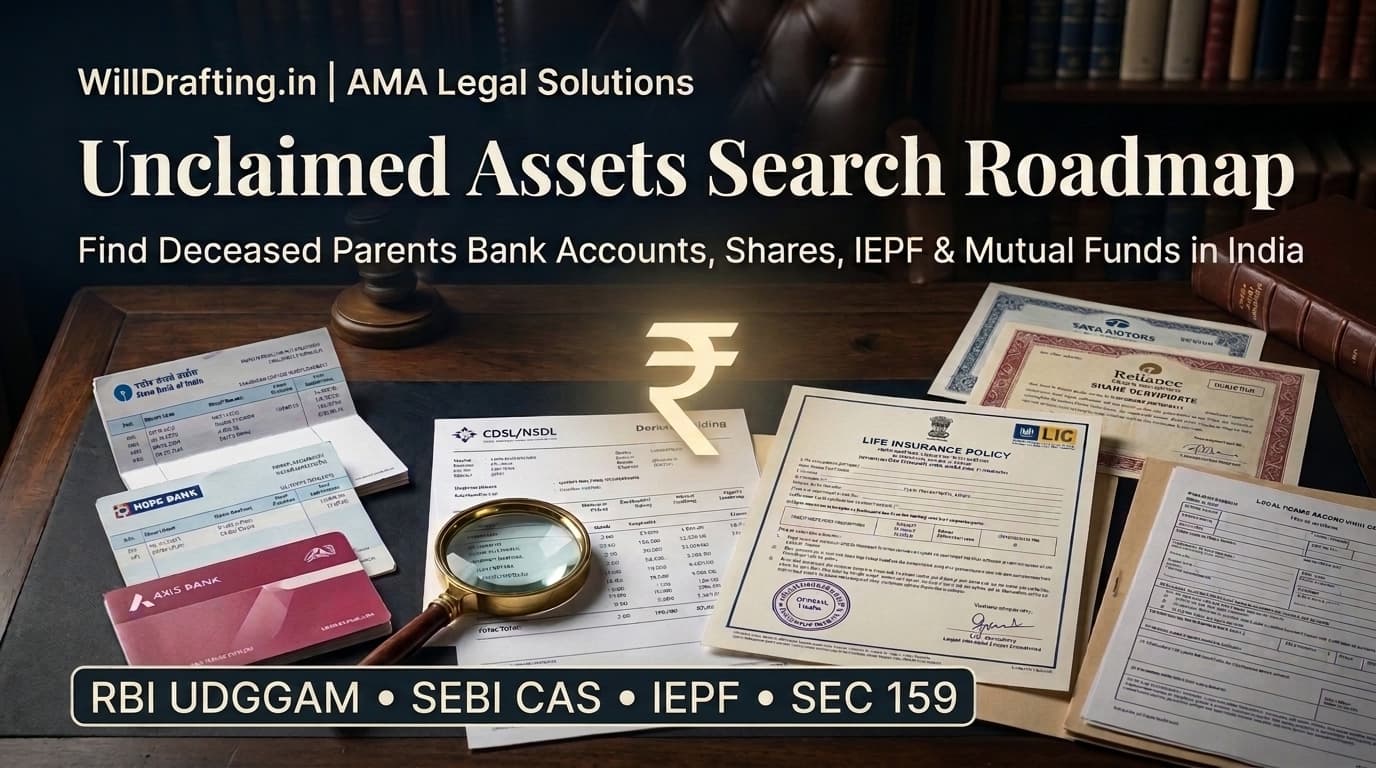
1. The Unclaimed Wealth Crisis: Why 98% of Assets Can Be Traced
Every year in India, thousands of families face an overwhelming crisis when an elderly parent passes away suddenly without having documented their financial assets. In traditional Indian households, parents often maintained bank accounts, fixed deposits, post office certificates, and physical shares across multiple institutions without discussing them with their children or spouse.
According to official government disclosures, over ₹1.8 Lakh Crore of unclaimed wealth currently sits locked across the Reserve Bank of India's Depositor Education and Awareness (DEA) Fund, the Ministry of Corporate Affairs' Investor Education and Protection Fund (IEPF), unclaimed insurance proceeds, and dormant mutual fund folios.
Most heirs assume they must manually visit dozens of physical bank branches or hire unlicensed recovery agents charging 20% to 30% cuts. In reality, modern Indian financial regulations have linked virtually every legitimate financial holding to the deceased's Permanent Account Number (PAN). By utilizing the 8 statutory portals detailed in this roadmap, legal heirs can systematically identify and claim up to 98% of all domestic assets directly.
2. Interactive Asset Detective: 8-Portal Discovery Roadmap
Select the documents and credentials you currently have in hand. The tool dynamically calculates your asset traceability score and reveals the exact statutory discovery steps.
The primary universal key linking all banking, mutual funds, demat, and tax databases.
Identity & TaxEssential for Section 159 Representative Assessee registration and bank branch access.
Identity & TaxAllows instant self-service OTP verification on MFCentral, CDSL CAS, and Camsonline.
Access & CommunicationsReveals monthly e-CAS statements, dividend credit intimations, and policy notices.
Access & CommunicationsInstant access to historical Form 26AS, AIS/TIS, and registered bank accounts.
Identity & TaxProvides specific branch account numbers, customer IDs, and locker references.
Financial RecordsCrucial for tracing legacy holdings from the 1980s-90s transferred to IEPF.
Financial RecordsLists policy numbers, sum assured, nomination details, and servicing branch.
Financial RecordsUnlocks Employee Provident Fund, EPS 1995 survivor pension, and EDLI ₹7 Lakh life cover.
Financial RecordsEnables tracing of National Savings Schemes and postal Public Provident Fund (PPF).
Financial RecordsAsset Traceability Probability Score
Because you have the deceased parent's PAN, you can unlock 100% of mutual funds (MFCentral), all Demat brokers (CDSL/NSDL e-CAS), dormant bank accounts (RBI UDGAM), and all interest-paying banks via Income Tax Section 159 legal heir login.
Income Tax AIS & TIS (Section 159 Legal Heir Login)
Every domestic bank account paying interest (SFT-005), term deposits, dividend income from all listed stocks, mutual fund switch/redemptions, high-value purchases, and active credit cards.
If the deceased parent's mobile is dead, the legal heir registers under their OWN PAN/mobile profile as 'Representative Assessee' and uploads the death certificate.
3. Income Tax AIS: Section 159 Legal Heir Registration SOP
The Single Most Comprehensive Tool for tracing unknown financial assets in India is the Annual Information Statement (AIS) and Taxpayer Information Summary (TIS) maintained by the Directorate of Income Tax (Systems). Under the Income Tax Act, 1961, all scheduled commercial banks, cooperative banks, depository participants, mutual fund registrars, and asset management companies are mandated to report financial transactions through the Statement of Financial Transactions (SFT).
Even if your deceased parent had 12 different savings accounts or fixed deposits across various cooperative banks that you never knew about, every bank that credited savings interest above ₹10,000 or term deposit interest exceeding ₹40,000 (₹50,000 for senior citizens) was legally required to file Form 26AS / SFT-005 reporting the deceased's PAN.
Heirs often mistakenly attempt to log in using the deceased parent's credentials, only to find that the registered mobile number has been disconnected by the telecom operator. The official legal procedure under Section 159 is as follows:
- Login to Your Own Profile: The legal heir must log into their own personal e-Filing portal profile at
incometax.gov.in. - Representative Assessee Request: Navigate to Authorized Partners > Register as Representative Assessee and click Create New Request.
- Select Category: Choose Deceased (Legal Heir).
- Upload Proof Docket: Provide: (a) PAN of the deceased, (b) Date of death, (c) Certified death certificate, (d) Legal Heir Certificate, Surviving Member Certificate, or registered Will / Probate, and (e) Indemnity Bond if applicable.
- Assessing Officer Approval: The jurisdictional Assessing Officer reviews the documents and approves access within 3 to 7 working days.
- Switch Account & Download AIS: Once approved, the heir uses the Switch Account toggle on the top right of the screen to enter the deceased parent's dashboard, where the full AIS, TIS, and Form 26AS can be downloaded in PDF/JSON format.
4. Mutual Funds & Demat: CAS Protocol via CDSL & MFCentral
Tracing stock portfolios and mutual fund folios was historically an exhausting process requiring correspondence with dozens of individual asset management companies. Under SEBI guidelines, all market holdings are now mapped to the investor's PAN in centralized depository databases.
Jointly launched by CAMS and KFintech, MFCentral covers all 44+ mutual fund houses in India. Legal heirs can generate a Consolidated Account Statement (CAS) summarizing all active folios, systematic investment plans (SIPs), and folio balances simply by entering the deceased's PAN.
Whether your parent held Demat accounts with Zerodha, Groww, ICICI Direct, HDFC Securities, or a local broker, CDSL and NSDL generate a monthly e-CAS aggregating all equities, exchange-traded funds (ETFs), and Sovereign Gold Bonds (SGBs) under their PAN.
5. RBI UDGAM Portal: Trace Dormant & Inactive Bank Accounts
Under Section 26A of the Banking Regulation Act, 1949, all commercial and cooperative banks in India are required to transfer balances from savings and current accounts that have not been operated for 10 consecutive years, or term deposits unclaimed for 10 years after maturity, to the Depositor Education and Awareness (DEA) Fund maintained by the Reserve Bank of India.
To eliminate the hurdle of visiting multiple banks, the RBI developed UDGAM (Unclaimed Deposits Gateway to Access Information). The portal covers over 30 major banks representing more than 90% of all unclaimed deposits in India, including State Bank of India, Punjab National Bank, Central Bank of India, Bank of Baroda, HDFC Bank, ICICI Bank, Axis Bank, and Kotak Mahindra Bank.
UDGAM provides the specific Bank Name, Branch Name, and Unclaimed Deposit Reference Number (UDRN). Once you locate an entry, you do not file the claim with the RBI; you visit the identified home branch. If a nominee exists, the branch must settle within 15 days under RBI guidelines. If no nominee is registered, Class I legal heirs submit Form DA-2 along with an Indemnity Bond and Legal Heir Certificate.
7. Bima Bharosa & Life Insurance: Finding Forgotten Policies
Life Insurance Corporation of India (LIC) and private life insurers hold thousands of crores in unclaimed maturity proceeds, survival benefits, and death claims. When policy documents are lost or damaged, legal heirs have two primary statutory search mechanisms:
Visit licindia.in and open the "Unclaimed Amounts of Policyholders" search tool. You can search across all 2,000+ LIC branches nationwide by simply entering the policyholder's name and date of birth.
Operated by the Insurance Regulatory and Development Authority of India (IRDAI), the Bima Bharosa grievance and search system helps trace active and unclaimed policies across private life insurers like HDFC Life, ICICI Prudential, SBI Life, Max Life, and Tata AIA.
8. EPFO & Post Office Schemes: Tracing Provident Fund & PPF
For salaried parents, substantial wealth is frequently locked in the Employees' Provident Fund (EPFO), which encompasses three distinct benefits:
- EPF Accumulation (Form 20): The full employee and employer provident fund balance with compound interest credited up to the date of settlement.
- EPS 1995 Survivor Pension (Form 10D): Monthly life pension payable to the surviving spouse for life, along with monthly pension for up to two children until age 25.
- EDLI Life Insurance Cover (Form 5IF): Under the Employees' Deposit Linked Insurance Scheme, legal heirs are entitled to an automatic, free life insurance payout of up to ₹7,00,000 without any separate insurance policy document.
Similarly, elderly parents frequently invested in India Post Small Savings Schemes like National Savings Certificates (NSC), Senior Citizen Savings Scheme (SCSS), and Public Provident Fund (PPF). Under the Government Savings Promotion Rules, 2018, claims up to ₹5 Lakhs can be settled by the Head Postmaster against an Indemnity Bond (Form 13) and Legal Heir Certificate without requiring a court order.
9. Official Portals Comparison: Authority & Access Rules
The following comparison table summarizes the 8 statutory portals, their governing legal authorities, the primary search parameters required, and typical turnaround times:
| Portal / Channel | Governing Authority | What is Traced | Search Input | Resolution Period |
|---|---|---|---|---|
| Income Tax AIS / TIS | CBDT (Sec 159 ITA) | Bank interest, FDs, Dividends, Stock Sales | Deceased PAN + Legal Heir Auth | 3 to 7 Days |
| MFCentral (CAS) | SEBI (CAMS & KFintech) | 100% Mutual Fund Folios Nationwide | PAN + Mobile OTP / Physical ISC | Instant / 2-5 Days |
| CDSL / NSDL e-CAS | SEBI Depositories | Demat Accounts, Equities, Bonds, SGBs | PAN + Depository Query | 24 to 48 Hours |
| RBI UDGAM | Reserve Bank of India (DEA Fund) | Dormant Accounts across 30+ Banks | Name + PAN / DOB / Voter ID | Instant Search |
| IEPF Authority | Ministry of Corporate Affairs | Shares & Dividends unpaid for 7 years | PAN, Folio Number, or Name | 45 to 90 Days |
| Bima Bharosa / LIC | IRDAI | Unclaimed Life Policies across 24 Insurers | Policyholder Name + DOB / PAN | Instant Search |
| EPFO Portal | Ministry of Labour (EPFO) | PF Balance, EPS Pension, EDLI ₹7L Cover | UAN / Aadhaar / Employer PF ID | 15 to 30 Days |
| India Post POSB | Department of Posts | PPF, NSC, KVP, SCSS Small Savings | Passbook / Form 11 at Head PO | 15 to 45 Days |
10. Step-by-Step SOP: Asset Discovery to Claim Transmission
To maximize efficiency and prevent duplicate legal paperwork, legal heirs should execute their post-death discovery in four sequential phases:
Secure the original Death Certificate (obtain at least 15-20 certified copies from the municipal registrar), keep the deceased parent's physical PAN card, Aadhaar card, and maintain their mobile SIM card active for at least 6 to 12 months.
Register under Section 159 on the Income Tax portal. Run searches across MFCentral, CDSL e-CAS, RBI UDGAM, and the IEPF portal. Compile a master inventory of all bank accounts, folios, and demat accounts.
Obtain an administrative Legal Heir Certificate or Surviving Member Certificate from the Tehsildar / SDM. If total share portfolios exceed ₹5-15 Lakhs or bank claims exceed branch limits, file for a Court Succession Certificate under Section 372 of the Indian Succession Act.
Submit transmission claims: Form DA-2 for banks with nominees, SEBI Form ISR-4 for demat/mutual fund units, Form IEPF-5 for MCA shares, and Form 11 at post offices. Coordinate mutual releases among co-heirs.
11. Case Studies: Delhi, Mumbai & Bengaluru Recoveries
Following the death of a retired Central Government engineer in Rohini, Delhi, his two daughters had no documentation other than his pension passbook. By registering as legal heirs under Section 159 on the Income Tax portal, their counsel downloaded his AIS, which revealed two previously unknown fixed deposit accounts in a public sector bank paying ₹1.8 Lakh annual interest. Further search on RBI UDGAM uncovered an inoperative savings account with ₹14 Lakhs. Both claims were successfully disbursed within 30 days.
A family in Matunga discovered 200 physical share certificates of an Indian FMCG major dating back to 1994 in an old metal trunk. Querying the IEPF portal confirmed that the shares and 14 unpaid dividend tranches had been transferred to IEPF under Section 124(6). AMA Legal Solutions filed a Section 372 Succession Certificate petition before the Bombay High Court, secured an Entitlement Letter from the RTA, and filed Form IEPF-5, crediting 12,000 split shares directly into the widow's demat account.
An IT professional in Whitefield passed away intestate. While the spouse had access to his primary bank account, he had invested in 6 different equity mutual funds across CAMS and KFintech without registering a nominee. Using MFCentral CAS, the surviving spouse mapped all folios. With a Surviving Member Certificate and mutual No-Objection Affidavits from the deceased's parents, the units were transmitted to the spouse under SEBI Form ISR-4 within 18 days.
12. Statutory Letter Templates: Bank Intimation & Folio Search
Use these lawyer-drafted, copy-pasteable legal notice templates to formally request account disclosures from banks and Registrars & Transfer Agents (RTAs) without unnecessary delays:
To:
The Branch Manager, [Bank Name], [Branch Location]
Subject: Intimation of Demise of Late [Parent Full Name] (PAN: [PAN]) and Request for Statement of Inoperative / Savings / Fixed Deposit Accounts & Locker Inventory.

Respected Sir / Madam,
1. I, [Legal Heir Name], residing at [Address], am the lawful legal heir / representative of Late [Parent Full Name], who passed away on [Date of Death]. Certified Death Certificate is enclosed.
2. Under Section 159 of Income Tax Act and RBI Master Circular DBOD.No.Leg.BC.95/09.07.005/2004-05:
   a) Please place an immediate caution / debit freeze on all sole accounts of the deceased;
   b) Issue certified statement of all Savings, Current, Inoperative, Fixed Deposit, and Locker accounts;
   c) Disclose whether any valid nomination exists under Form DA-1;
   d) Provide your branch deceased claim settlement forms.

Enclosed: Death Certificate, PAN & Aadhaar of Deceased, Legal Heirship Proof, Heir ID Proof.

Yours faithfully,
[Your Name]
To:
The Compliance Officer, [RTA Name: CAMS / KFintech / Link Intime], [Address]
Subject: Request for Search and Holding Statement of Equity Shares / Mutual Fund Folios of Deceased Investor Late [Parent Full Name] (PAN: [PAN]).

Dear Sir / Madam,
1. Sad demise of Late [Parent Full Name] on [Date of Death]. I am the surviving lawful legal heir.
2. Under SEBI Master Circular SEBI/HO/MIRSD/MIRSD_RTAMB/P/CIR/2022/65:
   a) Perform PAN-level query and issue Statement of Holdings across all folios;
   b) Disclose unpaid dividend history and whether shares are transferred to IEPF under Sec 124(6);
   c) Issue Form ISR-4 transmission docket.

Enclosed: Notarized Death Certificate, Deceased PAN, Legal Heir ID & Client Master List (CML).

Yours sincerely,
[Your Name]
13. Institutional Backing: Senior Succession Advocates & Team
Advocate Anuj Anand Malik
Specializing in complex testamentary disputes, Section 372 Succession Certificate petitions, high-stakes IEPF share recovery litigation, and Section 159 legal heir representation across North India, Maharashtra, and Karnataka. Backed by AMA Legal Solutions' dedicated corporate secretarial and High Court litigation bench.