- The Unclaimed Wealth Catastrophe: Indian families lose tens of thousands of crores because surviving spouses do not know which banks hold fixed deposits, which demat accounts hold stocks, or where insurance policies are registered.
- Nominee vs Legal Heir Distinction: A nominee is merely a temporary custodian (Supreme Court in Sarbati Devi & Shakti Yezdani). Without an accurate asset schedule in a registered Will, bank nominees face immediate lawsuits from other legal heirs.
- Statutory Compliance under Section 317: Executors must file an exhaustive inventory of assets within six months of probate. Maintaining a live dossier ensures frictionless probate and prevents legal challenges.
- Zero-Server Privacy Guarantee: Unlike insecure cloud apps or shared Google sheets, this tool computes everything in your browser memory. Generate your printable emergency dossier and keep it safely locked with your Will.
1. Statutory Basis: Estate Inventory Under Succession Act
In Indian testamentary jurisprudence, the administration of a deceased individual’s estate is governed primarily by the Indian Succession Act, 1925. Under Section 211, the executor named in a Will or the court-appointed administrator represents the legal personality of the deceased for all purposes, and all property vests in them.
Crucially, Section 317 of the Indian Succession Act establishes a mandatory statutory duty: an executor or administrator must, within six months from the grant of probate or letters of administration, exhibit in court an exact inventory containing a full and true estimate of all property in possession and credits belonging to the deceased. Within one year, they must submit formal accounts of the estate.
When individuals pass away without leaving an organized asset inventory, executors and surviving heirs face immense administrative hurdles. Banking institutions, depository participants (NSDL/CDSL), mutual fund registrars (CAMS/KFintech), and insurance companies operate in silos. Without knowing account numbers, folio identifiers, and registered branches, legitimate wealth remains permanently untracked.
2. Interactive Family Asset & Net Worth Inventory Vault
Catalog your assets and liabilities below. This tool computes your consolidated estate net worth, evaluates your Nomination Health Score to flag UDGAM/IEPF forfeiture risks, and generates a ready-to-print emergency financial dossier.
Under Reserve Bank of India and SEBI regulations, bank accounts or demat portfolios without an updated nominee become dormant after inactivity and are eventually transferred to the RBI DEA Fund (UDGAM portal) or IEPF. We strongly recommend updating nominations immediately.
An asset inventory alone does not prevent disputes among co-heirs. Under the Indian Succession Act, 1925, only a registered Will legally directs who inherits each cataloged property, bank account, and demat portfolio.
3. The 48,000 Crore Trap: How Unclaimed Assets End in UDGAM
According to official data presented by the Ministry of Finance in Parliament, as of 2024, over ₹48,262 Crores of unclaimed bank deposits lie deposited with the Reserve Bank of India’s Depositor Education and Awareness (DEA) Fund. Simultaneously, the Investor Education and Protection Fund (IEPF) holds over ₹30,000 Crores worth of unclaimed shares, corporate bonds, and accrued dividends, while the insurance sector holds thousands of crores in unclaimed maturity proceeds.
Why does this staggering wealth remain abandoned? The root cause is not insolvency, but information asymmetry within Indian families. In the vast majority of cases:
- The primary earner maintained accounts across multiple PSU and private banks (e.g., SBI, ICICI, HDFC, PNB) without creating a consolidated register.
- Fixed deposit receipts, physical share certificates, and PPF passbooks were kept in forgotten cupboards or single-operated bank lockers.
- The family never updated nominations after marriage, divorce, or the death of an earlier nominee.
- Following 10 years of inactivity, banks are legally mandated under Section 26A of the Banking Regulation Act, 1949 to transfer the balances to the RBI DEA Fund.
Recovering funds from the RBI UDGAM portal or filing IEPF-5 claim forms is a notoriously lengthy bureaucratic ordeal requiring indemnity bonds, court affidavits, legal heir certificates, and succession certificates. Maintaining an active Family Asset Inventory is the single most effective preventative shield against this trap.
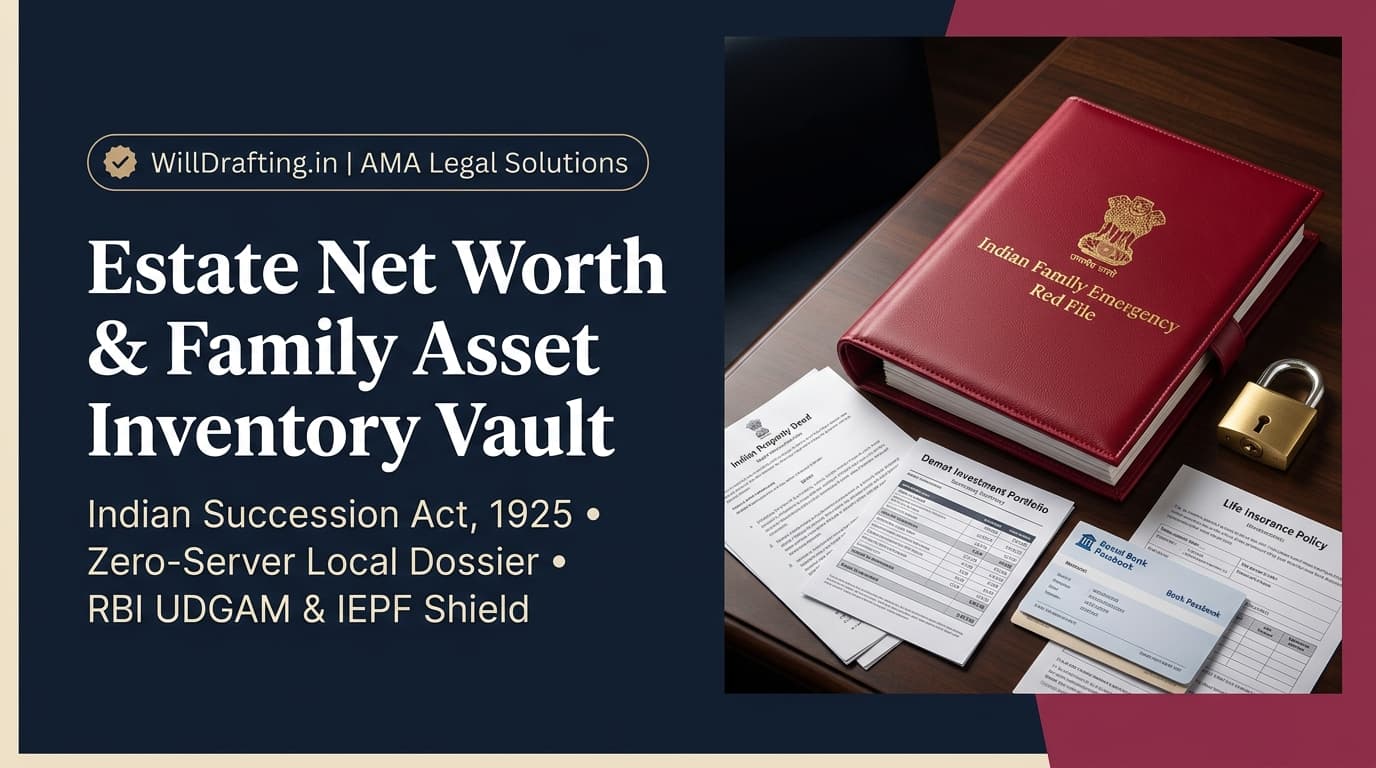
4. The Family Red File: Essential Documents Every Spouse Needs
In Indian personal finance forums (such as r/personalfinanceindia), the concept of an "Emergency Red File" or "In Case of Death Folder" has emerged as a viral best practice. It refers to a dedicated, brightly colored physical folder kept in a known home location that houses every critical document the family needs within the first 72 hours of an emergency.
- Health insurance cards & TPA cashless policy numbers
- Pure term insurance policy bonds & claim helpline contacts
- Emergency liquid cash / emergency savings account debit card
- Names and contact numbers of family physician and trusted lawyer
- Master password manager emergency access recovery kit
- Original Registered Will and registered codicils
- Original Title Deeds, conveyance deeds & share certificates
- Consolidated Demat Client Master List (CML) and CAS statements
- EPF UAN number and PPF passbook copies
- Bank safe deposit locker number, bank branch, and physical key
5. Comparing Asset Records: Sheets vs Red File vs Valid Will
Many individuals assume a casual Google Sheet or note in their smartphone is sufficient. Review the structural comparison below to understand the legal and operational differences:
| Evaluation Dimension | Unsecured Google Sheet / Excel | WillDrafting Client Vault | Challenge-Proof Registered Will |
|---|---|---|---|
| Privacy & Data Security | High risk of cloud leakage, accidental sharing, or unencrypted sync | 100% browser-local; zero server transmission or cloud storage | Confidential physical document; sealed in envelope until demise |
| Legal Enforceability | Zero legal standing under Indian Succession Act; inadmissible as bequest | Valid administrative memorandum; serves as Section 317 inventory basis | Absolute legal title under Section 213; binds all legal heirs |
| Dispute Immunity | Easily disputed by excluded relatives; cannot override intestate law | Provides verifiable evidence of asset provenance and liabilities | Highest immunity when attested by two independent witnesses & doctor |
| Family Accessibility | Spouse often locked out by 2-factor SMS authentication on deceased phone | Printable physical dossier immediately accessible in family safe | Read by designated Executor in presence of all family members |
| Bank & Demat Claims | Does not expedite claims if nominations are conflicting or missing | Includes Nominee Health Audit to eliminate UDGAM/IEPF pitfalls | Enables instant asset transmission and probate grant in High Court |
6. Step-by-Step SOP: Building Your Family Financial Dossier
Pull Consolidated Statements (CAS & AIS)
Download your CAMS/KFintech Consolidated Account Statement (CAS) for all mutual funds, NSDL/CDSL e-CAS for demat shares, and the Annual Information Statement (AIS) from the Income Tax e-filing portal. The AIS captures all interest from bank accounts, dividends, and property purchases.
Audit and Rectify Nominations Across All Portfolios
Verify that every single bank savings account, fixed deposit, PPF account, and demat portfolio has an active nominee registered. Use the online net banking or SEBI e-sign portal to add your spouse or children.
Input Asset and Liability Records in the Tool
Use the interactive vault builder above to record your property addresses, account identifiers (e.g., last 4 digits for privacy), estimated values, and liability loan numbers. Check if home loans carry term cover.
Print Physical Emergency Red File Dossier
Click 'Print Dossier' to generate an executive physical document. Place this dossier alongside certified copies of your marriage certificate, property purchase deeds, and locker keys in a safe, water-resistant folder.
Execute a Challenge-Proof Will
Draft your legally binding Will with specific bequests for each asset. Schedule A of the Will will reference your comprehensive asset inventory, ensuring zero ambiguity in court.
Compare Budget 2024 grandfathering (12.5% flat vs 20% indexation) and Section 54/54EC exemptions across multiple heirs.
7. Section 159 Income Tax Act: Legal Representative Duties
A vital reason to maintain an exact net worth statement is Section 159 of the Income Tax Act, 1961. When a taxpayer passes away, their legal representative (executor, administrator, or legal heir) is deemed to be an assessee liable to pay any sum which the deceased would have been liable to pay.
Crucially, Section 159(6) establishes that the liability of the legal representative is limited strictly to the value of the estate inherited. If an individual passes away leaving ₹10 Lakhs in assets but ₹25 Lakhs in income tax dues or unsecured personal loans, the heirs cannot be compelled to pay the remaining ₹15 Lakhs out of their personal pockets.
Having a documented asset and liability inventory protects heirs against unlawful demands by recovery officers, proving the precise quantum of net inherited estate.
8. Digital Assets & Locker Access: Critical Transmission Rules
Today’s estate planning goes far beyond physical real estate and gold. Millions of Indians possess cryptocurrency wallets, monetized YouTube channels, domain portfolios, SaaS equity, and online bank accounts without paper passbooks.
- Never Write Passwords in Plain Text: Do not record ATM PINs, crypto private keys, or net banking passwords inside the unencrypted dossier. Instead, record the existence of the asset (e.g., "Ledger Nano X hardware wallet") and state that recovery seeds are kept in a sealed tamper-evident tamper envelope in the master locker.
- RBI Revised Locker Guidelines (2023): Under RBI Circulars, if a safe deposit locker is operated with "Either or Survivor" or contains a registered nominee, the bank MUST grant access to the nominee/survivor without insisting on a probate or succession certificate, following inventory preparation in the presence of bank officers.
- Designate a Digital Executor: In your Will, appoint a tech-literate digital executor with explicit authority under the Information Technology Act, 2000 to manage cloud accounts, deactivate social media profiles, and liquidate digital tokens.
9. Practical Case Studies: Bengaluru, Mumbai & Delhi Families
The ₹1.8 Cr Lost ESOP & MF Folios
A 46-year-old tech architect passed away suddenly due to cardiac arrest. His spouse was unaware that he had accrued unvested US stock options, 14 mutual fund folios across different brokers, and three bank accounts. It took 22 months of court appearances and legal fees to trace the folios. A simple Emergency Red File would have transmitted assets in 30 days.
Locker Key Lost Without Nominee
A retired businessman in Bandra maintained a bank locker holding 650 grams of ancestral gold. He passed away intestate without adding his daughter as nominee. The bank refused to break open the locker without a formal Succession Certificate from the Bombay High Court, which took 18 months and ₹1.5 Lakhs in court fees.
Home Loan Insurance Saved Widow
A Delhi government official maintained an exact asset & liability dossier. When he died unexpectedly, his spouse discovered a ₹65 Lakh home loan schedule with an attached credit life insurance policy number. The insurance company settled the remaining loan balance in full, leaving the residential house 100% unencumbered.
10. Copy-Paste Legal Clauses & Emergency Disclosure Templates
Use these verified advocate-drafted clauses in your legal Will or family emergency memorandum:
"AND WHEREAS I maintain a comprehensive, updated Master Asset & Liability Dossier ('The Family Red File') setting out complete particulars of my immovable properties, bank accounts, fixed deposits, demat folios, mutual funds, provident funds, and insurance policies, which is kept in safe physical custody at [Location, e.g., Master Bedroom Safe / Advocate's Office].

AND I HEREBY DECLARE that the schedule of properties appended to this my Last Will and Testament reflects my full and true estate as of this date. I direct my Executor(s) named herein to refer to the said Master Asset Dossier immediately upon my demise, to liaise with the respective banking and financial institutions under Section 317 of the Indian Succession Act, 1925, and to ensure that all assets are seamlessly transmitted to the respective beneficiaries strictly in accordance with the bequests delineated in this Will, notwithstanding any statutory nomination recorded during my lifetime."EXECUTOR & SPOUSE 15-POINT FAMILY ASSET TRANSMISSION CHECKLIST: 1. Obtain 15-20 certified original copies of the Death Certificate from the Municipal Corporation (MCD/BMC/BBMP). 2. Locate the registered original Will, codicils, and the physical Family Red File / Asset Dossier. 3. Notify all life insurance companies within 30 days; submit Form 39 along with original policy bonds and canceled cheques. 4. Intimate primary salary/pension bank branches; stop standing instructions and auto-debits for credit cards. 5. Inquire whether home loans and vehicle loans are covered by credit life insurance (e.g., SBI RiNn Raksha, ICICI Lombard). 6. File death intimation with CDSL/NSDL depository participants to transmit demat shares to the surviving joint holder or nominee. 7. Submit transmission requests for mutual fund folios via MFCentral or respective AMCs with Form T2/T3. 8. Submit Form G/H for PPF accounts at Post Office/Bank branches to release accumulated tax-free balances. 9. File online e-nomination claim for EPF (Form 20/5IF) and monthly widow/children pension under EPS 95 (Form 10D). 10. Apply for title mutation of residential and commercial immovable properties in local Municipal & Revenue records. 11. Transfer electricity, water, and piped gas meters to the surviving spouse/heir using legal heir certificate. 12. Access bank safe deposit lockers following the joint survivor mandate or RBI guidelines on nominee locker opening. 13. Search the RBI UDGAM portal (udgam.rbi.org.in) for any unlinked dormant bank accounts or unclaimed fixed deposits. 14. Check the MCA IEPF portal (iepf.gov.in) for unclaimed corporate shares, physical share certificates, and dividends. 15. Discharge the deceased's pending income tax liabilities as Legal Representative under Section 159 of the Income Tax Act, 1961.
11. Institutional Legal Backing: AMA Legal Solutions Profile
Advocate Anuj Anand Malik leads the Succession, Wealth Transmission, and Testamentary Litigation practice at AMA Legal Solutions. Over 14+ years of specialized practice before the High Court of Delhi and Supreme Court of India, he has represented high-net-worth families, NRIs, and business owners in high-stakes probate disputes, partition suits, and testamentary asset audits.
WillDrafting.in was architected under his direct legal supervision to ensure that Indian citizens have access to institutional-grade testamentary protection without the risks of unregulated forms, invalid witness attestation, or omitted asset schedules.
12. Frequently Asked Questions: Family Asset Inventories
13. Statutory Citations & Central Regulatory Portals
- Indian Succession Act, 1925: Sections 211, 213, 317 (Inventory and Accounts), 318, and 332 (Assent of Executor).
- Income Tax Act, 1961: Section 159 (Legal Representative liability limited to estate value) and Section 47(iii) (Exclusion of inheritance from capital gains).
- Reserve Bank of India (RBI) UDGAM Portal: Official Centralized Web Portal for searching Unclaimed Deposits (udgam.rbi.org.in).
- Ministry of Corporate Affairs (MCA) IEPF: Investor Education and Protection Fund Authority rules for unclaimed shares & dividends (iepf.gov.in).
- Supreme Court Precedents: Smt. Sarbati Devi v. Smt. Usha Devi (1984) 1 SCC 424 and Shakti Yezdani v. Jayanand Jayant Salgaonkar (2023) Supreme Court confirming nominee as mere custodian.