- Statutory Deeming Fiction: Under Section 23(1), if a child neglects their maintenance obligations after receiving property, the law deems the gift deed to have been executed through fraud, coercion, or undue influence.
- Urmila Dixit (2025) Benchmark: The Supreme Court clarified that separate undertakings, affidavits, or promissory notes (vachan patra) signed around the time of the transfer are legally valid to prove that the gift was conditional upon care.
- Summary SDM Tribunal: Parents do not need to fight decades-long civil court trials. Petitions are heard by the Sub-Divisional Magistrate acting as the Maintenance Tribunal with a statutory 90-day disposal mandate.
- Eviction of Defaulting Children: Tribunals and High Courts have the inherent authority to order the eviction of abusive children and restore peaceful possession to the elderly parent.
1. Section 23 Statutory Ground: Voiding Property Transfers
In Indian society, elderly parents frequently transfer residential properties or agricultural land to their adult children during their lifetime. This is often done through registered gift deeds or release deeds under the emotional promise of care and medical support. However, once title deeds are registered, parents sometimes face neglect, physical mistreatment, or outright abandonment.
To counter this social crisis, Parliament enacted the Maintenance and Welfare of Parents and Senior Citizens Act, 2007 (MWPSC Act). The most potent legal provision within this legislation is Section 23(1). This section creates an extraordinary legal remedy. It empowers senior citizens to approach a dedicated administrative tribunal rather than a lengthy civil court to have their gift deeds declared null and void.
Section 23(1) establishes a statutory deeming fiction. Where a senior citizen transfers property subject to the condition of receiving basic amenities and physical needs, and the transferee child subsequently refuses or fails to provide them, the law presumes the transfer was procured through fraud, coercion, or undue influence. The Maintenance Tribunal can void the transfer and order the local Sub-Registrar to cancel the deed.
2. Interactive Section 23 Gift Revocation Checker
Answer the 5 statutory questions below to evaluate whether your property transfer qualifies for cancellation under Section 23 and calculate your Tribunal recovery probability.
Did the property transfer include an obligation to feed, house, or care for the parent?
Select all forms of mistreatment or neglect that have occurred:
Refusal to provide daily meals, clothing, or utilities.
Refusal to pay doctor bills, prescriptions, or treatments.
Threats, psychological cruelty, or intimidation.
Throwing parent out of home or locking them in a room.
Negotiating with buyers or mortgaging property without consent.
Tribunal Revocation Viability Assessment
Express clause in registered deed with documented neglect provides textbook grounds for cancellation and eviction.
Action Plan: File an immediate statutory application under Section 23(1) and Section 5 of the MWPSC Act before the Sub-Divisional Magistrate (SDM) / Maintenance Tribunal. Seek dual reliefs: (1) An order declaring the gift deed null and void with directions to the Sub-Registrar to record cancellation, and (2) Police assistance for eviction and restoration of peaceful possession.
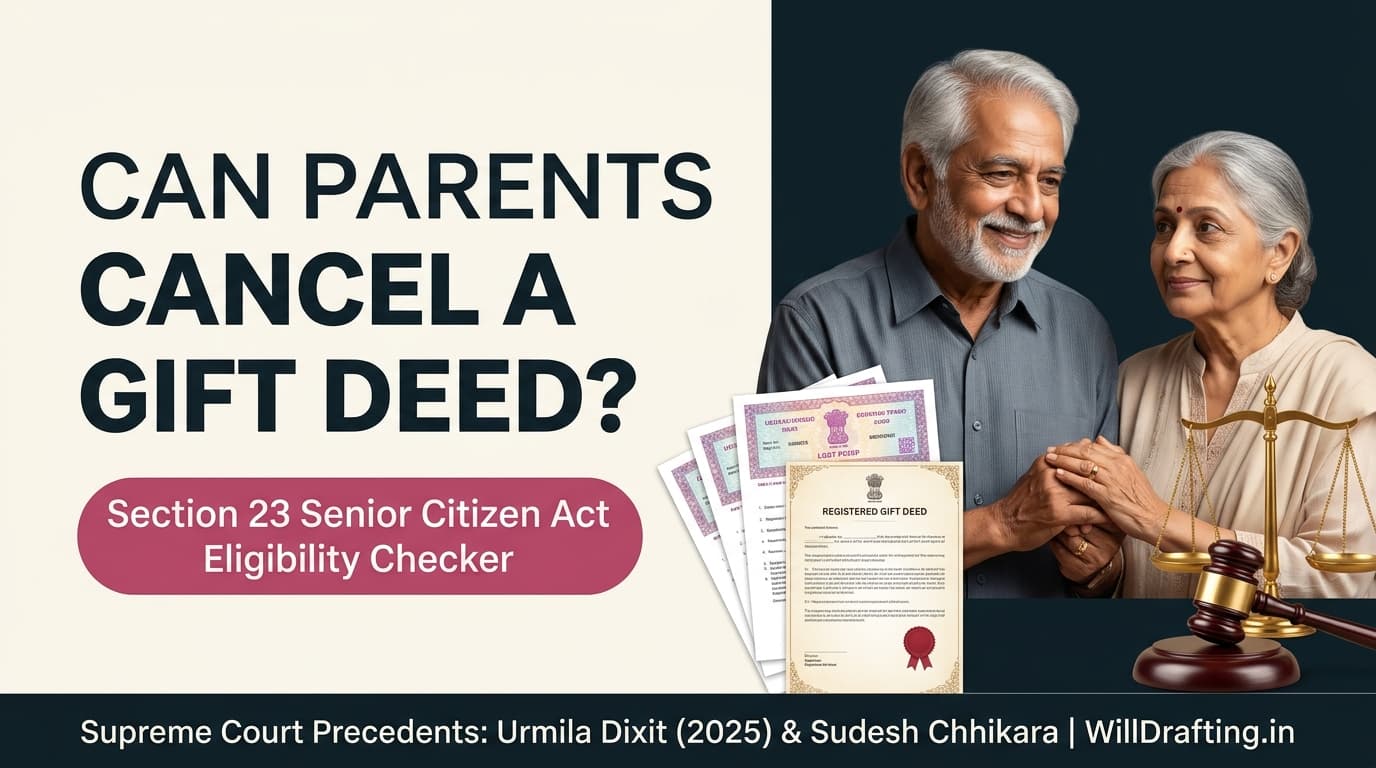
Statutory diagnostic roadmap illustrating parental gift deed revocation grounds under Section 23(1), the 4 mandatory prerequisite conditions, and landmark Supreme Court benchmarks in Urmila Dixit (2025) and Sudesh Chhikara.
3. Landmark Precedents: Urmila Dixit vs Sudesh Chhikara
Judicial interpretation of Section 23 has witnessed historic developments in the Supreme Court of India. Litigants must understand the interplay between two cornerstone rulings: Sudesh Chhikara (2022) and the latest benchmark in Urmila Dixit (2025).
Sudesh Chhikara v. Ramti Devi & Anr. (2022)
The Supreme Court held that Section 23(1) requires two conditions to be fulfilled concurrently: (1) The transfer must be subject to the condition of providing basic amenities, and (2) The transferee must have refused or failed to provide them. If a gift deed is strictly unconditional with no written requirement of care, the Tribunal cannot presume fraud merely because children subsequently fell out with parents.
Urmila Dixit v. Sunil Sharan Dixit & Ors. (Jan 2025)
A division bench of Justices C.T. Ravikumar and Sanjay Karol affirmed that the MWPSC Act is beneficial social welfare legislation designed to protect elderly citizens. The Court ruled that even if the registered gift deed did not contain an express condition on its face, contemporaneous instruments such as a Vachan Patra (promissory undertaking) execute a binding conditional transfer that triggers Section 23 revocation upon neglect.
The 2025 ruling in Urmila Dixit provides massive relief to Indian parents. It prevents errant children from using hyper-technical drafting loopholes to defeat the humane purpose of the Senior Citizens Act.
4. The 4 Statutory Prerequisite Conditions Explained
To secure an order of gift cancellation from the Maintenance Tribunal under Section 23(1), an applicant must plead and establish four distinct legal components:
Under Section 2(h) of the Act, a senior citizen means any individual who is a citizen of India and has attained the age of 60 years or above. The transferor must have been at least 60 years old on the date the transfer deed was executed.
Section 23 explicitly applies to transfers made "after the commencement of this Act". Because the Central Act received Presidential assent on December 29, 2007 and was notified across Indian states in 2008, property transfers executed prior to late 2007 cannot be voided under Section 23.
The transfer must be subject to an obligation that the transferee child provide basic food, shelter, clothing, medical care, or maintenance. Following Urmila Dixit (2025), this can be proven through express recitals in the deed, contemporaneous undertakings, or written agreements.
The applicant must prove that the child failed, neglected, or refused to provide basic maintenance or engaged in cruelty, eviction, or abandonment. Medical records, unpaid utility bills, or police station general diary entries serve as strong corroboration.
5. Property Comparison: Why a Will Beats a Gift Deed
Most parents execute gift deeds because they wish to avoid future probate procedures or family disputes after death. However, executing a lifetime gift deed is legally dangerous. It immediately alienates title, making the parent dependent upon the child’s goodwill.
A legally structured Will provides 100% security because it transfers ownership only upon demise while remaining completely revocable during your life.
| Legal Parameter | Registered Will (Recommended) | Lifetime Gift Deed (Risky) |
|---|---|---|
| Transfer of Ownership | Takes effect ONLY after demise. Parent remains 100% absolute owner for life. | Takes effect immediately on registration. Parent ceases to own the house. |
| Right of Revocation | 100% revocable anytime. Can alter, cancel, or draft a new Will without child’s consent. | Irrevocable under Transfer of Property Act unless contested under Section 23 Tribunal. |
| Stamp Duty & Registration | Nominal registration fee (₹100 to ₹1,000 depending on state). ₹0 Stamp Duty. | Heavy stamp duty (2% to 7% of market circle rate, costing lakhs in many states). |
| Rental Income & Sale Rights | Parent keeps 100% rental income, right to mortgage, or right to sell property anytime. | Child receives rents. Child can attempt to mortgage or sell house to third parties. |
| Risk of Abandonment | Virtually zero. Children remain attentive knowing the Will can be altered at any time. | Extremely high. Common trigger for parental neglect, harassment, and eviction. |
6. Tribunal Filing SOP: Procedure Before the SDM Court
A petition under Section 23 is not filed in a regular Civil Court. It is presented before the Maintenance Tribunal headed by the Sub-Divisional Magistrate (SDM) or Revenue Divisional Officer (RDO) possessing territorial jurisdiction where the senior citizen resides or where the property is situated.
Prepare a formal petition detailing the date of the gift deed, the conditional promise of maintenance, specific dates of neglect/cruelty, and prayers for deed revocation, monthly maintenance, and peaceful eviction.
The Tribunal issues summons to the child. Under Section 6(6), the Tribunal may refer the matter to a Conciliation Officer. If conciliation fails or the child remains recalcitrant, the Tribunal proceeds with summary inquiry.
During pendency, the Tribunal can order monthly interim allowance (up to ₹10,000 or higher as per recent High Court directions) and restrain the child from creating third-party rights or mortgaging the property.
The Tribunal passes an order declaring the gift deed void. A copy of the order is served on the local Sub-Registrar to record cancellation in Book I registers, reverting legal title exclusively back to the senior citizen.
If the child refuses to vacate the premises, the SDM directs the local police authorities to physically evict the child and hand over vacant keys to the parent pursuant to S. Vanitha (SC 2020).
7. Section 23(2) Rule: When Property Is Sold to Third Party
A frequent challenge arises when a child who received a gift deed rapidly sells or mortgages the property to a third-party purchaser or commercial bank before the parent can approach the Maintenance Tribunal. Section 23(2) of the Act addresses this contingency:
This means that if the child gifted the property to their spouse (gratuitous transfer) or if the outside buyer purchased the property knowing the elderly parent was being ousted (transfer with notice), the senior citizen can enforce their rights against that buyer.
However, if an outsider bought the property for fair market value in good faith without knowing of the family dispute, the Maintenance Tribunal cannot unilaterally cancel the third-party sale deed. In such cases, the senior citizen must file a declaration suit in the Civil Court while pursuing monthly maintenance and compensation against the child before the Tribunal.
8. Section 24 Penalties: Abandonment & Criminal Liability
In addition to civil property revocation under Section 23, the MWPSC Act imposes direct criminal liability on children who abandon their elderly parents.
Under Section 24 of the Act, whoever having the care or protection of a senior citizen leaves such senior citizen in any place with the intention of wholly abandoning them commits a cognizable and bailable criminal offense. The offense carries imprisonment for a term which may extend to three months, or with a fine up to ₹5,000, or with both.
Senior citizens facing physical assault or intimidation can also register an FIR under the relevant provisions of the Bharatiya Nyaya Sanhita, 2023 (BNS) for criminal intimidation, wrongful confinement, and voluntarily causing hurt.
9. Practical Case Studies: Delhi, Bengaluru, Mumbai
A 72-year-old retired central government officer gifted his ancestral floor in Vasant Kunj to his elder son. The gift deed contained a recital that the son would care for the father’s medical needs. Within 8 months, the son cut electricity, locked the kitchen, and stopped buying heart medication. Counsel filed a Section 23 petition before the SDM (South). The SDM declared the deed void, directed the Sub-Registrar to expunge the transfer, and deployed Delhi Police to evict the son within 15 days.
In Bengaluru, a widowed mother was harassed by her son and daughter-in-law after gifting them a residential villa. The daughter-in-law filed domestic violence claims to resist eviction. Applying the Supreme Court ruling in S. Vanitha, the Karnataka High Court ruled that a senior citizen’s right to live with peace and dignity overrides conflicting claims under the DV Act, upholding the SDM’s eviction order.
A 68-year-old mother in Borivali released her 50% share in an inherited apartment in favor of her son alongside a signed letter (Vachan Patra) promising monthly maintenance of ₹25,000. When the son stopped payments, the Maintenance Tribunal initially hesitated under Sudesh Chhikara. On appeal, relying on the 2025 Supreme Court ruling in Urmila Dixit, the Tribunal held that contemporaneous undertakings satisfy Section 23, voiding the release deed.
10. Protective Recital Clauses & Tribunal Checklist
If you are currently contemplating gifting property to a child, you must include a watertight protective recital in the gift deed. If you are already facing neglect, use our filing checklist to assemble your Tribunal petition docket.
"AND WHEREAS this Gift of the Schedule Property is executed by the Donor and accepted by the Donee SUBJECT TO THE EXPRESS STATUTORY CONDITION under Section 23(1) of the Maintenance and Welfare of Parents and Senior Citizens Act, 2007, that the Donee shall provide all basic amenities, physical needs, medical care, nourishment, and peaceful shelter to the Donor throughout the Donor's natural life.

AND WHEREAS it is mutually agreed and understood that in the event the Donee neglects, fails, or refuses to provide such basic amenities, medical expenses, and respectful maintenance to the Donor at any point of time, this Gift Deed shall be deemed to have been made by fraud, coercion, and undue influence, and shall at the sole option and petition of the Donor be declared null, void, and cancelled by the Maintenance Tribunal, with absolute title and vacant possession reverting forthwith to the Donor."
1. Formal Application under Section 23(1) & Section 5 before the Sub-Divisional Magistrate (SDM) / Maintenance Tribunal.
2. Certified Copy of the Registered Gift Deed / Settlement Deed from the Sub-Registrar Office (SRO).
3. Proof of Senior Citizen Age (Aadhaar Card, Passport, Voter ID, or Senior Citizen Card showing age 60+ on execution date).
4. Evidence of Maintenance Obligation: Copy of Deed recital, separate Vachan Patra, mutual agreement, or contemporaneous affidavit.
5. Evidence of Neglect or Harassment: Police complaints, medical prescriptions paid by parent, doctor certificates, bank statements.
6. Details of Immovable Property: Current municipal property tax receipt, mutation extract, and electricity/water bills.
7. Verification Affidavit duly attested by an Oath Commissioner or Notary Public.
11. Institutional Profile: AMA Legal Solutions Counsel
Advocate Anuj Anand Malik
Advocate Anuj Anand Malik has represented hundreds of senior citizens before Maintenance Tribunals, Appellate Tribunals (District Magistrates), and High Courts across India. His practice focuses on Section 23 gift cancellations, senior citizen eviction petitions, testamentary probate, and challenge-proof estate succession structuring.
12. Frequently Asked Questions: Gift Deed Revocation
13. Statutory Citations & Legal Redressal Resources
Primary Legislation: Maintenance and Welfare of Parents and Senior Citizens Act, 2007 (Act No. 56 of 2007), Sections 2(h), 5, 7, 8, 9, 19, 20, 23 & 24.
Landmark Supreme Court Precedents:
- Urmila Dixit v. Sunil Sharan Dixit & Ors., 2025 INSC 20 (Bench of Justices C.T. Ravikumar & Sanjay Karol).
- Sudesh Chhikara v. Ramti Devi & Anr., (2022) 15 SCC 493.
- S. Vanitha v. Deputy Commissioner, Bengaluru Urban District & Ors., (2021) 15 SCC 730 (Overriding effect of Senior Citizens Act over DV Act).
Related Tools on WillDrafting: Compare Gift Deed vs Will Stamp Duty Calculator or check your estate plan using the Will Validity Section 63 Audit Checker.