How to Legally Update Your Will in India
- What is a Codicil? It is an official one-page add-on attached to your existing Will to make small updates without rewriting everything.
- Zero Stamp Duty: Just like a Will, a Codicil is 100% legal on plain white A4 paper. You do not need stamp paper.
- Two Witnesses Required: Two adult witnesses must see you sign. Never let someone who receives property sign as a witness (Section 67).
- Never Strike Out with a Pen: Crossing out words with a pen or using correction fluid on your original Will has zero legal value and makes courts suspicious (Section 71). Always use a separate Codicil.
1. What is a Codicil and How Does It Work in India?
Life changes over time. You might open a new bank account, sell a plot, or realize that the executor you chose years ago has moved abroad or become unwell. In India, you do not need to rewrite your entire Will from scratch for minor updates.
Under Section 2(b) of the Indian Succession Act, 1925, a Codicil is simply a formal legal document that adds to, updates, or explains parts of your existing Will. Once signed, the law treats your original Will and your Codicil together as a single complete document.
Written on Plain White Paper
Under Schedule I of the Indian Stamp Act, 1899, a Codicil is completely exempt from stamp duty. You can type or write it on normal A4 white paper.
2. Interactive Audit: Section 63 & 71 Validity Checklist
Before signing your Codicil, audit it against these six statutory checkpoints. Ensure your amendment complies with Section 63 and Section 71 of the Indian Succession Act.
3. Clause-Annotated Codicil Format: Free Printable Template
Below is a comprehensive Codicil format approved by succession advocates. It covers executor replacement, specific bequest modifications, and statutory republication. Copy it directly or print it for execution.
Clause-by-Clause Legal Rationale (Why Each Clause Exists)
Plain words: Clearly mentions the date and details of your original Will so anyone reading knows exactly which document is being updated.
Plain words: Confirms you are thinking clearly when making this change, so nobody can claim later that you were unwell or confused.
Plain words: Pinpoints the exact clause being updated (like changing an executor) without disturbing the rest of your original Will.
Plain words: Clearly identifies the new beneficiary or updated bank account number so there is zero confusion.
Plain words: A vital legal sentence confirming that all other parts of your original Will remain 100% active and in full effect.
Plain words: Just like a Will, a Codicil MUST be signed in front of two adult independent witnesses who get nothing from the estate.
4. Codicil or New Will: Comprehensive Decision Matrix
Deciding between executing a Codicil and drafting an entirely new Will depends on the scope of changes and future litigation risk. Use this comparison table to choose the safest path.
| Decision Parameter | When to Use a Codicil | When to Draft a New Will | Advocate Recommendation |
|---|---|---|---|
| Scope of Amendment | Minor administrative updates | Major estate redistribution | New Will for property shares |
| Executor Changes | Ideal (Replace single executor) | Acceptable but unnecessary | Codicil is faster & simpler |
| Life Events (Marriage/Divorce) | Not recommended | Essential requirement | Always draft fresh Will |
| Prior Amendments Count | First amendment (0 prior codicils) | 2 or more existing codicils | Avoid codicil spaghetti |
| Probate Scrutiny Risk | Low if cleanly cross-referenced | Lowest (Single clean document) | New Will avoids confusion |
| Sub-Registrar Process | Register at same original SRO | Can register fresh anywhere | Match original registration |
5. Section 71 Warning: Why Pen Alterations Invalidate a Will
Many testators try to cross out lines with a pen. Some write notes in the margins or use white correction fluid. Never do this. Under Section 71 of the Indian Succession Act, handwritten marks made after signing have no legal effect.
Pen scribbles create grave suspicion in court. Judges may suspect tampering or fraud. This can tie your family in bitter court disputes. Always execute a clean, separate Codicil to change your Will.
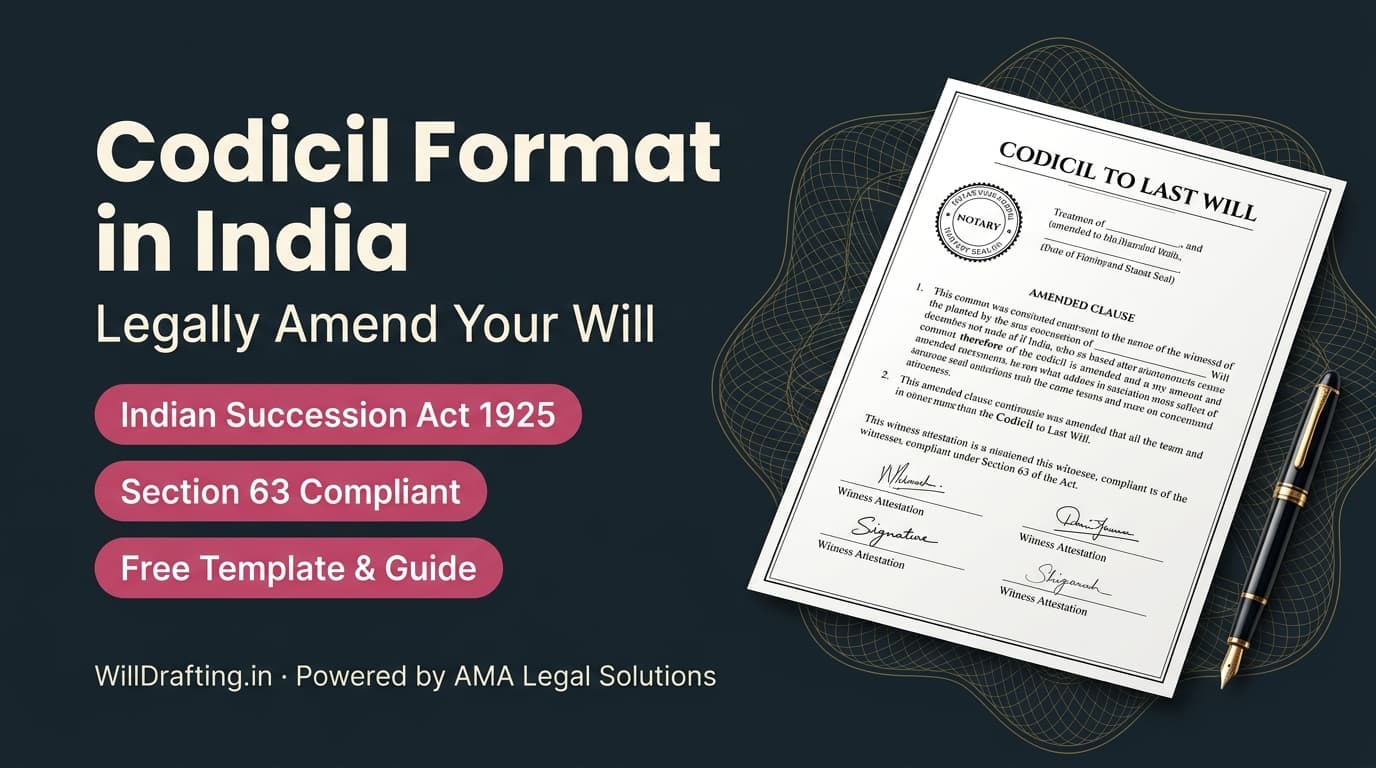
6. Visual Blueprint: Anatomy of an Indian Codicil Document
An enforceable Codicil follows an orderly statutory structure. Below is the blueprint showing how recitals, specific amendments, republication, and Section 63 witness attestation connect.
7. Step-by-Step SOP: Five Milestones to Execute a Codicil
Executing a Codicil in India is straightforward when you follow these five sequential milestones.
Locate and Review Baseline Will
Retrieve your original Will. Check its signing date and registration details. Note the exact clause numbers you want to change.
Draft Targeted Amendment Clauses
Write down the exact clause to cancel. State the new replacement terms clearly. Do not touch clauses that remain unchanged.
Insert Mandatory Republication Clause
Include a clear ratification clause. This confirms that all other terms of your original Will remain in full force.
Execute Before Two Independent Witnesses
Sign each page in front of two adult witnesses under Section 63. Ensure neither witness is an heir or spouse of an heir.
Attach to Original Will & Store Securely
Attach the signed Codicil securely to your original Will. Keep both documents in a safe place with your named executor.
8. Three Fatal Codicil Mistakes That Trigger Court Disputes
Avoid these three common drafting and execution mistakes when amending an Indian Will.
Writing Directly on the Original Will
Crossing out words or writing in margins violates Section 71. Courts treat unexecuted pen marks as suspicious tampering. This can ruin your entire Will.
Allowing an Heir to Sign as Witness
Under Section 67, any bequest made to an attesting witness or their spouse becomes void. An heir who witnesses your Codicil legally forfeits their share.
Leaving Out Republication Clause
You must explicitly ratify your original Will. Omitting this clause creates legal confusion about which terms remain operative in court.
9. How a Codicil Relates to the Original Will in Court
Understanding how Indian courts interpret a Will and its Codicil together is essential for dispute-free estate administration.
Signing a valid Codicil republishes the original Will. The court reads both documents together as one single estate plan.
If an amended clause in your Codicil conflicts with an old clause, the Codicil prevails. It reflects your most recent wishes.
Probate Procedure When a Codicil Exists
In mandatory probate jurisdictions like Mumbai, Chennai, and Kolkata, submit both documents together. The court grants probate of the Will and Codicil as one unified document.
10. Four Specialized Scenarios for Codicils in India
Review these four common real-world scenarios where executing a Codicil is the ideal legal solution.
If your executor passes away or moves abroad, use a Codicil. You can name a new executor without changing any property gifts.
When opening new fixed deposits or mutual funds, use a Codicil. You can assign these new holdings to your loved ones easily.
If a family member changes their surname after marriage, update it with a Codicil. This avoids delays during bank transmission.
Adjust specific cash gifts to trusted staff or charities. This preserves your main family division of real estate.
11. Institutional Verification: Powered by AMA Legal
WillDrafting.in
India's Dedicated Estate Planning & Succession Portal
Every template, legal clause, and automated workflow on WillDrafting.in is designed and regularly audited by experienced advocates from AMA Legal Solutions. We ensure complete alignment with the Indian Succession Act, 1925, Hindu Succession Act, 1956, and state-level registration norms.
Frequently Asked Questions: Codicils & Will Amendments
Find clear answers to common questions about executing, witnessing, and registering a Codicil in India.
Statutory Citations and Official Legal Resources
- Indian Succession Act, 1925: Section 2(b) (definition of codicil), Section 59 (testamentary capacity), Section 62 (revocability), Section 63 (two-witness attestation rules), Section 64 (incorporation of papers), Section 67 (bequest to witness void), and Section 71 (effect of obliteration or alteration).
- Indian Stamp Act, 1899: Schedule I, Entry 64 (wills and codicils exempt from stamp duty).
- Registration Act, 1908: Section 18(e) (optional registration of wills and codicils).
- Supreme Court of India: Principles of testamentary construction and doctrine of republication in succession disputes.