Online Will Drafting in India for NRIs & OCIs Abroad
Under Section 5 of the Indian Succession Act, 1925 (Lex Situs), succession to immovable property in India is governed strictly by Indian law—regardless of your citizenship or foreign domicile. Draft a separate, lawyer-verified Indian Will from abroad so your family never faces 18 months of Section 228 foreign probate re-sealing.
The Section 228 Foreign Probate Bottleneck
- US Living Trusts are not recognized: Indian Sub-Registrars and housing societies require a statutory Will or Indian court order—not a US Revocable Living Trust.
- DIFC & Abu Dhabi Wills are UAE-only: UAE expat Wills protect Dubai/Abu Dhabi assets but cannot mutate flats or NRE/NRO accounts in India.
- Accidental Revocation Risk: Updating your foreign Will with a standard revocation clause can accidentally cancel your Indian estate plan unless drafted under the Two-Will Strategy.
NRI Will Rules by Country of Residence
Select your country of residence to see how your local Will or Living Trust interacts with the Indian Succession Act, 1925, Hague Apostille rules, and Indian Consulate attestation:
Indian Will Rules for NRIs & OCIs in the USA
Many US NRIs set up a California, New York, Texas, or New Jersey Revocable Living Trust or US Pour-Over Will. However, Indian Sub-Registrars, cooperative housing societies, and banks do not recognize US Living Trusts for mutating Indian real estate or releasing NRE/NRO accounts without a 14–24 month Section 228 ancillary court proceeding in India.
India charges zero inheritance or estate tax (Section 56 Income Tax Act). However, H-1B/non-resident aliens in the US face a strict $60,000 US-situs estate tax exemption, while US citizens/Green Card holders report worldwide capital gains upon selling inherited Indian assets.
Hague Apostille Convention: Sign your Indian Will on plain A4 paper before 2 local witnesses. If executing a supporting Power of Attorney or notarized copy, obtain a State Secretary of State Apostille—no Indian Consulate visit required for apostilled documents.
Competent Authority: US State Secretary of State (Apostille) or Indian Embassy Washington D.C. & Consulates in New York, San Francisco, Chicago, Houston, Atlanta & Seattle.
- Keep your US Revocable Living Trust / US Will strictly limited to US-situs assets
- Execute a separate Indian Will with a non-revocation territorial clause for Indian flats, plots, Demat & NRE/NRO accounts
- Align Indian bank & Zerodha/Groww Demat nominations with your Indian Will beneficiaries
Indian Will Rules for NRIs & OCIs in the UK
Using an English or Scottish Will to transfer property in Mumbai, Delhi, Punjab, Gujarat, or Bengaluru requires waiting for a UK HMCTS Grant of Probate, getting it apostilled by the UK FCDO, and filing a second Section 228 petition in an Indian District or High Court.
The UK levies up to 40% Inheritance Tax (IHT) on worldwide assets for long-term UK residents / domiciled individuals, whereas India levies 0% inheritance tax. Separate UK and Indian Wills prevent cross-jurisdiction probate freezes while your accountant handles UK-India DTAA relief.
Hague Apostille Convention: Sign your Indian Will before 2 adult witnesses in the UK. For optional authentication or PoA legalization, obtain an Apostille from the UK Foreign, Commonwealth & Development Office (FCDO).
Competent Authority: UK FCDO Legalisation Office (Apostille) or High Commission of India in London & Consulates in Birmingham and Edinburgh.
- Ensure your UK Solicitor Will excludes Indian immovable property to avoid accidental revocation
- Draft a standalone Indian Will under Section 63 of the Indian Succession Act, 1925
- Name an Executor residing in India (or an alternate Indian Executor) for smooth bank and society mutation
Indian Will Rules for NRIs in the UAE & Gulf
Non-Muslim expats in the UAE frequently register a DIFC Courts Will (Dubai) or an Abu Dhabi Judicial Department (ADJD) Civil Family Court Will to avoid default Sharia distribution of UAE bank accounts and Dubai real estate. However, DIFC and ADJD Wills apply ONLY to UAE assets and do not govern property or NRE/NRO accounts inside India.
Neither the UAE nor India levies an inheritance or estate tax. Because UAE expats remain Indian citizens holding Indian passports, succession to their Indian assets is governed strictly by their Indian personal law (Hindu, Muslim Wasiyat, Christian, or Parsi).
Consular Attestation: Sign your Indian Will before 2 adult witnesses in Dubai or Abu Dhabi. If notarizing or executing an Indian Power of Attorney from the UAE, get it attested at the Indian Embassy in Abu Dhabi or Consulate General of India in Dubai (via BLS / IVS Global).
Competent Authority: Embassy of India (Abu Dhabi) & Consulate General of India (Dubai) + UAE Ministry of Foreign Affairs (MoFA).
- Keep your DIFC or ADJD Will for UAE bank accounts, gratuity, and Dubai/Abu Dhabi real estate
- Maintain a separate Indian Will for all Indian flats, ancestral shares, NRE/NRO fixed deposits, and mutual funds
- Ensure Muslim NRIs adhere to the 1/3rd Wasiyat rule under Muslim Personal Law for Indian assets
Indian Will Rules for NRIs & OCIs in Canada
An Ontario Certificate of Appointment of Estate Trustee or BC Probate grant is not directly enforceable by Indian banks or municipal authorities. Relying on a Canadian Will triggers multi-month court re-sealing under Section 228 of the Indian Succession Act.
Canada has no direct inheritance tax but enforces a 'deemed disposition at death' rule (capital gains tax on worldwide assets on the final T1 return). Having a clear Indian Will speeds up Indian valuation, property mutation, and Form 15CA/15CB repatriation.
Hague Apostille Convention (Effective Jan 2024): Canada is now a Hague Apostille member. Documents notarized in Canada can be apostilled directly by Global Affairs Canada or provincial authorities (Ontario ODS, BC, Alberta) without needing red-ribbon consular legalization.
Competent Authority: Global Affairs Canada / Provincial Apostille Offices, or High Commission of India (Ottawa) & Consulates in Toronto and Vancouver.
- Coordinate your Canadian Primary/Secondary Wills with a separate Indian Will
- Include a strict territorial clause so updating your Canadian Will never revokes your Indian Will
- Specify PAN, OCI card number, and Indian NRO account details clearly for future repatriation
Indian Will Rules for NRIs & OCIs in Australia
Australian Supreme Court Probate grants (NSW, Victoria, Queensland, WA) require formal authentication and ancillary Indian court proceedings under Section 228 before Indian immovable property can be transferred.
Neither Australia nor India imposes an inheritance tax on death, though Australian tax residents face Australian Capital Gains Tax (CGT) if they subsequently sell an inherited Indian property. A clear Indian Will establishes clean cost-base and title dates.
Hague Apostille Convention: Sign your Indian Will on plain A4 paper before 2 adult witnesses in Australia. Supporting affidavits or PoAs can be apostilled by the Australian Department of Foreign Affairs and Trade (DFAT).
Competent Authority: Australian DFAT Passport/Apostille Office or High Commission of India (Canberra) & Consulates in Sydney, Melbourne, Perth & Brisbane.
- Draft a standalone Indian Will covering Indian real estate, PPF/NRO balances, and Demat shares
- Ensure your Australian Will explicitly excludes assets situated within the Republic of India
- Keep a signed physical copy of your Indian Will accessible to your named Executor in India
Indian Will Rules for NRIs in Singapore & Europe
A Singapore Grant of Probate or European Certificate of Succession (Erbschein / Verklaring van Erfrecht) is unfamiliar to Indian Sub-Registrars and bank legal cells, forcing heirs into Section 228 ancillary court petitions in India.
Singapore abolished estate duty in 2008, and India charges zero estate tax. In EU civil-law countries (like Germany, France, or the Netherlands), EU Succession Regulation (Brussels IV) forced-heirship rules can conflict with Indian personal laws unless a separate Indian Will is executed.
Hague Apostille Convention: Both Singapore (via the Singapore Academy of Law — SAL) and EU member states issue Hague Apostilles recognized across India without requiring separate Embassy legalization.
Competent Authority: Singapore Academy of Law (SAL) / EU Competent Apostille Authorities & Indian Embassies across Singapore, Berlin, The Hague, Dublin & Paris.
- Separate your Singapore/EU estate from your Indian immovable and financial assets
- Execute your Indian Will before two adult non-beneficiary witnesses under Section 63 ISA
- Document NRE/NRO/FCNR account numbers and Demat DP/Client IDs in your Indian Will schedule
Do You Need a Separate Indian Will? Check in 30 Seconds
Select your overseas residence, your Indian asset profile, and your current estate setup to see your exact legal roadmap under Indian succession and FEMA laws:
Your Foreign Will Alone Triggers Dual-Country Court Delays
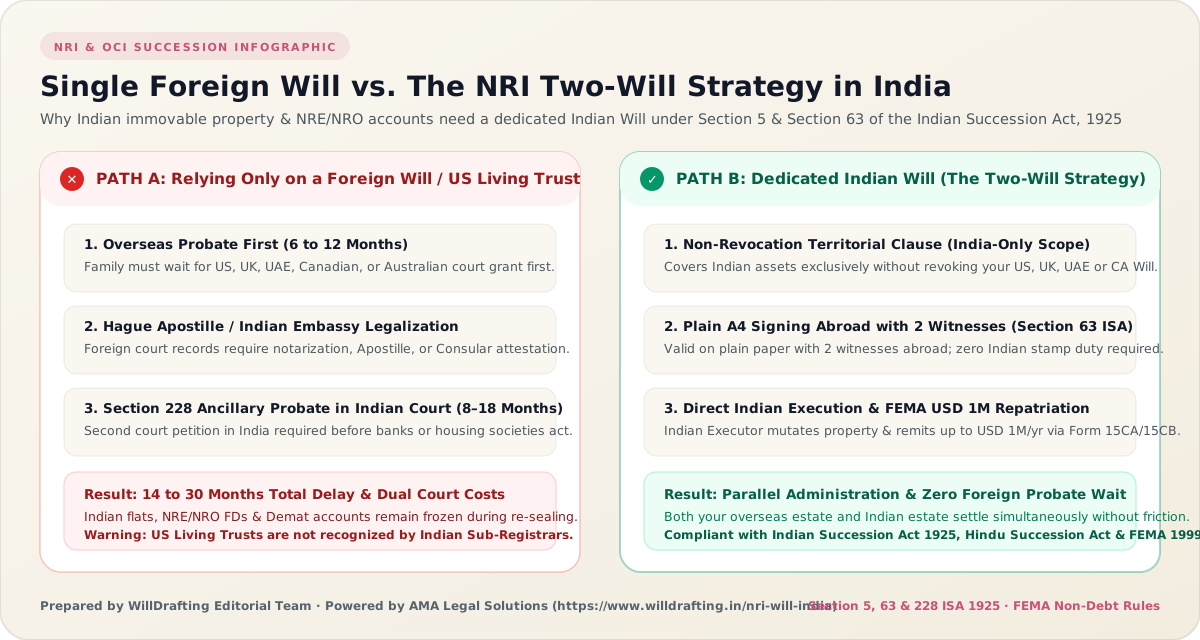
Relying on a US Living Trust, UK Will, UAE DIFC Will, or Canadian/Australian Will for Indian assets forces your family to wait for overseas probate first, obtain an Apostille/Embassy attestation, and then file a second Section 228 ancillary probate petition in an Indian court.
Infographic: Foreign Will vs. NRI Two-Will Strategy
How a separate Indian Will bypasses foreign probate re-sealing under Section 228 of the Indian Succession Act, 1925 and accelerates NRO repatriation:
FEMA Rules & USD 1 Million Repatriation for NRIs
Inheriting property in India is 100% tax-free under Section 56(2)(x) of the Income Tax Act, 1961. However, mutating title and wiring sale proceeds abroad through an Authorised Dealer (AD) bank requires strict compliance with the Foreign Exchange Management Act (FEMA), 1999:
| Indian Asset Class | Governing FEMA / Statutory Rule | NRI / OCI Inheritance Status | Repatriation & Bank Release Requirement |
|---|---|---|---|
| Residential Flats, Houses & Commercial Plots | Section 6(5) FEMA & Non-Debt Rules, 2019 | 100% Inheritable by NRIs & OCIs | Sale proceeds credited to NRO account can be repatriated up to USD 1 Million per financial year per heir (up to 2 residential properties). |
| Agricultural Land, Plantation & Farmhouse | Rule 24 FEMA (Non-Debt Instruments) Rules, 2019 | Inheritable by Will / Succession (Cannot be purchased) | NRIs/OCIs can legally inherit agricultural land under a Will, but any future sale must be made only to a Resident Indian citizen. |
| NRE & FCNR(B) Bank Deposits | RBI Master Direction — Deposits & Accounts | 100% Freely Repatriable | Principal and interest are fully repatriable. Aligning your NRE/FCNR bank nominee with your Indian Will beneficiary prevents bank freezes. |
| NRO Savings, Fixed Deposits, Demat & Mutual Funds | FEMA (Remittance of Assets) Regulations + Supreme Court Shakti Yezdani Rule | 100% Inheritable (Will Overrides Nominee) | Requires Death Certificate + Valid Indian Will + Chartered Accountant Certificate (Form 15CB) & Form 15CA for remittance up to USD 1M/year. |
| Undivided Ancestral / HUF Coparcenary Share | Section 6 & Section 30 Hindu Succession Act, 1956 | 100% Bequeathable by Will | An NRI/OCI Hindu coparcener can bequeath their undivided coparcenary share by Will without needing prior partition. |
How NRIs Sign a Valid Indian Will from Abroad
You do not need to travel to India or purchase non-judicial stamp paper to make a legally enforceable Indian Will. Follow these 4 statutory steps from your home abroad:
Draft India-Only Will
Enter your Indian flats, plots, NRE/NRO accounts, and Demat folios online. Our engine automatically embeds a Non-Revocation Territorial Clause protecting your foreign Will.
Advocate Verification
An Indian succession advocate at AMA Legal Solutions reviews your draft for Hindu Succession Act, Muslim Wasiyat (1/3rd rule), or Indian Succession Act compliance.
Sign on Plain A4 Paper
Print your court-ready Will PDF on plain A4 paper abroad and sign in the simultaneous presence of two independent adult witnesses (who are not beneficiaries).
Optional Apostille or SRO
Your signed Will is immediately valid under Section 63 ISA. For extra protection, you may get it apostilled locally or register it at an Indian Sub-Registrar on a future visit.
Helping Elderly Parents in India Make Their Will
One of the most stressful situations for NRIs in the US, UK, UAE, Canada, and Australia occurs when aging parents in Delhi, Mumbai, Bengaluru, Chennai, Pune, Hyderabad, or Kolkata pass away without a clear Will—leaving NRI children to take repeated international flights for court Succession Certificates and bank KYC clearances.
With WillDrafting.in, your parents can complete their Will from home using our Bilingual (English & Hindi) interface and AI Voice Assistant, attach a Doctor's Medical Fitness Certificate, and have an AMA Legal Solutions advocate verify that every bequest and bank nomination matches.
Frequently Asked Questions on NRI Wills in India
Clear statutory answers prepared by the WillDrafting Editorial Team and verified by AMA Legal Solutions:
Do NRIs and OCIs need a separate Indian Will if they already have a US, UK, UAE, or Canadian Will?
Yes. While a foreign Will or US Living Trust can theoretically cover Indian assets, executing it in India triggers Section 228 of the Indian Succession Act, 1925. Your family must wait 6 to 12 months for overseas probate, obtain an Apostille or Indian Embassy attestation, and then file a second ancillary court petition in India (taking another 8 to 18 months). Maintaining a separate Indian Will under the Two-Will Strategy allows immediate parallel administration in India.
How do I prevent my Indian Will from accidentally revoking my US, UK, or Canadian Will?
Every NRI Indian Will drafted on WillDrafting.in includes an explicit Non-Revocation Territorial Scope Clause. It declares that the Will applies exclusively to movable and immovable property situated within the Republic of India and preserves any past or future Wills or Living Trusts governing assets outside India.
Does an NRI need to fly to India or buy Indian stamp paper to sign a valid Indian Will?
No. Under Section 63 of the Indian Succession Act, 1925 and the Indian Stamp Act, 1899, Wills are 100% exempt from stamp duty. You can print your Indian Will on plain white A4 paper in New York, London, Dubai, Toronto, Sydney, or Singapore and sign it in the simultaneous presence of two independent adult witnesses (who are not beneficiaries or spouses of beneficiaries).
When is a Hague Apostille or Indian Embassy attestation required for an NRI Will?
For basic validity under Section 63 of the Indian Succession Act, plain-paper signing before two adult witnesses is sufficient. However, if you execute a supporting Power of Attorney or notarized affidavit abroad for Indian property mutation, residents of Hague Convention countries (USA, UK, Canada, Australia, Singapore, EU) use a local Apostille stamp, while residents of non-Hague jurisdictions (such as the UAE) use Indian Embassy (Abu Dhabi) or Consulate (Dubai) attestation.
Can an NRI or OCI cardholder inherit agricultural land or a farmhouse in India through a Will?
Yes. Under Section 6(5) of FEMA, 1999 and the FEMA (Non-Debt Instruments) Rules, 2019, an NRI or OCI is prohibited from purchasing agricultural land, plantation property, or a farmhouse in India, but CAN lawfully inherit it by way of a valid Will or intestate succession from a Resident Indian. Any subsequent sale of that inherited agricultural land must be made to a Resident Indian citizen.
How much inherited money or property sale proceeds can an NRI repatriate abroad each year?
Under RBI and FEMA Remittance of Assets regulations, each NRI or OCI beneficiary can repatriate up to USD 1 Million per financial year (April 1 to March 31) from their NRO account after submitting a Chartered Accountant certificate in Form 15CB and filing Form 15CA on the Income Tax portal along with the deceased's Will.
Does India charge an Inheritance Tax or Estate Duty on property inherited by NRIs?
No. India abolished Estate Duty in 1985 and Wealth Tax in 2015. Under Section 56(2)(x) of the Indian Income Tax Act, 1961, property or money received under a Will or by inheritance is completely exempt from income tax in India at the time of inheritance (capital gains tax applies only when the inherited property is later sold).
Can NRIs use WillDrafting.in to help their elderly parents living in India make a Will?
Yes. Thousands of NRIs face multi-year travel and court hurdles when aging parents in India pass away without a Will. Our platform offers a Bilingual (English & Hindi) interface and an AI Voice Assistant so your parents in India can comfortably record their wishes from home, backed by AMA Legal Solutions advocate verification.
Explore our statutory guides and transparent pricing tiers for Resident Indians and NRIs:
This guide is prepared in accordance with the Indian Succession Act, 1925, the Hindu Succession Act, 1956, the Muslim Personal Law (Shariat) Application Act, 1937, and the Foreign Exchange Management Act (FEMA), 1999. It is intended for informational purposes and does not substitute individualized cross-border tax counsel.