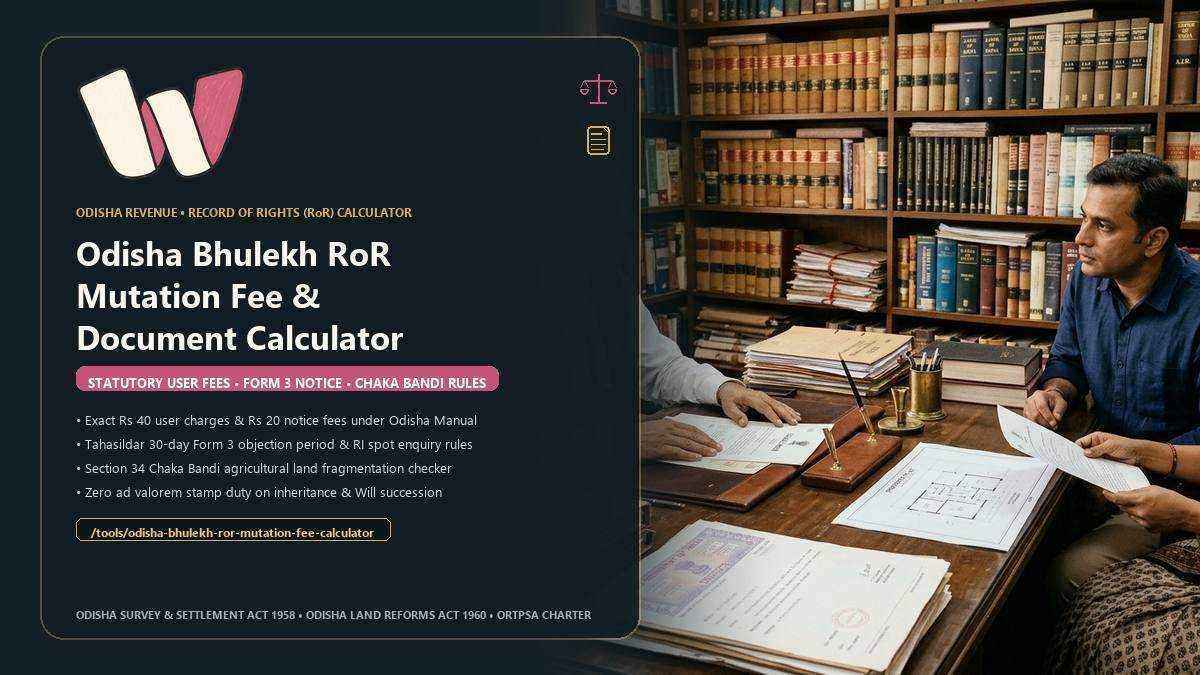
/tools/odisha-bhulekh-ror-mutation-fee-calculator- Zero Ad Valorem Stamp Duty on Inheritance: Transfer of land rights to legal heirs through succession or a registered Will attracts zero stamp duty in Odisha. Only statutory portal user charges (Rs 40) and notice fees (Rs 20 per heir) apply.
- Mandatory 30-Day Form 3 Public Notice: Under Rule 34 of the Odisha Mutation Manual, the Tahasildar must issue a Form 3 notice inviting objections from co-heirs and villagers before correcting Khatiyan Column 2.
- No Probate Required in Odisha: Unlike Kolkata, Mumbai, or Chennai, probate is not mandatory in Odisha for Wills executed by Hindus. You can directly present a registered Will before the Tahasildar for RoR correction.
- Strict Chaka Bandi Land Restrictions: Consolidated agricultural parcels under the 1972 Act cannot be partitioned if any parcel drops below 1 standard acre without prior sanction.
1. Statutory Framework: Odisha Bhulekh RoR Mutation Rules
In the State of Odisha, land ownership and revenue records are maintained digitally on the Bhulekh Odisha portal under the authority of the Board of Revenue and the Directorate of Land Records and Surveys. When a recorded tenant (Rayat) passes away, their name in Column 2 of the Record of Rights (RoR / Khatiyan) must be substituted by the names of their surviving legal heirs.
This procedural substitution is legally governed by the Odisha Survey & Settlement Act, 1958, the Odisha Mutation Manual, 1962, and the substantive provisions of the Hindu Succession Act, 1956 (or relevant personal laws). The quasi-judicial authority empowered to initiate, hear, and dispose of mutation proceedings is the Tahasildar or Additional Tahasildar of the respective revenue circle.
Unlike property sale or gift deeds, mutation by inheritance (Warisan) does not transfer fresh ownership. Instead, it formally updates the state land ledger to reflect devolution by operation of law. As held consistently by the Hon’ble Supreme Court and the High Court of Orissa, an RoR entry does not create fresh title; however, it constitutes vital presumptive evidence of possession and fiscal liability for land revenue (Khajana).
2. Interactive Bhulekh Fee, Stepper & Chaka Checker
Use the tabs below to compute exact statutory charges, simulate the Tahasildar case hearing stages, and verify land consolidation fragmentation bars.
Odisha Bhulekh RoR Mutation Fee Estimator
Statutory charges under Odisha Mutation Manual and Revenue Department rules
Statutory Note: Inheritance and Will mutations are exempt from ad valorem stamp duty under Odisha Stamp Rules. Only nominal user and notice fees apply. Under Section 15 of the Odisha Survey & Settlement Act and ORTPSA charter, disposal target is 90 days for uncontested inheritance cases.
3. Form 3 Notice: 30-Day Tahasildar Objection Window
A critical safeguard in Odisha land administration is the issuance of the statutory Form No. 3 Notice under Rule 34 of the Odisha Mutation Manual. Whenever a mutation case is instituted following the death of a recorded tenant, the Tahasildar cannot summarily substitute names on private request.
The Tahasildar is mandated by law to publish general and special notices. Special notices are served upon all direct co-heirs named in the genealogy chart. General notices are affixed on the notice board of the Tahasil office, the concerned Gram Panchayat / Municipality, and at prominent spots in the village (Mouza).
A mandatory statutory window of 30 calendar days is provided from the date of notice service. During this period, any person claiming an interest, coparcenary right, or raising an objection based on a conflicting Will, oral family partition, or prior sale must file their written objections before the revenue court. If no objection is received within 30 days, the Tahasildar records an order of non-objection and proceeds to stage the RI inquiry.
4. Revenue Inspector (RI) Field Spot Enquiry
The Revenue Inspector (RI) functions as the primary field officer in Odisha revenue hierarchy. Following the publication of Form 3 notices, the case docket is transmitted to the RI of the concerned revenue circle. The RI is tasked with conducting an on-site field inquiry to verify ground reality versus paper claims.
The RI performs five indispensable checks during the spot inspection:
- Actual Physical Possession: Verifying who is cultivating agricultural land or residing in homestead (Gharabari) structures.
- Boundary Verification: Comparing ground boundaries with the village revenue map (Sadar Naksha) and Hal survey plots.
- Genealogy Verification: Recording statements of local Ward Members, village elders (Bhadralok), and neighbouring boundary holders (Chouhaddi).
- Government Land Encroachment Check: Ensuring the applicant is not attempting to blend Gochar (pasture), Rakshit (reserved), or Gramya Jungle land into private Khatas.
- Arrears of Land Revenue: Confirming that all past land tax (Khajana) and development cess have been paid in full.
5. Hal vs Sabik Khatiyan Discrepancies & Remedies
One of the most frequent hurdles in Odisha property inheritance is the correlation between Sabik (previous survey/settlement) and Hal (current major settlement) revenue records. Many ancestral title deeds, partition decrees, and pre-1980 registered documents reference Sabik Khata and Sabik Plot numbers, whereas the Bhulekh portal strictly tracks Hal records.
During mutation, if there is a mismatch between the Sabik acreage and the Hal recorded area, or if an ancestor’s name was mistakenly omitted during the final publication under Section 12-B of the Odisha Survey & Settlement Act, the Tahasildar may decline summary mutation.
In such cases, the applicant must obtain a certified Comparative Sabik-Hal Statement from the District Record Room or Settlement Office. Where gross clerical or settlement errors exist, a revision petition under Section 15 of the Odisha Survey & Settlement Act before the Settlement Officer or Sub-Collector is the statutory corrective avenue before mutation can proceed.
6. Registered Will vs Intestate: No Probate in Odisha
A widespread misconception among Odisha landowners is that a Will must be probated by a District Court or High Court before the Tahasildar can mutate land records. This is legally incorrect in Odisha.
Under Section 213(2) read with Section 57 of the Indian Succession Act, 1925, the requirement of obtaining probate or Letters of Administration applies only to Wills executed within the local limits of the ordinary original civil jurisdiction of the High Courts at Calcutta, Madras, and Bombay, or Wills relating to immovable property situated within those Presidency towns.
The Hon’ble High Court of Orissa has repeatedly reaffirmed (including in Durga Charan Routray v. Basanta Kumar Routray and subsequent division bench rulings) that a Hindu executing a Will in the State of Odisha in respect of properties located in Odisha is not required to obtain probate. A registered Will accompanied by the testator’s death certificate and witness affidavits is fully admissible before the Tahasildar for updating Column 2 of the Bhulekh RoR.
7. Chaka Bandi Rules: Bar on Land Fragmentation
The Odisha Consolidation of Holdings and Prevention of Fragmentation of Land Act, 1972 was enacted to prevent the crippling division of agricultural land into economically unviable fragments. In thousands of Odisha villages, land holdings were reorganized into consolidated blocks termed “Chaka”.
Under Section 34 of the Act, a strict statutory prohibition applies: no person shall transfer, partition, or sub-divide any consolidated Chaka plot so as to create a fragment below the statutory standard area (ordinarily 1 standard acre for agricultural land). Any partition deed or settlement that violates this provision is null and void under Section 35.
When multiple legal heirs inherit a consolidated Chaka, the Tahasildar will not divide the physical plot or create separate micro-Khatas if each heir’s share falls below the threshold. Instead, the Tahasildar will issue a Joint Khata (Ijmal Khata), recording all co-heirs as joint tenants with specified fractional shares.
8. SC & ST Land Alienation Safeguards (OLR Act)
The Odisha Land Reforms Act, 1960 (OLR Act) contains stringent constitutional protections designed to prevent land alienation of Scheduled Castes and Scheduled Tribes. Under Section 22, any transfer of holding belonging to a rayat of a Scheduled Tribe or Scheduled Caste to a person who is not a member of the same community is strictly void without prior written permission of the Revenue Officer (Sub-Collector).
Under Section 23, the Sub-Collector possesses suo motu powers to evict any unauthorized occupant and restore possession to the tribal rayat or their legal heirs. During inheritance mutation, the Tahasildar verifies that all applicant heirs belong to the same community. Any attempt to use an informal agreement or Will to transfer tribal holding to non-tribal persons will be summarily rejected and reported for Section 23 proceedings.
9. Statutory Fee Breakdown: Succession vs Sale
Review the statutory difference between inheritance mutation and other property conveyance modes under Odisha Stamp and Revenue regulations:
| Transaction Type | Stamp Duty (SRO) | Registration Fee | Bhulekh Mutation User Fee | Court / Notice Fee |
|---|---|---|---|---|
| Inheritance / Warisan (No Will) | Rs 0 (Exempt) | Rs 0 (Exempt) | Rs 40 (e-Services) | Rs 20 per notice heir |
| Registered Will Succession | Rs 0 (Exempt) | Nominal (Registration) | Rs 40 (e-Services) | Rs 150 (Citation/Notice) |
| Family Partition Deed | Rs 250 - Rs 500 flat | 1% or flat fee | Rs 40 (e-Services) | Rs 20 per notice heir |
| Gift Deed (Family Member) | 5% of Benchmark Value | 2% of Benchmark Value | Rs 40 (e-Services) | Rs 20 per notice heir |
| Sale Deed (Third-Party) | 5% (Male) / 4% (Female) | 2% of Market Value | Rs 40 (e-Services) | Rs 20 per notice party |
10. Step-by-Step SOP: Online Bhulekh to Final RoR
Obtain the official Death Certificate from the Registrar of Births and Deaths. Apply for a Legal Heir Certificate before the competent Tahasildar via the e-District Odisha portal to establish the verified list of Class I legal heirs under the Hindu Succession Act.
Download the latest certified copy of the Record of Rights from bhulekh.ori.nic.in. Pay all pending Land Revenue (Khajana) through the Odisha e-Pauti portal and secure an up-to-date digital clearance receipt.
Log on to the Odisha Revenue Court Management System (or Odisha One / Mo Seva Kendra). Fill Form No. 1 with Mouza, Thana No., Hal Khata No., and Plot details. Pay the Rs 40 user charge and upload all KYC and succession documents. Note the Mutation Case Number.
Track the issuance of Form No. 3 notice by the Tahasildar. Ensure all co-heirs receive notice copies. If any co-heir resides outside Odisha, ensure postal service or sworn consent affidavits are filed early to avoid unnecessary hearing adjournments.
Attend the scheduled hearing before the Tahasildar or Additional Tahasildar. Present original documents for verification. Once the Tahasildar signs the Form 13 final order, the Bhulekh database updates within 7 days, allowing you to download the new RoR.
11. Practical Case Studies: Cuttack, Khordha, Sambalpur
Situation: Three sons applied to mutate 4.2 acres of agricultural land in Mouza Choudwar following father’s demise.
Challenge: One married daughter lived in Hyderabad and had not signed the initial application.
Resolution: Tahasildar issued Form 3 notice to daughter under Rule 34. Following Vineeta Sharma (2020), her equal 1/4th share was recognized, and a Joint Khata was issued in 58 days with Rs 120 total statutory fees.
Situation: Grandson presented registered Will for Gharabari plot in Jatani Tahasil.
Challenge: Tahasil clerk insisted on High Court probate certificate.
Resolution: Counsel cited Section 213(2) of Indian Succession Act and Orissa High Court precedents. The Tahasildar verified the registered Will with attesting witness affidavits and passed Form 13 order without demanding probate.
Situation: Two brothers sought separate Khatas for a 1.2-acre consolidated Chaka holding.
Challenge: Proposed split yielded 0.60 acres each, violating the 1.0-acre standard area limit under Section 34 of the 1972 Act.
Resolution: Physical fragmentation was denied. Tahasildar issued a Joint Khata with 50% undivided fractional shares, protecting title validity.
12. Legal Recital Templates & Document Checklist
Copy statutory clauses and verify all 10 mandatory documents before approaching the Tahasil:
"I declare that the Schedule Property situated in Mouza [Name], Tahasil [Name], District [Name], under Hal Khata No. [Number], Plot No. [Number], measuring [Area in Acres/Decimals], is my absolute self-acquired property.

I acquired absolute title through [personal earnings / inheritance under Section 8 of Hindu Succession Act, 1956 / registered settlement].

Under the ruling of the Hon'ble High Court of Orissa, probate is not mandatory for this Will. Upon my demise, my named beneficiary [Beneficiary Name] shall hold absolute title and shall be entitled to apply for Record of Rights (RoR) mutation before the Tahasildar under Rule 34 of the Odisha Mutation Manual and Section 15 of the Odisha Survey & Settlement Act, 1958, without partition dispute."
13. Frequently Asked Questions: Odisha Mutation
14. Legal Citations & Judicial Portals
All fee computations and procedural workflows on this page are grounded in Indian statutes, state revenue codes, and High Court of Orissa judgments:
Why Write a Will Now?
A clear Will protects your family from long Tahasildar disputes. You decide exactly who gets your agricultural plots and homestead land. It stops partition fights among relatives.
No Probate Needed in Odisha
You can write your Will on plain paper. Probate is not mandatory for Hindus in Odisha. Sign before two adult witnesses to create a fully valid testamentary document.
How Our Legal Team Helps
Our advocates draft fight-proof Wills with exact Hal Khata and Plot numbers. We also guide you through Tahasildar Form 3 notices and ensure smooth digital Khatiyan updates.