Contested Will Litigation Lawyer & High Court Defense
Defend your rightful inheritance against forged Wills, suspicious deathbed transfers, and wrongful disinheritance in high-stakes estates. Our senior High Court advocates file strategic caveats, coordinate CFSL forensic handwriting audits, and dismantle suspicious Wills under Sections 268 and 295 of the Indian Succession Act, 1925.
Why High Courts Require Specialist Contested Will Lawyers
- Section 295 Suit Conversion: A caveat converts a non-contentious probate petition into a full civil suit. Generic trial lawyers often fail the stringent proof standards mandated under High Court Original Side Rules.
- Removing Suspicious Clouds: Under the Supreme Court ruling in Venkatachala Iyengar, the propounder must prove sound disposing mind and dispel all suspicious circumstances to satisfy the court conscience.
- CFSL Scientific Scrutiny: Forensic ink analysis, microscopic signature tremor testing, and cross-examination of attesting witnesses under BSA 2023 determine multi-crore estate ownership.
Select Your Contested Will Litigation Defense Strategy
High Court testamentary suits turn on scientific evidence, witness credibility, and strict procedural caveats. Click through our four trial defense pillars to inspect our courtroom strategy:
CFSL Forensic Handwriting & Signature Audit
A surprise Will suddenly surfaces with shaky signatures, unnatural font formatting, or altered pages disinheriting natural legal heirs in high-value estates.
Under Sections 61 and 73 of the Bharatiya Sakshya Adhiniyam 2023 (BSA), the court compares disputed signatures with admitted contemporaneous standards. We move an application under Order 26 Rule 10A CPC and Section 73 BSA for scientific inspection by Central Forensic Science Laboratory (CFSL) or accredited handwriting examiners.
- Procure 5 to 10 admitted contemporaneous signatures from bank KYC or registered deeds
- File interim application for original Will custody in High Court vault
- Engage senior forensic document expert for preliminary microscopic report
- Formulate precise cross-examination on line quality and hesitation marks
Visual Blueprint: High Court Testamentary Suit Defense Framework
Contested probate suits require simultaneous defense across civil procedure, statutory evidence, and forensic science. Here is how our High Court litigation team protects multi-crore estates:
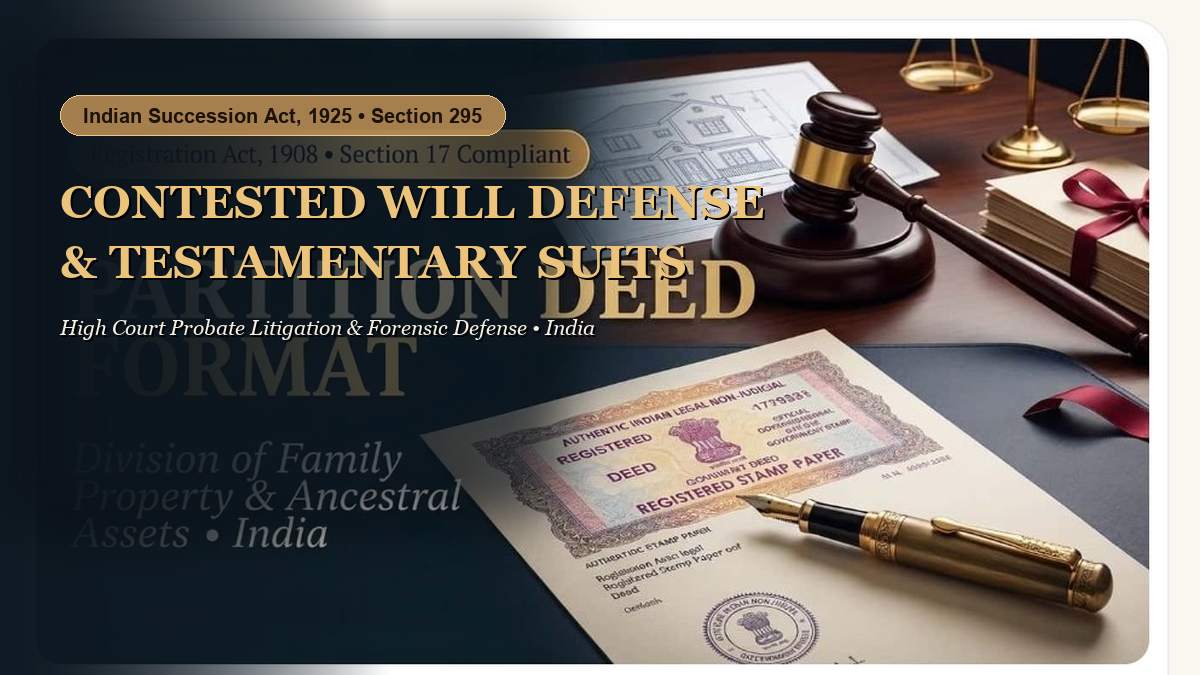
High Court Original Side Jurisdictional & Testamentary Table
Testamentary procedures vary significantly between Bombay, Delhi, Calcutta, and Madras High Courts. Review our jurisdictional matrix to navigate caveat deadlines and court fee caps:
| Judicial Forum | Governing Rules | Pecuniary Jurisdiction | Caveat & Suit Procedure | Court Fee Scale |
|---|---|---|---|---|
| Bombay High Court (Original Side) | Original Side Rules (Chapter XXV, Rules 397 to 403) | Exclusive original jurisdiction over Greater Mumbai estates | Caveat under Rule 397; Affidavit in support within 8 days under Rule 401 | Capped at max ₹75,000 under Maharashtra Court Fees Act Schedule I Article 11 |
| Delhi High Court (Original Side) | Delhi High Court (Original Side) Rules 2018 (Chapter XXV) | Original side suits where estate valuation exceeds ₹2.0 Crore | Caveat lodged in testamentary department; written objections within 14 days | Ad-valorem scale under Court Fees Act as applicable to NCT of Delhi |
| Calcutta High Court (Original Side) | Original Side Rules (Chapter XXV, Testamentary & Intestate) | Ordinary original civil jurisdiction over Kolkata municipal limits | Caveat lodged within 14 days of citation notice; affidavit in support filed | Tiered rate under West Bengal Court Fees Act schedules |
| Madras High Court (Original Side) | Original Side Rules 1956 (Order XXV, Rules 1 to 70) | Presidency town jurisdiction over Chennai metropolitan area | Caveat under Order XXV Rule 51; converting OP to regular contested suit | Schedule scale under Tamil Nadu Court Fees and Suits Valuation Act |
| District Courts (Pan-India) | Indian Succession Act, 1925 (Sections 264 to 295) read with CPC | District Judge holds plenary testamentary authority where High Court has no original side | Caveat lodged before District Delegate or District Judge under Section 284 | Respective State Court Fees Acts (ad-valorem or fixed schedules) |
Forensic Audit: Unmasking Forgery & ICU Deathbed Wills
In multi-crore estate disputes, bad-faith actors frequently fabricate holographic documents or coerce elderly relatives on their deathbeds. Proving or refuting these allegations demands scientific rigor under Bharatiya Sakshya Adhiniyam 2023.
Under Section 73 of BSA 2023 and Order 26 Rule 10A CPC, we move for immediate High Court custody of the original disputed document. Our coordinating forensic examiners evaluate line quality, microscopic hesitation tremors, pen lifts, and chemical ink degradation.
Landmark Precedent Shield: Under H. Venkatachala Iyengar (AIR 1959 SC 443) and Kavita Kanwar (2021 11 SCC 209), the propounder must affirmatively remove all suspicious circumstances to satisfy the court conscience, failing which probate is summarily denied.
5-Stage High Court Testamentary Suit Trial Roadmap
Navigating a contested Will from caveat to final decree requires precision. Here is our structured five-stage litigation roadmap:
Caveat & Injunction
Lodge caveat under Section 284 ISA to block ex-parte probate. Move urgent Order 39 CPC motion to freeze property sales and bank accounts.
Suit Conversion
File comprehensive Affidavit in Support under High Court Rules. Case converts into a regular Testamentary Suit under Section 295 ISA.
Forensic Document Audit
Secure original Will into court registry vault. Apply under Section 73 BSA 2023 for CFSL microscopic handwriting and ink testing.
Witness Cross-Exam
Cross-examine attesting witnesses and propounder under Sections 67 & 68 BSA 2023 to expose simultaneous presence contradictions.
Final Decree & Mutation
Deliver closing arguments on suspicious clouds. Secure decree refusing or granting probate, followed by municipal revenue mutation.
Statutory Framework: Indian Succession Act & BSA 2023
Testamentary disputes are decided on strict statutory mandates rather than general equity. Key provisions governing our High Court defense include:
Section 295 ISA: Regular Civil Suit Conversion
When caveat objections are lodged, probate proceedings cease to be summary. The petition converts into a full civil suit governed by the Code of Civil Procedure, 1908, requiring framed issues and oral evidence.
Sections 61 & 73 BSA 2023: Document Examination
Bharatiya Sakshya Adhiniyam 2023 empowers High Courts to compare disputed signatures with admitted contemporaneous standards. Scientific reports by handwriting experts form critical trial evidence under Section 39 BSA.
Section 247 ISA: Administrator Pendente Lite
Where an executor or co-heir attempts to siphon rental collections, dividend payouts, or commercial revenues pending suit disposal, High Courts appoint an independent administrator to safeguard the corpus.
Sample Legal Grounds: Affidavit in Support of Caveat
Review the statutory grounds formulated in our standard High Court caveat defense affidavit to challenge suspicious or forged Wills:
"GROUNDS OF OBJECTION IN SUPPORT OF CAVEAT:

1. The Caveator has a direct, substantial, and caveatable interest in the estate of the deceased Testator as a Class-I legal heir under the Hindu Succession Act, 1956, entitled to an undivided share upon intestate succession.

2. The alleged paper-writing propounded as the Last Will and Testament dated [Date] is an outcome of deliberate forgery, fabrication, and fraud, and does not bear the genuine signature or mark of the deceased Testator.

3. The deceased Testator was critically infirm, hospitalized in intensive care, and not possessed of a sound and disposing mind, memory, or understanding (non compos mentis) at the time of the purported execution of the said paper-writing.

4. The alleged execution is surrounded by thick clouds of suspicious circumstances: the Petitioner-Propounder took an active, dominant, and exclusive role in the procurement, drafting, and custody of the alleged Will to the complete exclusion of all natural heirs.

5. The alleged attesting witnesses are interested parties under the direct financial control and employment of the Petitioner-Propounder, and the statutory requirements of Section 63 of the Indian Succession Act, 1925 were never complied with.

6. The Caveator therefore prays that the Testamentary Petition be converted into a regular Testamentary Suit under Section 295 of the Indian Succession Act, 1925, and probate be refused with exemplary costs."
Statutory Notice: Drafted in compliance with High Court Original Side Rules (Chapter XXV) and Sections 284 & 295 of the Indian Succession Act, 1925. Establishing specific grounds in the affidavit prevents ex-parte probate and compels full trial discovery.
AMA Legal Solutions vs Generic Trial Advocates
General trial advocates frequently treat probate disputes like ordinary title suits, missing critical testamentary rules and forensic timelines. Here is how our specialized practice defends your rights:
| Litigation Parameter | Generic Trial Lawyers | AMA Legal Solutions Specialists |
|---|---|---|
| Testamentary Subject Specialization | General civil trial advocates handling broad property disputes without deep succession focus | Specialized testamentary litigators handling Section 295 ISA conversions and High Court Original Side trials |
| CFSL & Forensic Handwriting Coordination | Leaves handwriting inspection to late trial stages; no in-house forensic document examiner networks | Immediate microscopic examination, contemporaneous standards audit, and Section 73 BSA court commissioner motions |
| Cross-Examination Blueprint under BSA 2023 | Standard cross-examination without systematic attesting witness simultaneous presence interrogation | Meticulous cross-examination targeting fatal gaps in Section 63 ISA attestation and ICU medical incapacity |
| Emergency Injunctions & Estate Ring-Fencing | Delays in moving interim motions, allowing adverse co-heirs to secretly sell or mortgage land | Same-day caveat filing and urgent Order 39 CPC stay motions with Section 247 Administrator Pendente Lite requests |
| Pan-India High Court Reach & NRI Support | Confined to a single local court; NRIs required to fly to India for routine appearances | Coordinated representation across Bombay, Delhi, Calcutta and Madras High Courts with NRI video-conferencing support |
Frequently Asked Questions: Contested Will Litigation
Review answers to common questions about High Court testamentary suits, caveats, and forensic trial defense:
What happens when a caveat is lodged against a probate petition in High Court?
Under Section 284 and Section 295 of the Indian Succession Act, 1925, lodging a caveat halts ex-parte probate. Once the caveator files an affidavit in support of caveat within the prescribed window, the non-contentious petition converts into a regular Testamentary Suit (TS or TOS). The probate petitioner becomes the Plaintiff, and the caveator becomes the Defendant under the Code of Civil Procedure, 1908.
Can an executor sell or lease estate property while a testamentary suit is pending?
No. An executor has no absolute authority to alienate or transfer estate assets during an active contest. Under Section 269 of the Indian Succession Act and Order 39 Rules 1 and 2 CPC, High Courts routinely grant interim injunctions preserving status quo. In cases of financial mismanagement or waste, courts appoint an Administrator Pendente Lite under Section 247 ISA to collect rents and safeguard assets.
How does CFSL forensic handwriting analysis help prove a forged Will?
Under Section 61 and Section 73 of the Bharatiya Sakshya Adhiniyam 2023 (BSA), disputed signatures are scientifically compared against admitted standards. Forensic examiners at CFSL or certified document laboratories inspect microscopic tremor of fraud, unnatural pen lifts, blunt terminal strokes, line quality, and chemical ink age to determine whether the signature was forged or traced.
What are suspicious circumstances under Supreme Court rulings on contested Wills?
Starting from H. Venkatachala Iyengar v. B.N. Thimmajamma and Kavita Kanwar v. Pamela Mehta, the Supreme Court ruled that a propounder must dispel all suspicious circumstances to satisfy the court conscience. Suspicious factors include unnatural disinheritance of natural heirs, active participation of the sole beneficiary in drafting or execution, shaky signatures without medical fitness, and execution in hospital ICUs.
What is an Administrator Pendente Lite under Section 247 of the Indian Succession Act?
An Administrator Pendente Lite is a court-appointed neutral custodian who manages the estate pending the outcome of a contested testamentary suit. The administrator collects commercial rents, deposits dividend income, pays municipal taxes, and ensures that neither side misappropriates high-value family assets before the High Court delivers its final judgment.
How long does a contested testamentary suit take in Indian High Courts?
Because testamentary suits involve cross-examination of attesting witnesses, forensic testimony, and document trials, they typically take 2 to 4 years in original side High Courts like Bombay, Delhi, Calcutta, and Madras. However, our early application for interim status quo, witness subpoenas, and fast-track discovery significantly reduces delays.
Can an NRI defend or challenge a Will in India without travelling for every hearing?
Yes. Non-Resident Indians (NRIs) residing in the US, UK, Canada, Australia, or UAE can execute a Special Power of Attorney (SPA) appointing our High Court advocates to file caveats and conduct trial proceedings. Under modern High Court rules, witness evidence and advocate arguments can also be facilitated through authorized video conferencing.
How does AMA Legal Solutions charge for High Court contested will litigation?
Unlike traditional trial advocates who charge unpredictable daily appearance fees that quickly escalate, AMA Legal Solutions offers structured litigation retainers. We provide clear milestone fees covering caveat filing, forensic coordination, witness cross-examination, and final arguments with zero hidden surprises.
Access our High Court petition templates, stay formats, and succession guides:
This litigation guide is prepared under the Indian Succession Act, 1925, the Code of Civil Procedure, 1908, the Bharatiya Sakshya Adhiniyam, 2023, and the Original Side Rules of the Bombay, Delhi, Calcutta, and Madras High Courts. It provides general legal information and does not constitute formal attorney-client representation until a Vakalatnama is executed.