Injunction to Stop Co-Heir Selling Ancestral Property
Is your brother, sister, or relative trying to sell joint family land? Order 39 of the Civil Procedure Code gives you a fast court stay. Our High Court lawyers file same-day stay pleas to freeze sales and save your land.
Why Urgent Injunctions Are Essential in Co-Heir Disputes
- Stops Third-Party Possession: Evicting an outside buyer takes years once they get in. A court stay stops any sale or physical handover right away.
- Blocks Sub-Registrar Recording: Giving a certified court order to the local Sub-Registrar freezes land records and stops any sale deed transfer.
- Prevents Waste and Demolition: Co-owners cannot break walls, cut trees, or build new rooms while a court stay is active.
Assess Your Co-Heir Alienation Dispute & Remedy
Select your dispute scenario to examine statutory stay procedures, landmark High Court rulings, and emergency filing checklists:
Restraining Sibling from Selling Undivided Family Land
A brother or sister enters into secret talks with local builders or property buyers without taking consent from other co-heirs.
- Collect land revenue records, Jamabandi, or Khata extracts
- File partition suit along with an Order 39 stay application
- Serve certified court copy to local Sub-Registrar under Section 52 TPA
- Publish legal caution notice in local circulating newspapers
Calculate Injunction Filing Urgency & Motion Type
Choose your current stage to find the fastest civil court procedure:
The co-heir is arranging buyers. An immediate ex-parte status quo application preserves the title. Simultaneously serve an official caveat and intimation letter to the local Sub-Registrar.
Visual Blueprint: Injunction & Property Restraint Protocol
Securing a court stay order freezes title at the Sub-Registrar and prevents unauthorized third-party possession. Here is the operational framework for Order 39 CPC filings:
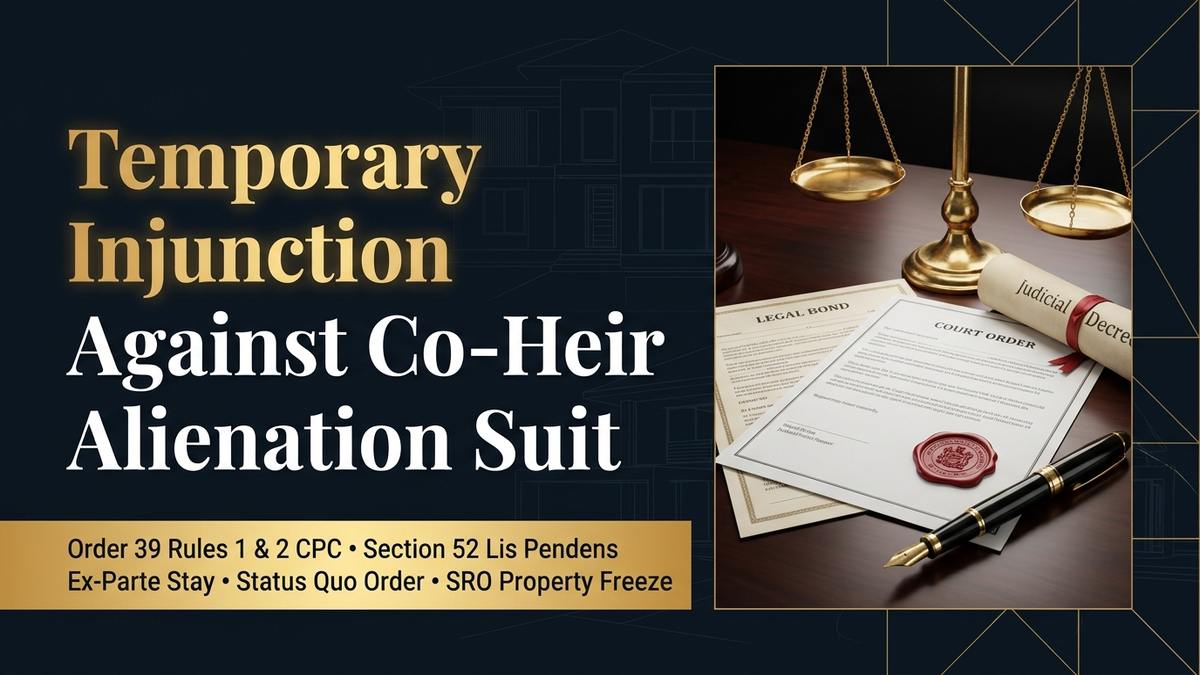
Legal Comparison: Order 39 CPC vs Section 52 Lis Pendens
Different legal tools protect undivided family land at different stages of a dispute. Review this statutory comparison to understand how each remedy shields your estate:
| Remedy & Instrument | Governing Statute | Execution Stage | Legal Effect & Injunction | Recommended Use |
|---|---|---|---|---|
| Ad-Interim Ex-Parte Injunction (Order 39 R 1 & 2) | Code of Civil Procedure, 1908 Order 39 Rules 1-3 | Day 1 of filing partition suit before issuing summons. | Immediately freezes sale negotiations and developer deals. | Co-heir actively negotiating or taking token money. |
| Status Quo Order on Title & Possession | Civil Court Inherent Powers (Section 151 CPC) | Hearing after preliminary notice to opposing parties. | Both sides strictly prohibited from changing site character. | Threat of construction, tree cutting, or demolition. |
| Lis Pendens Registration Notice (Section 52 TPA) | Transfer of Property Act, 1882 Section 52 | Immediately upon filing plaint and obtaining suit number. | Binds third-party buyers to final outcome of the suit. | Blocking buyers from claiming bona fide purchaser status. |
| Perpetual Injunction Decree (Section 38 SRA) | Specific Relief Act, 1963 Section 38 | Final decree passed after full civil trial and evidence. | Permanent legal prohibition against unauthorized alienation. | Conclusive partition of estate and boundary demarking. |
Restraining Brother from Selling Undivided Family Property
In many Indian homes, one brother tries to sell the best part of family land without telling his sisters or brothers. Under the Hindu Succession Act, 1956, all heirs hold equal rights in family land.
No single heir can sell a specific corner without a registered family deed or court partition order. A private deal signed by one brother cannot bind the other heirs.
Supreme Court Protection: Under Section 44 of the Transfer of Property Act and the landmark Supreme Court ruling in Dorab Cawasji Warden, a stranger who buys an undivided share cannot force their way into joint possession of a family house.
4-Step Protocol: Filing Urgent Stay in Civil Court
When a sale threat is immediate, every hour counts. Our High Court and District Court advocates execute a proven 4-step emergency litigation protocol:
Evidence & Records
We collect land records, Jamabandi papers, Khata files, and proof of secret sale talks or site visits.
Same-Day Drafting
Our lawyers draft the suit, stay plea, urgent hearing motion, and sworn affidavit on the same day.
Ex-Parte Mentioning
We appear before the Civil Judge or High Court to argue the stay tests and get an immediate status quo order.
Sub-Registrar Service
We hand-deliver the signed court order to the local Sub-Registrar and revenue Tehsildar to freeze registry books.
Order 39 Legal Checklist: The Three Injunction Pillars
Under the Code of Civil Procedure, 1908 and Supreme Court rulings, judges grant temporary injunctions only when all three mandatory pillars are proven:
1. Prima Facie Case
You must show a clear legal right and family ownership in the property. Land records, family trees, or death papers prove this right easily.
2. Balance of Convenience
The court checks who suffers more harm if the stay is not granted. Keeping the property as it is maintains family peace.
3. Irreparable Injury & Loss
You must show that cash cannot fix the loss if land is sold to strangers. A sale to outside builders causes endless court battles.
Sub-Registrar Restraining Letter & Lis Pendens Notice
Do not wait for court summons to be served. Serve this formal statutory objection letter directly upon the local Sub-Registrar to freeze property conveyance:
"FORMAL STATUTORY OBJECTION & RESTRAINT NOTICE UNDER SECTION 52 TPA, 1882

To:
The Sub-Registrar of Assurances / Joint Sub-Registrar,
Office of the Sub-Registrar, [Jurisdictional Tehsil / Sub-District], [State]

SUBJECT: Formal Intimation of Pending Civil Partition Suit No. [___] of [2026] and Objection Against Registration of Any Sale Deed, Agreement, or Transfer in Respect of Undivided Property [Full Schedule / Khasra No. / Municipal House No.].

Sir / Madam,

1. TAKE NOTICE that the Applicant is an equal co-owner and Class I legal heir holding an undivided share in the immovable property situated at [Complete Property Description and Boundaries].

2. TAKE FURTHER NOTICE that Civil Suit No. [___] of [2026] titled '[Plaintiff Name] vs. [Defendant Co-Heir Name]' for Partition, Separate Possession, and Permanent Injunction has been duly instituted and is actively pending before the Court of Learned Senior Civil Judge at [District/City].

3. Under Section 52 of the Transfer of Property Act, 1882 (Doctrine of Lis Pendens), any alienation, sale, mortgage, or charge created during the active pendency of this suit is legally subordinate to the rights of the parties under any decree or interim order passed by the Court.

4. Furthermore, an urgent application under Order XXXIX Rules 1 and 2 of the Code of Civil Procedure, 1908 has been preferred seeking an ad-interim ex-parte injunction restraining the Defendants from selling, transferring, alienating, or creating third-party interests over the undivided property.

5. You are hereby called upon and requested:
   (a) To enter this statutory notice in Book 1 / Index II encumbrance registers;
   (b) To refuse registration of any Deed of Sale, Gift Deed, Agreement to Sell, or Power of Attorney presented by Defendant [Co-Heir Name] without prior leave of the competent Civil Court;
   (c) To inform any prospective buyer presenting documents that the property is subject to pending partition litigation.

Dated: [Date]
[Name of Advocate]
Advocate for the Co-Heir / Plaintiff
Bar Council Enrollment No. [___]"
Statutory Notice: Drafted under Section 52 of the Transfer of Property Act, 1882 and state registration rules. Serving this notice officially puts the Sub-Registrar on alert and deprives outside buyers of the defense of being an innocent purchaser without notice.
WillDrafting Injunction Retainer vs Traditional Litigators
Traditional lawyers take weeks to draft petitions while co-heirs execute covert sale deeds. AMA Legal Solutions and WillDrafting combine rapid response with fixed pricing:
| Litigation Parameter | Traditional Court Litigators | AMA Legal Solutions & WillDrafting |
|---|---|---|
| Turnaround Time for Emergency Motion | 5 to 14 days due to drafting backlogs and junior briefing | Same-day drafting and emergency filing within 24 hours |
| Sub-Registrar (SRO) Restraint Notice | Rarely served; left to client to figure out local SRO steps | Official legal notice served on SRO with Book 1 diary entry |
| Pricing Structure & Transparency | Uncapped per-hearing appearance fees with hidden extras | Clear flat-fee litigation retainer starting from ₹49,990 |
| Urgent Ex-Parte Mentioning Skill | Routine listing through ordinary registry channels | Special urgent mentioning before Senior Civil Judge / High Court |
| Local Commissioner & Site Audit | Requested only after defendant files written statement | Simultaneous Order 26 Rule 9 motion to freeze ground status |
Frequently Asked Questions: Co-Heir Property Injunctions
Review quick legal answers on stopping property alienation, obtaining civil stay orders, and serving Sub-Registrars:
Can a brother or co-heir legally sell undivided ancestral property without consent?
No. Under Hindu law and Indian property rules, a co-heir can only sell their undivided share, not a specific physical plot. In addition, Section 44 of the Transfer of Property Act prevents an outside buyer from claiming joint possession of a family house. You can seek an immediate Order 39 injunction to stop an unauthorized sale.
How fast can an advocate secure an ex-parte stay order in civil court?
Under Order 39 Rule 3 of the CPC, civil courts can grant an emergency ad-interim ex-parte injunction within 24 to 48 hours without prior notice to the opposing co-heir if delay causes irreparable loss. Our litigation counsels prepare same-day pleadings and mention the matter urgently.
What is the tripartite test courts use to grant an Order 39 temporary injunction?
Courts evaluate three strict statutory requirements: first, a prima facie case showing legal title or co-heirship; second, balance of convenience favoring property preservation; and third, irreparable injury that cannot be compensated in money if third-party rights are created.
How does Section 52 Lis Pendens protect me if my co-heir signs an agreement to sell?
Section 52 of the Transfer of Property Act, 1882 establishes that any transfer during active court proceedings is subject to the final decree. Serving an official intimation letter to the local Sub-Registrar puts the suit on public record and blocks the buyer from claiming protection as a bona fide purchaser.
What should I do if my brother has already accepted token money from a buyer?
Act immediately before a formal sale deed is registered. File a partition suit with an urgent Order 39 injunction motion. Simultaneously submit a written objection letter to the Sub-Registrar and issue a public caution notice in local newspapers stating that the property is undivided and under litigation.
Can an injunction stop a co-heir from demolishing or constructing on joint land?
Yes. Order 39 Rule 1(a) of the CPC empowers the court to issue a status quo order restraining any waste, damage, or alteration of joint property. We also apply for the appointment of a court Local Commissioner under Order 26 Rule 9 to conduct an immediate site inspection and record physical status.
What remedy is available if a sale deed is already registered by a co-heir?
You must file a civil suit for cancellation of the sale deed under Section 31 of the Specific Relief Act, 1963, accompanied by a declaration of co-ownership. You must also seek an interim injunction under Order 39 restraining the outside buyer from taking physical possession or creating further encumbrances.
What is the cost of retaining High Court and District Court advocates for stay motions?
Unlike traditional litigators who charge unpredictable appearance fees, WillDrafting and AMA Legal Solutions provide transparent flat-fee litigation retainers starting from ₹49,990 for emergency stay drafting and court mentions, scaling with court jurisdiction and contested trial stages.
Access our verified legal formats, estate dispute advocates, and calculation tools:
This civil litigation advisory guide is prepared in accordance with the Code of Civil Procedure, 1908, the Transfer of Property Act, 1882, the Specific Relief Act, 1963, and the Registration Act, 1908. It provides legal information on emergency stay remedies and does not constitute formal legal representation until an advocate engagement agreement is executed.