- Lawful Persuasion vs Unlawful Coercion: Indian law allows family members to appeal to love, affection, or past care. Under Section 61 ISA, undue influence occurs only when pressure overbears the testator’s mind, destroying free agency.
- Caregivers & Deathbed Wills: When a bedridden senior bequeaths valuable property to a full-time nurse, driver, or exclusive attendant weeks before death while cutting off children, the Supreme Court presumes suspicious circumstances under H. Venkatachala Iyengar.
- Strict Pleading Rule: Under Order 6 Rule 4 CPC and Afsar Shaikh (1976 SC), general claims of fraud are rejected. Caveators must state exact dates, dominance methods, and medical incapacities.
1. Legal Framework: Undue Influence & Free Will in India
In Indian estate jurisprudence, a Will is not a routine contract. It is the solemn declaration of a person who is no longer alive to confirm their intentions. Consequently, the Indian Succession Act, 1925 establishes two statutory pillars to preserve the sanctity of testamentary succession: Section 59, which mandates that the testator must possess a sound disposing mind, and Section 61, which enacts that any Will procured through fraud, coercion, or importunity taking away free agency is void.
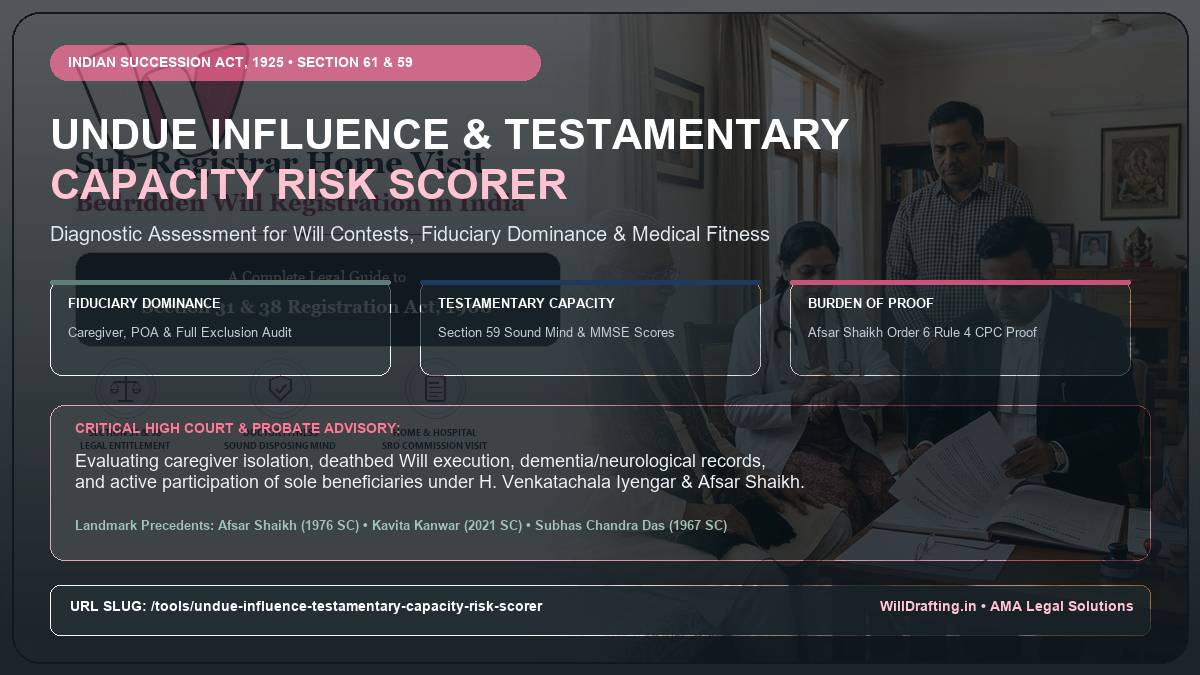
Testamentary capacity requires understanding the nature of the act, the exact extent of property, and the claims of natural heirs under Banks v. Goodfellow. A person who cannot comprehend their assets due to illness, dementia, or intoxication cannot execute a valid Will.
Importunity means persistent entreaty or nagging pressure until the sick or exhausted testator submits merely for peace. If moral or physical coercion deprives the maker of the power to say no, the entire instrument is nullified.
2. Free Undue Influence & Mental Capacity Scorer
Does the primary beneficiary stand in an active position of trust, dependence, or authority over the testator?
Extreme Vulnerability Under Section 61 ISA & Afsar Shaikh SC
Court Impact: The combination of fiduciary dominance, profound physical vulnerability, total exclusion of natural heirs, and active beneficiary participation creates an overwhelming presumption of suspicious circumstances in High Court probate proceedings.
Burden Allocation: Under H. Venkatachala Iyengar (1959 SC), the propounder faces an insurmountable legal burden to dispel these suspicious circumstances before any court conscience can be satisfied.
Recommended Next Step: Caveators have strong grounds to file an urgent Caveat under Section 284 ISA in the High Court and request impounding of medical records and hospital registers.
3. Section 61 vs Section 59: Free Agency & Sound Mind
Will contest litigation frequently blurs the distinction between lack of testamentary capacity (Section 59) and undue influence (Section 61). Although both lead to the nullification of the Will, they operate under distinct evidentiary legal standards in Indian probate courts.
- •The testator is mentally incapable of understanding their assets or legal heirs.
- •Caused by dementia, Alzheimer’s, delirium, intoxication, or severe coma.
- •The initial burden is on the propounder to establish sound disposing mind.
- •Defeated by proving lucid intervals or contemporaneous doctor certifications.
- •The testator may be mentally lucid, but their independent will is overpowered.
- •Caused by fear, psychological isolation, continuous nagging, or dependence.
- •Must be specifically pleaded under Order 6 Rule 4 CPC with date and mode.
- •Defeated by showing independent legal counsel and open family communication.
4. Fiduciary Dominance: Caregivers & Legal Agents
Section 16 of the Indian Contract Act, 1872 defines undue influence when one party is in a position to dominate the will of another and uses that position to obtain an unfair advantage. In the context of Wills, Indian courts scrutinize situations where a person holds real or apparent authority, or stands in an active fiduciary relationship with an elderly testator.
The senior citizen is relocated or kept in a secluded room; phone calls and visits by children are systematically discouraged or monitored.
Chequebooks, net banking credentials, and Power of Attorney instruments are transferred to the caregiver shortly before the Will is executed.
Trusted long-term domestic helpers, drivers, and accountants are abruptly fired to prevent external alarms from reaching family members.
The drafting advocate and attesting witnesses are personal associates of the caregiver, having zero prior acquaintance with the testator.
5. Medical Evidence Matrix & Standardized MMSE Scores
When testamentary capacity is contested, Indian courts do not rely on speculation. Judicial weight depends strictly on the hierarchy of medical documentation, the timing of clinical examinations, and standardized cognitive scoring.
| Medical Record Category | Cognitive Indicators | Evidentiary Weight in Court | Judicial Impact |
|---|---|---|---|
| Formal MMSE Score < 18 / MoCA < 15 | Severe cognitive impairment; inability to register facts | ★★★★★ Conclusive (Decisive) | Strong presumption of incapacity under Section 59 ISA |
| ICU Charts: High Sedative / Morphine Dosing | Severe somnolence, altered mental status, stupor | ★★★★★ Conclusive (Decisive) | Overturns Will signed while under intensive critical care |
| Treating Neurologist Clinical Consultation Note | Documented vascular dementia or Alzheimer’s progression | ★★★★☆ High Weight | Shifts burden to propounder to prove lucid interval |
| Sub-Registrar Endorsement with Video Capture | Visual recording of testator answering questions coherently | ★★★★☆ High Weight | Strong prima facie defense against hostile witnesses |
| Generic GP “Fit to Sign” Slip (No MMSE) | Single-line slip without cognitive or physical tests | ★★☆☆☆ Low Weight | Easily discredited during cross-examination of doctor |
6. Lawful Persuasion vs Unlawful Coercion Comparison
Generic legal websites mistakenly advise that any influence invalidates a Will. The Supreme Court of India in Subhas Chandra Das Mushib (1967) categorically affirmed that persuasion, affection, and family preference are lawful. The crucial boundary lies between fair persuasion and overpowering coercion.
| Litigation Factor | Lawful Persuasion (Valid Will) | Unlawful Coercion (Void Will) |
|---|---|---|
| Mental Agency | Testator retains full power to say no and chooses to give | Testator submits because resistance is exhausted |
| Motivation | Gratitude for care, devotion, affection, family loyalty | Fear of abandonment, starvation, denial of medical care |
| Legal Counsel | Testator consulted independent lawyer in private session | Beneficiary brought their own advocate to hospital bed |
| Family Knowledge | Family aware of testator’s intentions during lifetime | Will concealed until after funeral and sudden mutation |
| Statutory Standing | Upheld under Section 59 ISA | Voided under Section 61 ISA |
7. Active Participation: The Kavita Kanwar Doctrine
In Kavita Kanwar v. Pamela Mehta (2021) 11 SCC 209, the Supreme Court delivered an authoritative ruling on the doctrine of suspicious circumstances. When a beneficiary who takes a substantial share under a Will actively participates in its execution, the court presumes suspicion unless the propounder offers a completely clear explanation.
- 1.Drafting Intermediation: If the sole or major beneficiary engages the advocate, provides the text or instructions, and pays the fees, the Will is viewed with intense suspicion.
- 2.Physical Presence in Execution Chamber: The presence of the favored beneficiary in the room while the testator signs creates a presumption that the testator was not acting freely.
- 3.Exclusion of Other Heirs: Total silence regarding why natural children or a surviving spouse are cut off without provision will not be lightly accepted by probate courts.
8. Step-by-Step SOP: Proving or Defending Will Contests
Whether you are challenging a deathbed caregiver Will or defending a genuine disposition against disgruntled relatives, follow this structured procedural litigation roadmap:
File a formal Caveat in the High Court or District Court where probate is sought. This ensures no ex-parte probate or Letters of Administration can be granted without notice to you.
Serve notices under Section 65B and BSA 2023 on treating hospitals and nursing homes to preserve ICU charts, nurse notes, and CCTV footage before records are purged.
State specific dates of cognitive decline, the nature of caregiver dependence, and the exact instances of importunity to satisfy the Afsar Shaikh pleading threshold.
Cross-examine attesting witnesses on whether they saw the testator sign, whether the beneficiary was in the room, and summon SRO Book 3 records under Order XVI CPC.
Subject disputed signatures or shaky thumb impressions to forensic analysis under Section 72 BSA and present expert neurologist testimony on MMSE thresholds.
9. Practical Court Case Studies: Mumbai, Delhi & Bengaluru
Review how Indian High Courts adjudicate real-world disputes involving undue influence, fiduciary caregivers, and deathbed dispositions:
Facts: An 84-year-old widower bequeathed his South Mumbai flat to his nurse 10 days before demise, excluding his daughter in the UK.
Verdict: Will voided under Section 61 ISA. Propounder failed to prove testator was free from sedation; no independent legal advice was provided.
Facts: Eldest son holding GPA executed Will for father suffering from vascular dementia, taking 85% of commercial assets.
Verdict: Caveat allowed. Active participation by GPA holder attracted Kavita Kanwar doctrine; hospital MMSE score of 14 proved incapacity.
Facts: Mother bequeathed house to younger son who cared for her. Estranged son alleged undue influence and dementia.
Verdict: Will upheld. Mother had independent advocate, video examination by neurologist, and recitals explaining prior family gifts.
10. Caveat Pleading Grounds & Evidence Preservation Guide
Use these verified model legal grounds when lodging a caveat objection or cross-examining a suspicious caregiver Will in Indian courts:
11. Institutional Profile: High Court Testamentary Suits
High Court Representation in Complex Probate & Will Disputes
Will contests involving undue influence, dementia, caregiver dominance, and fraudulent attestation demand elite litigation strategy. AMA Legal Solutions represents clients in the Supreme Court of India and High Courts across New Delhi, Mumbai, Bengaluru, Chennai, Kolkata, and Chandigarh in testamentary suits, caveat challenges, and probate trials.
12. Frequently Asked Questions: Undue Influence & Capacity
13. Statutory Citations & Judicial Evidence Checkpoints
Consult verified central statutes and judicial authorities governing testamentary capacity, coercion, and burden of proof: