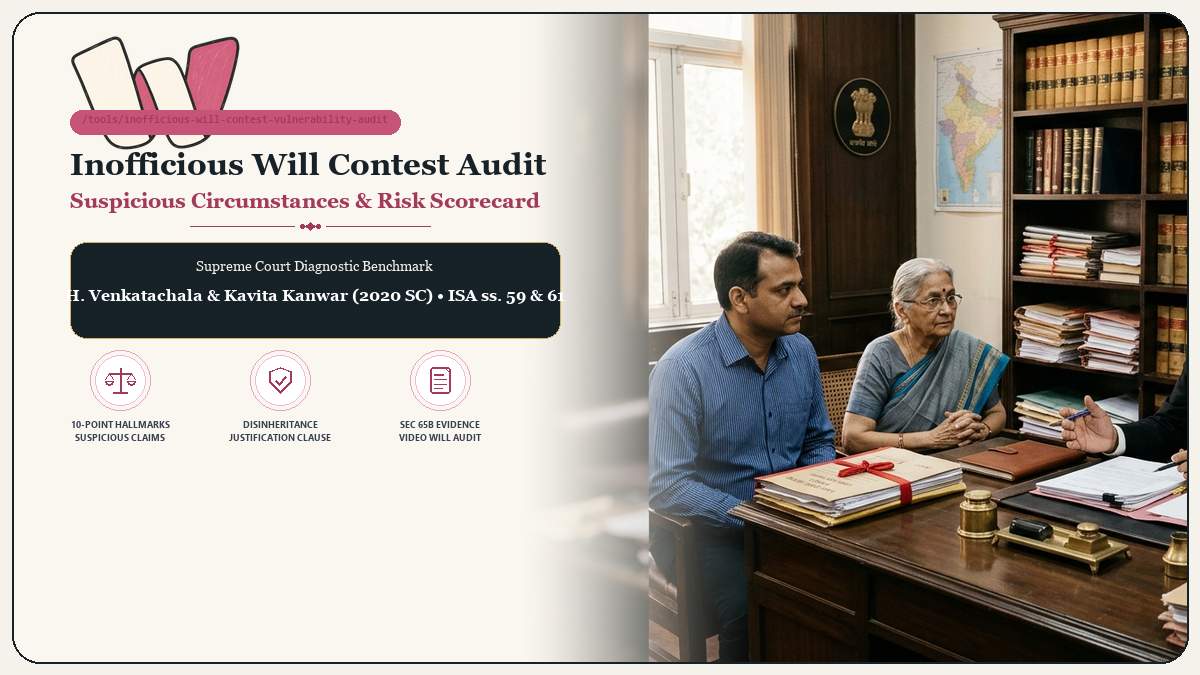
1. Legal Foundation: Inofficious Wills & Suspicious Claims
In classical Roman and Anglo-Indian law, an inofficious will (testamentum inofficiosum) is a will that departs from natural family affections. It leaves natural heirs with nothing without any logical explanation.
Under Section 59 of the Indian Succession Act 1925, an Indian citizen has full freedom to bequeath self-acquired property to anyone. You can favor one child over another or even give your estate to a stranger. The court does not sit as a moral umpire over your decisions.
However, an unnatural distribution triggers immediate suspicion in Indian courts. When natural heirs like a daughter, son, or spouse are disinherited, the Supreme Court places a heavy burden of proof on the propounder. The beneficiary must remove all suspicious circumstances before a court grants probate.
2. 10-Point Suspicious Circumstance Vulnerability Scorecard
Select the parameters that reflect your current will deed or proposed draft to measure contest vulnerability in High Court probate proceedings.
The will has several standard vulnerabilities that should be patched with medical certification and disinheritance recitals.
Age over 70 without contemporary medical certification leaves the will open to senility claims.
3. The 10 Judicial Hallmarks Established by Supreme Court
In H. Venkatachala v. B.N. Thimmajamma (1959), a 3-judge bench of the Supreme Court established the core principles governing will contests. These tests were affirmed in Kavita Kanwar v. Pamela Mehta (2020) and Shivakumar v. Sharanabasappa (2021).
When suspicious circumstances exist, the court will not grant probate on mere formal proof of signatures under Section 68 of the Evidence Act. The propounder must prove the testator understood and freely approved the bequests.
Unnatural Disinheritance
Exclusion of natural heirs (children, spouse) without credible written reasons in the will deed.
Active Beneficiary Role
The primary beneficiary taking a lead role in hiring the lawyer, buying stamp papers, or attending execution.
Shaky or Guided Signatures
Testator's signature departing sharply from normal handwriting or showing evidence of guided hand tremors.
Physical & Mental Impairment
Execution during acute hospitalization, delirium, or severe terminal illness without a doctor certificate.
Interested Attesting Witnesses
Witnesses who are close employees or friends of the beneficiary rather than neutral family acquaintances.
Secrecy & Concealment
The will was kept secret during the testator's life and only surfaced from the beneficiary's hands.
Unexplained Change from Prior Wills
Sudden reversal of an earlier registered will or family settlement without stated change in circumstances.
Deprivation of Vulnerable Heirs
Depriving a destitute spouse, minor child, or disabled relative who depended upon the testator.
Delayed Custody & Surfacing
The will appearing years after death during a partition suit or revenue mutation dispute.
Language & Translation Defects
Will drafted in English for a testator who could not read English, without a translation certificate.
4. Supreme Court Landmark Precedents Analysis
Indian High Courts rely on settled Supreme Court jurisprudence when examining contentious wills. The table below outlines how each ruling impacts probate trials:
| Landmark Case | Core Issue Addressed | Supreme Court Ruling | Drafting Defense |
|---|---|---|---|
| H. Venkatachala v. B.N. Thimmajamma (1959 AIR 443) | Suspicious circumstances and burden of proof | Propounder must remove all suspicious clouds; court will not grant probate on mere signatures. | Independent witnesses and clear factual recitals. |
| Rani Purnima Debi v. Khagendra Narayan (1962 AIR 567) | Effect of registration before Sub-Registrar | Registration does not cure inherent suspicion or prove free agency. | Sub-Registrar visit record plus video evidence. |
| Jaswant Kaur v. Amrit Kaur (1977 1 SCC 369) | Shaky signatures & exclusion of heirs | Unnatural exclusion combined with feeble signature invalidates the will. | Doctor certificate on execution date. |
| Gurdev Kaur v. Kaki (2007 1 SCC 546) | Right of testator to be unfair or capricious | Testator has absolute right to exclude natural heirs if free will is proved. | Documentary proof of lifetime advancements. |
| Kavita Kanwar v. Pamela Mehta (2020 SC) | Active role of major beneficiary | Beneficiary drafting or managing execution invalidates will if unexplained. | Total beneficiary exclusion during drafting. |
| Shivakumar v. Sharanabasappa (2021 11 SCC 277) | Credibility of interested attesting witnesses | Interested witnesses fail to remove judicial suspicion. | Professional independent attesting witnesses. |
5. Inofficious Bequests & Natural Affections in High Courts
Why do Indian courts view an unequal will with caution? The law assumes that an ordinary parent acts with natural affection toward all offspring. When one child receives three residential properties and another child receives nothing, the court asks: Why?
If the will is silent, the disinherited child will file a caveat under Section 284 ISA. They will allege undue influence, fraud, or mental infirmity under Section 61 ISA. The case then transforms into a regular contentious civil suit under Section 295 ISA.
To protect your will, you must articulate the precise factual reasons for excluding any natural heir. General phrases like “due to personal reasons” are routinely dismissed by High Courts as vague.
6. Disinheritance Justification Clause Builder
Generate court-tested testamentary recitals to protect unequal or exclusive bequests against High Court caveats.
7. Video Evidence Protocol Under Section 63 BSA & 65B
The most definitive shield against inofficious will challenges is a contemporaneous audio-video recording of the will execution. Under Section 63 of the Bharatiya Sakshya Adhiniyam 2023 (formerly Section 65B of the Indian Evidence Act), electronic records are fully admissible when accompanied by a statutory certificate.
A video recording visually disproves all 10 judicial hallmarks. It proves the testator was lucid, steady, physically independent, and acting out of their own free will.
8. Pre-Emptive Probate Fortification Protocol
To ensure that an inofficious will survives scrutiny in Indian High Courts, follow this 5-step fortification protocol before execution:
Step 1: Total Beneficiary Quarantine
The favored beneficiary must never contact the drafting lawyer or attend the signing session. Keep written proof that the testator met the lawyer alone.
Step 2: Documentary Audit of Advancements
Collect bank statements, gift deeds, and property sale papers showing earlier financial provisions made to the disinherited heir. Attach them as exhibits.
Step 3: Registration with Sub-Registrar
While registration does not automatically cure suspicion, it creates a statutory entry in Book 3 under Section 51 of the Registration Act, proving execution date.
Step 4: Deposit in Sealed Envelope
Deposit the will under Section 42 of the Registration Act with the Registrar in a sealed cover, or deposit it in bank escrow to disprove delayed tampering.
Step 5: Pre-Emptive Caveat Readiness
Have the executor retain a High Court testamentary advocate immediately upon the testator's death to file for probate before the disinherited heir files a partition suit.
9. Real-World Case Studies: Mumbai, Delhi & Karnataka
South Mumbai Flat Exclusively Left to Younger Daughter
Father left ₹18 Crore flat in Malabar Hill to daughter who nursed him through cancer, disinheriting affluent NRI son in USA.
Vasant Vihar Property Left to Second Wife, Excluding Children
Testator excluded children from first marriage. Will was executed 12 days before demise in hospital without independent witnesses.
Bengaluru Tech Entrepreneur Leaving Shares to Foundation
Founder left 80% equity to charitable trust, leaving 20% to spouse and children. Video will executed with two doctor witnesses.
10. Legal Comparison: Natural vs Inofficious Burden of Proof
| Audit Dimension | Natural Equal Distribution | Inofficious Disinheritance Will |
|---|---|---|
| Judicial Presumption | Presumed natural; minimal inquiry if formally proved. | Presumed suspicious; requires comprehensive independent proof. |
| Evidentiary Standard | Section 68 Indian Evidence Act (1 witness testimony). | Rigorous removal of all 10 suspicious hallmarks (Venkatachala test). |
| Medical Proof Required | Optional unless testator was critically ill. | Strictly essential; doctor certificate on day of execution. |
| Caveat Lodging Risk | Very low (< 5% contested). | Very high (> 75% contested by disinherited heirs). |
| Recommended Safeguard | Standard registration before Sub-Registrar. | Disinheritance recitals + Video Will under Section 63 BSA. |
11. Institutional Profile: High Court Contested Will Defense
AMA Legal Solutions is India's leading estate planning and contested probate litigation firm. Our testamentary litigation practice represents executors, administrators, and beneficiaries facing probate caveats and testamentary suits across the Supreme Court of India and High Courts of Bombay, Delhi, Calcutta, and Madras.
When drafting unequal or complex succession plans, our advocates deploy forensic fortification techniques: independent medical evaluations, high-definition video recordings under Section 63 BSA, and unassailable disinheritance justification recitals.
12. Frequently Asked Questions: Contested Wills & Audit
13. Statutory Citations & Official Judicial Portals
Review verified statutory provisions and Supreme Court orders directly on official Indian government portals:
Draft a Fortified Will That Survives High Court Scrutiny
Whether you are distributing assets equally or executing an exclusive bequest, our automated legal engine generates court-tested disinheritance clauses, medical compliance recitals, and video will protocols.