- 60-Year Payouts: Under Section 22 of the Copyright Act, book and music royalties stay active for 60 years after death.
- No Account Freeze: Top book firms like Penguin, HarperCollins, and Amazon KDP pause payouts unless a clear Will names your heir.
- Brands & Patents: Brand marks need Form TM-M under Section 45. Patent deals follow Section 68 of the Patents Act.
- Moral Rights Kept: Section 57 lets your heirs protect your name and stop bad edits to your work.
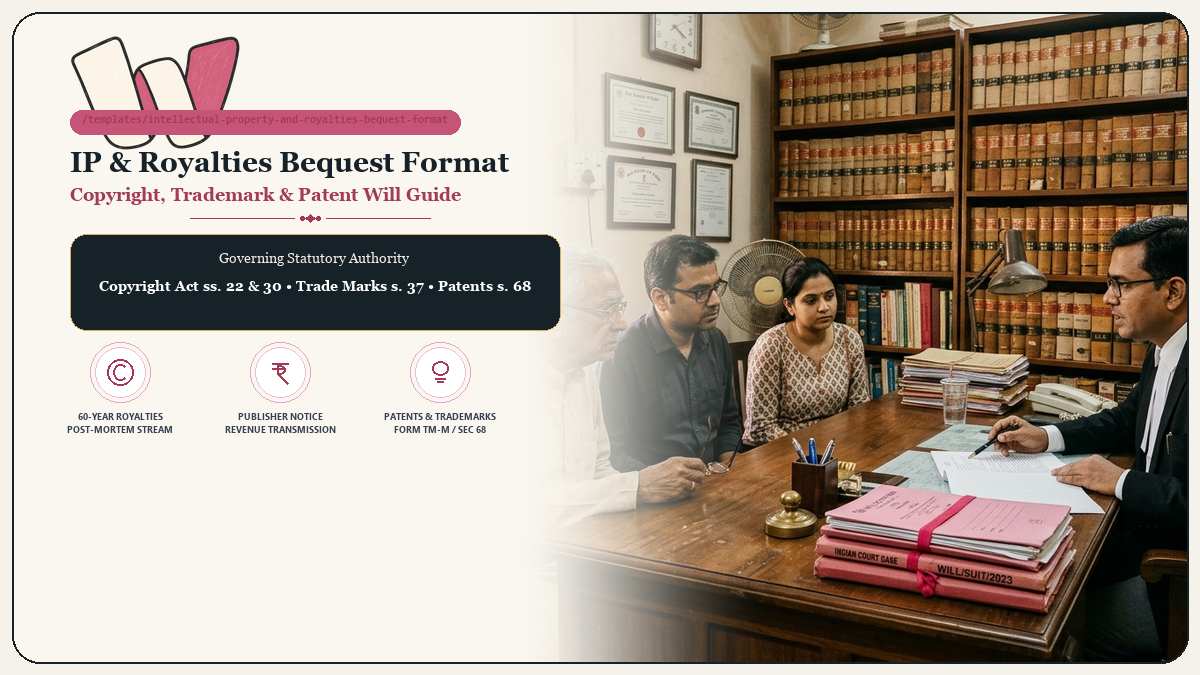
1. Intellectual Property Succession in India: Legal Scope
Most standard Indian Will drafts list only flats, plots, and bank cash. They leave out creative rights. This gap hurts writers, songwriters, coders, and patent owners.
In India, creative work is legal wealth. It pays steady cash long after the creator dies. If you write books, hold a patent, or own a brand mark, you must add a clear clause in your Will.
Copyright lasts for 60 years in any book, play, song, or art work. The 60 years start from the first day of the new year after the author dies.
Without a clear clause, your royalties fall into the rest of the estate. If kin fight in court, book firms stop sending cheques. The cash stays locked until a judge passes an order.
2. Free IP & Royalty Succession Diagnostic Tool
Pick your asset type and payout source below. See how long the right lasts and what forms your family needs.
Use a clear clause giving print, ebook, and audio rights to your spouse or child.
3. Copyright Act Section 22: The 60-Year Post-Mortem Rule
How long do book royalties last after death? Section 22 of the Copyright Act, 1957 gives a clear rule. Rights stay active for 60 full years after the year the author dies.
Suppose a writer dies on July 15, 2026. The 60-year clock starts on January 1, 2027. Rights stay safe until December 31, 2086. For six decades, all print fees, foreign rights, and film deals belong to the heir named in the Will.
Covers novels, guides, poems, plays, and scripts. Protection lasts for life plus 60 years.
Covers audio tracks and films for 60 years from the year after release.
If an author leaves no Will, rights split equally among Class I heirs. When heirs disagree, firms cannot pick whom to pay. Money sits idle in escrow.
4. Master IP & Royalties Will Clause Format
Copy and paste this full clause into your Indian Will. It covers books, brand marks, patents, and all future payouts.
BEQUEST OF INTELLECTUAL PROPERTY, COPYRIGHTS, AND FUTURE ROYALTIES

1. IDENTIFICATION OF INTELLECTUAL PROPERTY ASSETS:
I declare that I am the sole author, originator, and legal owner of the following intellectual property assets:
(a) All copyrights, title, and ownership rights in my published and unpublished literary works, manuscripts, books, articles, screenplay drafts, and translations, including [Title of Book 1, ISBN: _____] and [Title of Book 2, ISBN: _____];
(b) All registered trademarks, brand names, and logos registered in my name under the Trade Marks Act, 1999, specifically Trademark No. [_______] in Class [___];
(c) All granted patents, patent applications, and proprietary technologies filed with the Indian Patent Office, specifically Patent No. [_______];
(d) All proprietary software codebases, SaaS applications, digital media libraries, and developer accounts;
(e) All publishing contracts, licensing agreements, movie adaptation option deals, translation rights, and digital distribution agreements executed by me during my lifetime.

2. SPECIFIC BEQUEST OF INTELLECTUAL PROPERTY & ROYALTIES:
I hereby specifically give, devise, and bequeath all my right, title, interest, and ownership in the aforesaid intellectual property assets, together with:
(a) All past accrued, current, and future royalty payments, advances, public lending rights, licensing fees, syndication revenues, and streaming payouts arising therefrom; and
(b) All right to grant future licenses, negotiate republications, authorize translations, or assign commercial rights under Section 18 and Section 30 of the Copyright Act, 1957;
ABSOLUTELY AND FOREVER unto my [Spouse / Son / Daughter / Named Beneficiary], [Full Legal Name of Beneficiary], son/daughter/spouse of [Name], residing at [Complete Residential Address], for their sole and exclusive use and benefit.

3. DIRECTIONS TO EXECUTOR AND PUBLISHERS:
I hereby direct my Executor named herein:
(a) To immediately notify all publishing houses, literary agencies, digital distributors, and collection societies (including IPRS, PPL, and IRRO) of my demise and this testamentary bequest;
(b) To execute all necessary forms, transmission applications (including Form TM-M under the Trade Marks Act, 1999, and transmission forms under the Patents Act, 1970), and formal deeds of assent to effectuate the complete transfer of my intellectual property and royalty streams to [Full Legal Name of Beneficiary];
(c) To instruct all publishers and distributors to remit all future royalty payouts directly to the dedicated bank account of [Full Legal Name of Beneficiary].

4. MORAL RIGHTS & INTEGRITY OF WORK:
Pursuant to Section 57 of the Copyright Act, 1957, I authorize my said beneficiary and my Executor to assert and defend my moral rights as author, including my right of paternity and integrity, and to restrain any distortion, mutilation, or derogatory alteration of my published works.
5. Publisher & Music Label Royalty Direction Notice Format
Send this notice to book firms, music labels, or Amazon KDP after the author dies. It tells them to send all payouts straight to the heir's bank account.
FORMAL NOTICE OF DIRECTION FOR TRANSMISSION OF PUBLISHING ROYALTIES

TO:
The Royalties & Contracts Department,
[Name of Publishing House / Music Label / Digital Distributor],
[Address of Publisher / Distributor],
Email: [contracts@publisher.com]

DATE: [Day, Month, Year]

SUBJECT: Notice of Testamentary Bequest and Direction for Transmission of Royalties in respect of Author Late [Full Name of Author]

RE: Publishing Agreement(s) Dated: [Agreement Date]
Work(s) Covered: [Title of Book / Album / Software], ISBN / Catalog No: [_______]

Dear Sir / Madam,

1. We write to formally inform you of the sad demise of the distinguished author, Late [Full Name of Author], who departed this life on [Date of Death]. A certified copy of the Death Certificate is enclosed herewith for your records.

2. During their lifetime, Late [Full Name of Author] executed their Last Will and Testament dated [Date of Will]. Under Clause [___] of the said Will, the deceased specifically bequeathed all copyrights, publishing agreements, and all accrued and future royalty payments arising from the aforementioned work(s) absolutely unto:
   Beneficiary Name: [Full Name of Beneficiary]
   Relationship to Deceased: [Spouse / Son / Daughter]
   Residential Address: [Complete Address of Beneficiary]
   PAN: [Permanent Account Number]
   Bank Account Details: [Bank Name, Account No, IFSC Code]

3. Pursuant to Section 22 and Section 30 of the Copyright Act, 1957, copyright ownership subsists for 60 years post-mortem. You are hereby formally called upon and directed to:
   (a) Update your contract records and author ledger to record the transmission of rights in favor of [Full Name of Beneficiary];
   (b) Remit all future royalty statements, tax deduction certificates (Form 16A), and royalty payments directly to the aforesaid bank account;
   (c) Cease remitting any funds to the deceased's prior bank account.

4. Enclosed herewith please find:
   (i) Certified Copy of Death Certificate;
   (ii) Notarized Copy of the Last Will and Testament;
   (iii) Executor's Letter of Assent / Succession Certificate;
   (iv) PAN Card and Address Proof of the Beneficiary;
   (v) Cancelled Cheque for bank transfer verification.

Yours faithfully,

___________________________                       ___________________________
[Signature of Executor]                            [Signature of Beneficiary]
[Name of Executor]                                 [Name of Beneficiary]
Executor to the Estate of Late [Author Name]       Legatee & Legal Successor
6. Trademark & Patent Transmission: Section 45 & Form TM-M
Passing a copyright does not shift brand marks or patents. You must update records at the Indian IP Office.
When a brand owner dies, the heir must write to the Registrar under Section 45. File Form TM-M with the Will, Death Paper, and proof of claim.
Under Section 68 of the Patents Act, a transfer must be in writing and filed. The heir files Form 16 or Form 20 with the Patent Office to update the record.
If you skip the registry step, you cannot sue copycats. A judge will not hear a case from an unlisted owner.
7. Software Code, Digital Content & Creator Royalties
Today, creators earn via YouTube, apps, SaaS tools, and online courses. Under Section 2(o) of the Copyright Act, computer code counts as a literary work.
If you build apps or make videos, list these items in your Will:
- Code Repos: GitHub and GitLab accounts, private code, and tech docs.
- App Accounts: Google Play Console, Apple Developer IDs, and payout links.
- Media Income: YouTube AdSense, Spotify for Artists, and fan pages.
- Cloud Servers: AWS, Azure, and cloud hosts that run your apps.
Pick a tech-savvy executor in your Will. Give them clear power under the IT Act to manage logins and pass income to your family.
8. Moral Rights vs Economic Rights Under Section 57
Indian law splits rights into two parts: money rights and moral rights. Know both before you draft your Will.
The right to print, sell, license, and collect fees. You can gift or will these rights to anyone.
The right to claim credit as author and stop bad edits. You cannot sell these rights. Your heirs hold them to guard your name.
Even if a trust collects the cash, your heirs can sue under Section 57(2) if someone alters your work in a harmful way.
9. Step-by-Step SOP: Transferring IP Rights After Death
- Find the Will and Contracts: Get the signed Will, book deals, brand files, and patent papers.
- Get Death Papers: Obtain five to ten certified copies of the Death Certificate.
- Send the Payout Notice: Your executor signs the notice and adds the Will, KYC, and bank cheque.
- File Form TM-M for Brands: For registered brand marks, file Form TM-M at the Trademark Office.
- File Form 16 or 20 for Patents: Send the patent transfer form to update the Patent Register.
- Update Music Bodies (IPRS / PPL): Send member transfer forms to shift monthly music payout streams.
- Get Court Probate if Asked: If a firm doubts the Will, apply for probate or a Succession Paper in court.
10. Five Costly Mistakes in IP Estate Planning
11. Institutional Profile: Legal Excellence
WillDrafting, backed by AMA Legal Solutions, helps Indian authors, coders, and founders protect their creative wealth.
Our lawyers make sure your work pays your family for decades, with zero publisher delays or family fights.
12. Frequently Asked Questions: IP & Royalties Will
13. Statutory Authority & Official Government Portals
- Copyright Act, 1957 Section 22: 60-year post-mortem term for published works.
- Copyright Act, 1957 Section 30: Grant of licenses and future fee streams.
- Trade Marks Act, 1999 Section 37 & 45: Brand transfers and Form TM-M filing.
- Patents Act, 1970 Section 68 & 69: Written transfer and Patent Roll update.
- Indian Succession Act, 1925 Section 63: Rules for signing and witnessing a Will.
Why Write an IP Will Now?
Your books, songs, and brand create wealth for 60 years after death. A clear Will stops book firms from freezing cash. It keeps your spouse and kids safe.
Simple Plain Paper Rules
You can write your Will on plain paper. No stamp paper is needed in India. Sign it in front of two adult witnesses to make your IP bequest valid.
How Our Team Helps
Our team drafts clear IP clauses covering book deals, brands, and patents. We make sure your family gets every rupee of royalties fast.