Legal Heir Certificate vs Succession Certificate Explained
Compare an administrative Legal Heir Certificate from the Tehsildar with a judicial Succession Certificate from the Civil Court. Learn asset rules, court fees, timelines, and how a valid Will bypasses both.
Key Takeaways: Choosing Between Both Certificates
- Different Issuers: A Legal Heir Certificate comes from the local Tehsildar. A Succession Certificate comes from a Civil District Judge.
- No Real Estate for Succession Certificate: Under Section 370 of the Indian Succession Act, courts cannot grant a Succession Certificate for land, houses, or flats.
- Bank Claim Limits: Small bank deposits can often be settled using a Legal Heir Certificate. Large balances require a Succession Certificate.
- Cost and Time Gap: A Legal Heir Certificate takes 15 to 30 days and costs under ₹100. A Succession Certificate takes 6 to 12 months in court and incurs court fees up to 7.5%.
- Best Protection: Writing a valid Will avoids both certificates. The named executor transfers assets directly under Section 211.
1. Statutory Framework: Indian Succession Act & State Rules
When a person dies without a Will in India, their estate follows intestate succession rules. Family members face strict demands from banks, mutual funds, and revenue offices. Each agency asks for legal proof before releasing money or transferring property records.
The main difference begins with legal origin. A Succession Certificate is created by a central law. It is governed by Part X of the Indian Succession Act, 1925 (Sections 370 to 390). Only a Civil District Judge can issue it after a formal court hearing.
In contrast, a Legal Heir Certificate has no central parliamentary act. It is an administrative document issued under state land revenue codes. Local officers like the Tehsildar, Talukdar, or SDM issue it after local Patwari field verification.
2. Head-to-Head Comparison: Core Differences at a Glance
Review this direct legal comparison before applying. Understanding these parameters helps you avoid wasted fees and needless delays.
| Parameter | Legal Heir Certificate | Succession Certificate | Practical Advantage |
|---|---|---|---|
| Issuing Authority | Tehsildar, Talukdar, Mandal Revenue Officer (MRO), or Sub-Divisional Magistrate (SDM) | Civil District Judge or Senior Civil Judge having territorial & pecuniary jurisdiction | Legal Heir (Faster Administrative) |
| Governing Statute | State Land Revenue Codes, citizen charters, and state revenue department orders | Part X of the Indian Succession Act, 1925 (Central Act No. 39 of 1925) | Succession Cert (Parliamentary Statute) |
| Core Legal Purpose | Identifies surviving family kinship for pensions, compassionate jobs, and municipal mutation | Conclusively establishes title to recover debts and transfer negotiable securities | Succession Cert (Confers Legal Title) |
| Asset Applicability | Immovable land mutation, employee benefits, insurance dues, small bank balances | Movable assets strictly: Bank FDs, demat shares, mutual funds, government bonds | Depends on asset category |
| Immovable Property Scope | Accepted for municipal and land revenue records mutation (with registered deeds) | Barred under Section 370; cannot be granted for land, flats, or real estate | Legal Heir Certificate Only |
| Statutory Indemnity for Banks | No statutory indemnity; banks accept at discretion with indemnity bond and sureties | Absolute statutory protection under Section 381; debtors are fully discharged | Succession Cert (Complete Protection) |
| Application & Court Fees | Nominal administrative fee: ₹20 to ₹100 depending on state e-District portal | Ad valorem court fees under Court Fees Act: typically 2% to 7.5% of total asset value | Legal Heir (Significantly Cheaper) |
| Processing Timeline | 15 to 30 days after revenue inspector or Patwari field verification | 6 to 12 months due to civil petition, newspaper notices, hearings, and bond execution | Legal Heir (Much Faster) |
| Public Notice Requirement | None required in most states; local village or ward verification is conducted | Mandatory public citation in national and local newspapers with 30-45 day objection window | Legal Heir (Private) |
| Appellate & Revocation Forum | Revenue Sub-Divisional Magistrate, District Collector, or Civil Title Suit | High Court appeal under Section 384; court revocation under Section 383 | Succession Cert (High Court Jurisdiction) |
3. Which Certificate Do You Need: Asset-by-Asset Guide
The document you need depends on the type of asset. Follow this guide to see whether you should visit the Tehsildar or approach the District Court.
Immovable Property (Flats, Houses, Land)
Section 370 bars civil courts from granting a succession certificate for real estate. Revenue offices accept a Legal Heir Certificate. Heirs also sign a registered Release Deed or Family Settlement Deed to complete municipal mutation.
Bank Savings Accounts & Fixed Deposits
A registered nominee receives bank funds quickly upon submitting a death certificate. If no nominee exists, banks allow small claims using a Legal Heir Certificate and indemnity bond. High balances require a court certificate.
Demat Shares, Stocks & Mutual Funds
SEBI rules allow share transmission on a Legal Heir Certificate up to ₹5 Lakhs per company. For larger stock portfolios or contested shares, depositories require a Succession Certificate.
Government Pension, Gratuity & GPF
Government departments and treasuries accept a Legal Heir Certificate. They use it to sanction family pensions, release employee gratuity, and process compassionate jobs.
Life Insurance & Postal Life Insurance
Under Section 39 of the Insurance Act, 1938, registered nominees receive the insurance payout directly. If no nominee is on record, insurers pay the claim using a Legal Heir Certificate.
Motor Vehicles (Cars, Commercial Fleets)
The regional transport office (RTO) transfers car ownership under Rule 56 of the Central Motor Vehicles Rules. The applicant submits a Legal Heir Certificate and NOC from other family members.
4. Succession Certificate in Court: Part X Jurisdiction
Part X of the Indian Succession Act, 1925 governs the judicial recovery of debts and securities. Understanding these core sections protects your rights during court proceedings:
This section bars courts from granting succession certificates for real estate. Land and apartments require partition deeds, Letters of Administration, or probate.
The petition must be filed where the deceased lived. The applicant must list all debts, bank accounts, folio numbers, and surviving relatives under oath.
This key rule protects debtors. Any bank or company that pays money to the certificate holder is completely freed from all future legal liability.
A judge can cancel a certificate obtained by fraud or false statements. Any appeal against the District Judge decision goes directly to the High Court.
5. Legal Heir Certificate: Tehsildar & SDM Procedure
Getting a Legal Heir Certificate is an administrative process. Family members apply online through the state revenue portal or visit the local Tehsil office.
Next, the file goes to the local Patwari or Village Administrative Officer. The officer visits your neighborhood to verify surviving family members against death and birth records.
After the field officer submits their report, the Tehsildar or SDM approves the certificate. The entire procedure usually takes between 15 and 30 business days.
Recognized Class I Legal Heirs Under Hindu Succession Act:
6. Visual Blueprint: Decision Flowchart & Framework
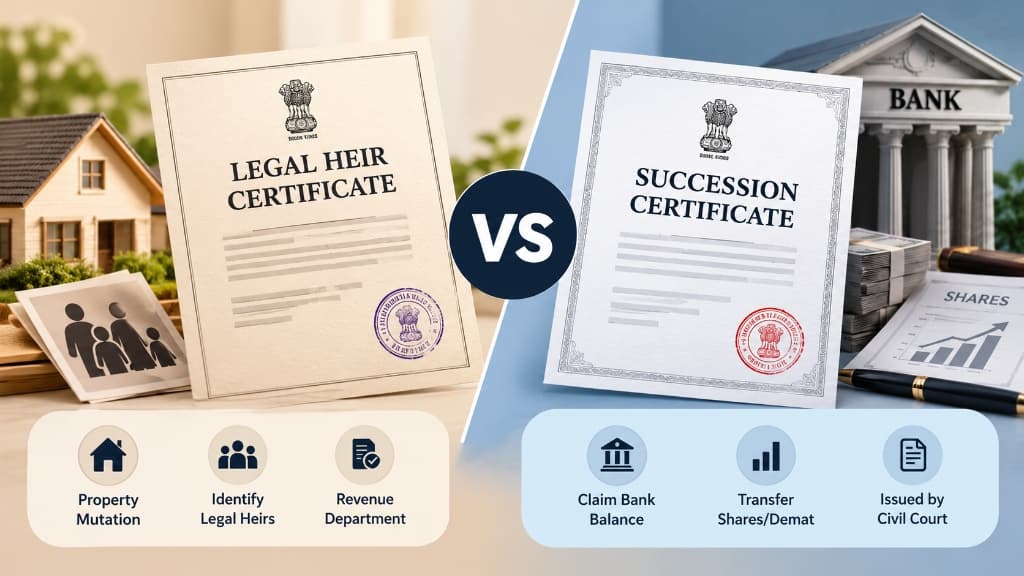
The visual comparison below illustrates the core distinction between a Legal Heir Certificate and a Succession Certificate. Notice how property mutation and family kinship follow the revenue track, while bank accounts, shares, and court decrees follow the judicial track.
7. Documents Required: Comprehensive Preparation SOP
Missing paperwork causes delay in both revenue offices and courts. Select a tab below to check the exact document list for each procedure.
Required Paperwork for Revenue Tehsildar Application:
- Original Death Certificate: Issued by the Municipal Corporation or Registrar of Births & Deaths.
- Identity & Address Proofs: Aadhaar Cards, PAN cards, or Passports of all surviving legal heirs.
- Family Tree Affidavit: Notarized self-declaration on ₹10 or ₹100 stamp paper naming all legitimate heirs.
- Deceased Residence Proof: Electricity bill, voter ID, or registered sale deed confirming permanent address.
- NOC from Co-Heirs: Signed declarations from surviving siblings or co-heirs if one member applies on behalf of all.
- Service / Pension Book: Official service letter if applying for government employee dues or compassionate appointment.
8. State Portal Directory: Where to Apply Across India
Most states offer online applications for Legal Heir certificates. The directory below lists the designated portals, fees, and processing times for major states:
| State / UT | Designated Portal | Certificate Name | Issuing Authority | Fee & SLA | Action |
|---|---|---|---|---|---|
| Delhi NCT | e-District Delhi | Surviving Member Certificate | Sub-Divisional Magistrate (SDM) | ₹20 + nominal portal fee • 14 to 21 Days | Apply Portal |
| Maharashtra | Aaple Sarkar | Varisa Pramanpatra (Legal Heir) | Tehsildar / Taluka Executive Magistrate | ₹50 (MahaOnline fee) • 15 to 30 Days | Apply Portal |
| Tamil Nadu | e-Sevai (TNeGA) | Legal Heirship Certificate | Taluk Tahsildar (Revenue Department) | ₹60 (e-Sevai service charges) • 15 Days | Apply Portal |
| Karnataka | Seva Sindhu / Nadakacheri | Surviving Family Member Certificate | Tahsildar / Atalji Janasnehi Kendra | ₹40 (service charge) • 14 to 21 Days | Apply Portal |
| Uttar Pradesh | eSathi UP | Varisan Praman Patra | Tehsildar / Revenue Inspector | ₹30 to ₹50 • 15 to 30 Days | Apply Portal |
| West Bengal | e-District West Bengal | Legal Heir Certificate | Block Development Officer (BDO) / SDO | ₹20 nominal • 21 to 30 Days | Apply Portal |
| Telangana | MeeSeva Telangana | Family Member Certificate | Tahsildar (Revenue Mandal) | ₹45 (MeeSeva charges) • 15 Days | Apply Portal |
| Andhra Pradesh | MeeSeva AP | Family Member Certificate | Tahsildar (Mandal Revenue) | ₹45 (MeeSeva charges) • 15 Days | Apply Portal |
| Gujarat | Digital Gujarat | Pedhinama / Varai Certificate | Talati / Mamlatdar Office | ₹50 (digital portal fee) • 15 to 25 Days | Apply Portal |
| Rajasthan | e-Mitra Rajasthan | Warisan Praman Patra | Tehsildar / Sub-Divisional Officer | ₹50 (kiosk service fee) • 21 to 30 Days | Apply Portal |
| Kerala | e-District Kerala | Relationship / Legal Heirship | Tahsildar (Taluk Office) | ₹40 to ₹60 • 15 to 30 Days | Apply Portal |
9. Next Steps: Claiming Assets After Certificate Issuance
Getting the certificate is only the first step. To transfer title or access funds, heirs submit certified copies to each asset institution:
1. Immovable Property Mutation
Submit your Legal Heir Certificate and a registered relinquishment deed to the local municipality. This updates property tax records. Read our guide on property transfer after death without a Will.
2. Bank Accounts & Fixed Deposits
Present certified copies of your certificate and indemnity bond to the bank branch. For dormant accounts, check our guide on claiming unclaimed bank deposits on UDGAM.
3. Demat Shares & Mutual Funds
Submit Form ISR-5 and certified court certificates to depository participants. Read our complete guide on SEBI demat transmission rules after death.
10. Cost & Timeline Comparison: Court Fees vs SRO Delays
A Succession Certificate costs more because of ad valorem court fees. Instead of a flat charge, state laws calculate fees as a percentage of total assets:
11. How a Valid Will Avoids Both Certificates Entirely
The struggle of visiting revenue offices, newspaper notices, and court hearings happens only when someone dies without a Will.
When you make a valid Last Will and Testament, your wishes govern your estate. Here is how a Will protects your family:
Months of Bureaucracy
- • Heirs must apply to Tehsildar or file court petitions
- • Pay 2% to 7.5% in ad valorem court fees
- • Wait 6 to 12 months for newspaper citation windows
- • High risk of bitter family disputes over asset shares
- • Locked bank accounts and demat portfolios during court delay
Direct, Immediate Vesting
- • Named executor holds legal authority under Section 211
- • Zero succession court fees on debts and securities
- • Immediate transmission to designated beneficiaries
- • Clear distribution eliminates sibling and family friction
- • Print-ready, advocate-verified Will in 15 minutes
Protect Your Family from Court Battles and Heavy Fees
Draft an advocate-verified, legally binding Will customized for Indian law. Free from stamp duty, completely private, and valid across all Indian states.
12. Professional Succession Legal Services by AMA
If your family is handling an intestate demise, dealing with revenue departments and civil courts can be hard. AMA Legal Solutions offers full legal support:
Succession Petition
Drafting, filing, newspaper citations, and court appearances before the District Judge.
Learn More →Probate of Will
Mandatory probate petitions in Mumbai, Chennai, Kolkata, and High Court jurisdictions.
Learn More →Succession Calculator
Calculate exact legal shares under Hindu, Muslim, and Christian personal laws.
Use Tool →13. Frequently Asked Questions: Succession & Heirship
14. Statutory Citations & Official Government Portals
Primary Legislation:
- Indian Succession Act, 1925 (Act No. 39 of 1925), Part X, Sections 370–390.
- Court Fees Act, 1870 (Act No. 7 of 1870), Schedule I, Article 12 (Ad Valorem Succession Fees).
- Hindu Succession Act, 1956 (Act No. 30 of 1956), Sections 8, 9, 10, & Schedule of Class I Heirs.
- Insurance Act, 1938, Section 39 (Beneficial Nominee Provisions).
- State Land Revenue Acts (e.g. Maharashtra Land Revenue Code 1966, UP Revenue Code 2006).