Transmission of Demat Shares After Death: Complete SEBI Guide
Understand SEBI rules for transmission of demat shares after death. Learn nominee rights, the Rs 15 lakh simplified threshold, Form ISR-5 paperwork, and how a Will prevents frozen portfolios.
How Transmission of Demat Shares Operates in India
1. SEBI Transmission Framework: Demat Shares After Death
When an individual investor holding shares in an Indian demat account passes away, those investments do not vanish. However, family members cannot simply log into the trading app and sell the shares. Attempting to trade on a deceased person's account is illegal and triggers account suspension. Instead, the securities must undergo a formal legal process called transmission.
Transmission of shares differs significantly from a regular transfer. A share transfer is a voluntary transaction between two living individuals through a sale or gift, requiring payment of stamp duty. In contrast, transmission occurs automatically by operation of law upon the death of the investor. Under the Depositories Act, 1996 and SEBI regulations, transmission is completely exempt from stamp duty.
To streamline this process, the Securities and Exchange Board of India (SEBI) issued its landmark Master Circular (Circular No. SEBI/HO/MIRSD/MIRSD_RTAMB/P/CIR/2022/65). This directive established standardized documentation rules across all Depository Participants (DPs) such as Zerodha, Groww, ICICI Direct, HDFC Securities, Angel One, and Upstox, as well as both national depositories, NSDL and CDSL.
2. Nominee vs Legal Heir: Supreme Court Precedent & Rights
The most frequent source of family conflict after an investor's death is the misunderstanding of what a nominee is. Many people assume that being named as a nominee in a demat account makes them the sole legal owner of all the shares. Under Indian succession law, this assumption is completely wrong.
In a historic verdict delivered on December 14, 2023, the Supreme Court of India in Shakti Yezdani & Anr. v. Jayanand Jayant Salgaonkar & Ors. (2023 INSC 1079) conclusively resolved this issue. The Supreme Court ruled that Section 72 of the Companies Act, 2013 (and the earlier Section 109A of the Companies Act, 1956) does not create an independent line of succession. A nominee is merely a fiduciary agent or trustee.
“A nominee does not become the absolute owner of the shares to the exclusion of the legal heirs. The nomination only provides the company or depository with a valid discharge of its liabilities. The shares form part of the estate of the deceased holder and devolve upon the legal heirs under the law of succession or a valid testamentary Will.”
This means that while the depository broker will transfer the shares into the nominee's demat account without asking for court orders, the nominee cannot legally pocket the money if other legal heirs exist. If the deceased left a valid Will, the shares belong to the beneficiaries named in that Will. If there is no Will, the shares belong equally to all Class I legal heirs under the Hindu Succession Act or applicable personal law.
3. Five Transmission Scenarios: Joint Accounts to Heirs
The exact documentation you need to submit depends on how the demat account was set up and whether a Will or nominee exists. SEBI categorizes share transmission into five distinct scenarios:
Scenario 1: Surviving Joint Account Holder
When two or more individuals hold a demat account and one holder passes away, the surviving holders do not need to share the account with the deceased's heirs immediately.
- Form ISR-5 signed by surviving holder(s)
- Original or attested death certificate
- Client Master Report (CMR) of survivor account
Scenario 2: Sole Holder with Registered Nominee
If the deceased was the sole account holder and filed a valid nomination with the broker, the depository transmits the entire shareholding directly to the nominee.
- Form ISR-5 signed by nominee
- Original or notarized death certificate
- Nominee CMR report with broker stamp
- Self-attested PAN and Aadhaar card
Scenario 3: Sole Holder Without Nominee (Under Rs 15 Lakh)
When no nominee was registered, but the total market value of securities in the demat account is Rs 15 Lakhs or less, SEBI allows a simplified documentation procedure.
- Form ISR-5 (Legal Heir request)
- Death certificate of sole holder
- Legal Heir Certificate or Family Deed
- Indemnity Bond & Affidavit on Stamp Paper
- NOC from non-claiming legal heirs
Scenario 4: Sole Holder Without Nominee (Over Rs 15 Lakh)
If the deceased sole holder left no nomination and the stock portfolio exceeds Rs 15 Lakhs, depositories cannot transfer the shares on simple affidavits.
- Form ISR-5 with court decree reference
- Certified Succession Certificate or Letters of Administration
- Death certificate of sole holder
- CMR of all entitled legal heirs
- State ad valorem court fee receipts
Scenario 5: Deceased Left a Valid Last Will & Testament
When the deceased left a clear, advocate-drafted Will designating specific beneficiaries for the demat shares, the named executor carries out the transfer.
- Certified copy of the Last Will
- Death certificate of testator
- Executor identification & assent letter
- CMR of named beneficiaries
- Probate grant (only if legally required)
4. SEBI Monetary Tiers: Rs 15 Lakh Threshold Explained
Prior to SEBI's revised guidelines, families without a registered nominee were forced to obtain a court-issued Succession Certificate even for small investments. This caused immense distress because obtaining a court order takes 6 to 12 months and costs up to 7.5% in state court fees.
Under the revised SEBI Master Circular, the threshold for simplified transmission without a nominee has been significantly raised:
Per beneficial owner account. If total market value on date of application is up to ₹15 Lakhs, no Succession Certificate or court probate is required.
Per listed entity. For physical paper shares without nomination, simplified transmission applies up to ₹5 Lakhs per company.
Comprehensive Transmission Comparison Matrix
| Key Parameter | Surviving Joint | Nominee | Heir (≤ ₹15L) | Heir (> ₹15L) | With Valid Will |
|---|---|---|---|---|---|
| Governing Authority | Depository Participant (DP) | Depository Participant (DP) | DP & Depository (NSDL/CDSL) | Civil Court (Succession Order) | Named Executor & DP |
| Court Order Required? | No (Immediate transfer) | No (Transfers as custodian) | No (Simplified paperwork) | Yes (Succession Certificate) | No (Unless contested or probate) |
| Value Limit for Simplified Route | Unlimited portfolio value | Unlimited portfolio value | Capped at Rs 15 Lakhs per account | Above Rs 15 Lakhs threshold | Unlimited portfolio value |
| Core Application Form | Form ISR-5 (Joint Transmission) | Form ISR-5 (Nominee Request) | Form ISR-5 + Legal Heir Affidavits | Form ISR-5 + Court Decree | Form ISR-5 + Certified Will Copy |
| Stamp Paper Affidavits Needed? | No | No | Yes (Indemnity, Affidavit, NOC) | Yes (Court Bond + Depository KYC) | Executor verification only |
| Processing Time | 7 to 15 Days | 15 to 21 Days | 30 to 45 Days | 6 to 12 Months (Civil Court) | 21 to 30 Days |
| Ultimate Ownership Status | Surviving holder becomes full owner | Trustee only (holds for legal heirs) | Legal heirs receive absolute title | Legal heirs receive judicial title | Named beneficiaries receive title |
5. Document Checklist: Form ISR-5 & Statutory Affidavits
To prevent rejected applications, submit the exact documents specified in the SEBI Master Circular. Use this interactive checklist to verify your document package before submitting it to your broker:
Required Transmission Documents
Check off each item as you collect them from family members and government offices.
6. Demat Share Transmission: Visual Roadmap & Milestones
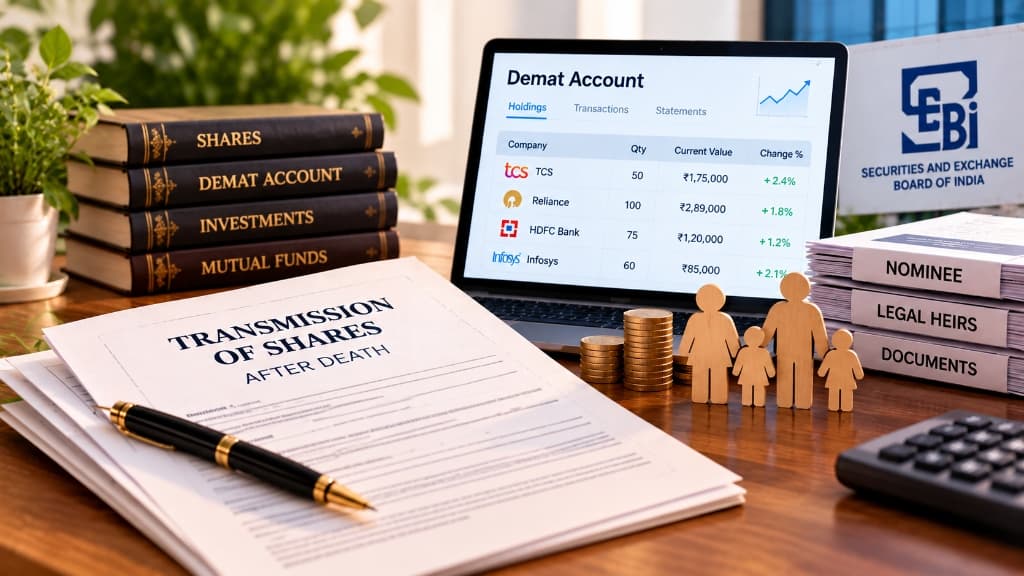
Transferring securities and real property following an investor's death involves clear legal milestones. The visual guide below illustrates how statutory succession laws, property title records, and depository transmission rules connect together.
7. Step-by-Step Guide: How to Approach Your Depository
Follow this six-stage verified procedure to complete the transmission of demat shares smoothly without unnecessary back-and-forth rejections:
Intimate Depository Participant & Freeze Trading
Notify the broker or DP immediately in writing along with a copy of the death certificate. The broker will freeze trading access to protect against unauthorized trades while keeping the account open for dividends.
Open or Verify Claimant's Demat Account
Shares cannot be remitted as cash or deposited into a regular bank account. Each claimant or nominee must have an active demat account with full KYC compliance.
Obtain an Officially Stamped Client Master Report (CMR)
Download and get your broker to physically sign and stamp your CMR. The CMR proves your active Beneficiary Owner ID (BO ID) and DP ID to the transferring depository.
Determine Portfolio Value under SEBI Formula
Calculate the total market value of the shares based on the closing price on the date of application. This establishes whether your claim falls under the Rs 15 Lakh simplified ceiling.
Execute Form ISR-5 & Notarized Affidavits
Fill in Form ISR-5 accurately. If claiming without nomination, have all legal heirs execute the Affidavit (Annexure D), Letter of Indemnity (Annexure E), and NOC (Annexure F) on non-judicial stamp paper.
Physical Submission & Depository Verification
Courier the physical dossier to the DP's central operations hub. Once verified, the DP initiates an off-market transfer, and the shares reflect in the claimant's demat account within 21 to 30 days.
8. Resolving Disputes Among Multiple Legal Heirs for Shares
When a parent dies without a Will, leaving multiple children and a valuable share portfolio, dividing those shares often creates conflict. Under Section 8 of the Hindu Succession Act, 1956, all Class I heirs (surviving spouse, sons, and daughters) inherit equal rights.
To divide the shares smoothly, families have three legally recognized options:
Option A: Apportionment
Each legal heir opens their own demat account. On Form ISR-5, the family specifies the exact percentage of shares to transfer into each heir's separate account.
Option B: Relinquishment (NOC)
Siblings execute a formal Relinquishment Deed or notarized NOC in favor of one sibling or the surviving mother, allowing one person to hold the entire portfolio.
Option C: Court Partition
If heirs disagree on share values or division, the only remedy is filing a succession petition under Section 372 in Civil Court, which freezes the shares until the judge decides.
9. Mutual Fund Transmission: AMFI Rules & Central Portals
Many investors hold both demat stocks and mutual funds. The transmission process for mutual fund units depends on whether they are held in demat mode or in Statement of Account (SoA) mode with fund houses:
Demat Mode Mutual Funds: If your mutual fund units are held inside your demat account with Zerodha (Coin), Groww, or Angel One, they are transmitted along with your equity shares under SEBI Form ISR-5. You do not need to contact individual fund houses.
Physical / SoA Mode Mutual Funds: If you bought mutual funds directly or through platforms like Kuvera, Zerodha non-demat, or distributors, units are held under individual folios. You must use AMFI standardized formats:
- Form T2: For transmission to surviving joint unitholders.
- Form T3: For transmission to registered nominees or legal heirs.
- Centralized Processing: You can submit claims centrally across all mutual funds using the MF Central portal or through RTAs like CAMS and KFintech.
10. How a Registered Will Avoids Probate & Court Delays
The entire headache of transmission, indemnity bonds, surety signatures, and civil court hearings exists solely because an investor passed away without leaving a clear Last Will and Testament.
When you draft an advocate-verified Will on WillDrafting.in, you eliminate all uncertainty for your family:
- • Demat account frozen upon notice of demise
- • Claims above ₹15L require civil court Succession Certificate
- • Takes 6 to 12 months in court with newspaper notices
- • Ad valorem court fees of 2% to 7.5% of total share value
- • Sibling disputes can lock blue-chip shares for years
- • Clear beneficiary designated for each demat account
- • Named executor holds legal title under Section 211 of ISA 1925
- • No Succession Certificate required for undisputed Wills
- • Zero percentage-based court fees on your share portfolio
- • Straightforward transmission completed in 21 to 30 days
Protect Your Demat Portfolio & Family Today
Do not let your life savings get stuck in broker paperwork or court litigation. Create an advocate-drafted, legally binding Will on plain paper in just 15 minutes.
11. Five Critical Mistakes to Avoid During Share Transmission
Families dealing with the loss of a loved one often make innocent mistakes that result in frozen funds or legal penalties:
1. Trading on the Deceased Person's Account
Using the deceased holder's login credentials to sell shares or withdraw funds post-death is an offence under Indian penal law and SEBI regulations. Brokers will immediately freeze the account and reverse unauthorized transactions.
2. Assuming the Nominee Can Keep All the Shares
Relying on nomination to bypass other children or siblings invites civil lawsuits. As settled in Shakti Yezdani (2023), the nominee must distribute the proceeds to lawful legal heirs.
3. Submitting an Unsealed Client Master Report
Depositories reject CMR printouts downloaded directly from apps. The CMR must carry the physical stamp and wet signature of the receiving broker.
4. Executing Indemnity Bonds on Incorrect Stamp Value
Affidavits and Indemnity Bonds must be printed on non-judicial stamp paper compliant with state-specific Stamp Acts (typically ₹100 to ₹500 depending on state rules).
5. Ignoring Unclaimed Shares Until They Move to IEPF
If transmission is ignored and dividends remain unclaimed for seven consecutive years, the shares are transferred to the central government's Investor Education and Protection Fund (IEPF), requiring a complicated refund process.
12. Lawyer-Verified Guidance: Succession Support by AMA
WillDrafting.in is powered by AMA Legal Solutions, a premier Indian succession law practice. If you are dealing with a complex share transmission involving disputed heirs, missing nominations, or high-value portfolios exceeding Rs 15 Lakhs, our succession advocates provide end-to-end representation.
13. Frequently Asked Questions: Demat Transmission Rules
Find answers to common questions about SEBI demat transmission rules, nominee responsibilities, and succession certificates:
14. Official Regulatory Citations & Depository Circulars
Primary Statutes and Master Circulars:
- SEBI Master Circular for Registrars to an Issue and Share Transfer Agents (Circular No. SEBI/HO/MIRSD/MIRSD_RTAMB/P/CIR/2022/65 dated May 18, 2022).
- Depositories Act, 1996 (Act No. 22 of 1996), Sections 9 & 10 (Fungibility and Depository Records).
- Companies Act, 2013 (Act No. 18 of 2013), Section 56 (Transfer & Transmission) & Section 72 (Nomination).
- Indian Succession Act, 1925 (Act No. 39 of 1925), Part X, Sections 370–390 (Grant of Succession Certificates).
- Supreme Court Landmark Judgment: Shakti Yezdani & Anr. v. Jayanand Jayant Salgaonkar & Ors. (2023 INSC 1079).