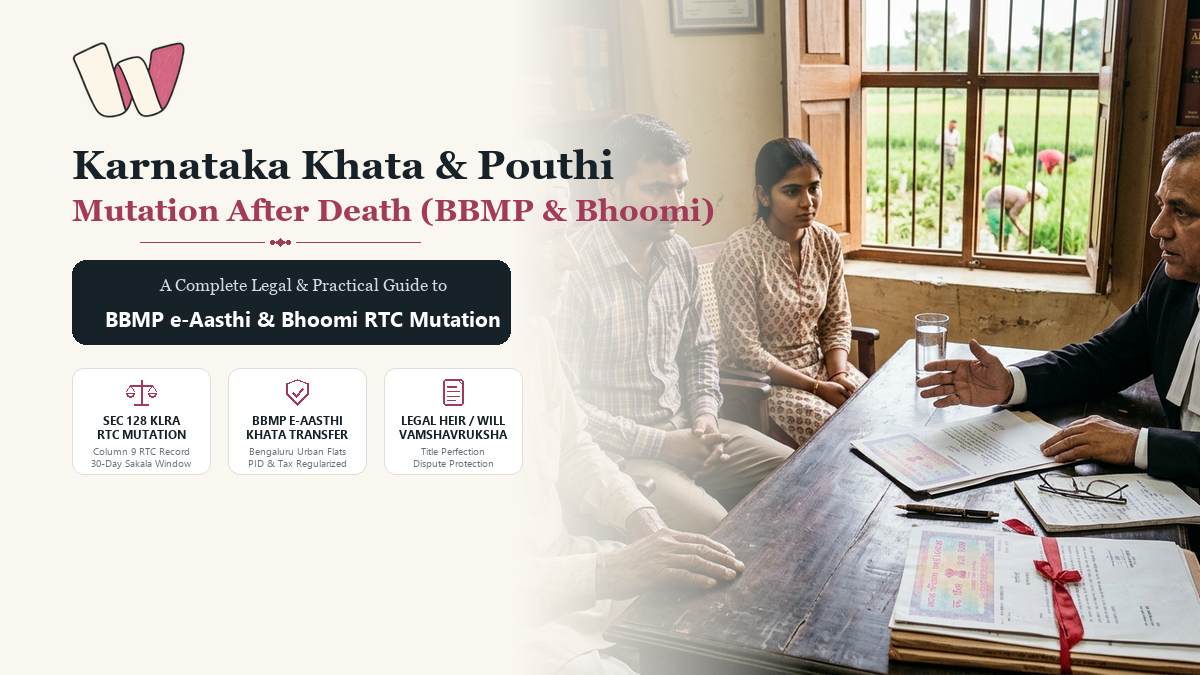
- Two Parallel Systems: Karnataka administers urban properties via municipal bodies (BBMP e-Aasthi Khata) and agricultural/revenue lands via the State Revenue Department (Bhoomi RTC Pahani).
- Section 128 KLRA Mandate: The Karnataka Land Revenue Act, 1964 mandates reporting property succession within three months of the owner's death to update the Record of Rights.
- Pouthi Khata (ಪೌತಿ ಖಾತೆ): Literally inheritance ledger update, Pouthi Khata enters surviving legal heirs or Will legatees as cultivators and occupants in Column 9 (Kabzedar) of the RTC.
- BBMP e-Aasthi Khata Transfer: Urban flats and layouts in Bengaluru require Khata Transfer through the Sakala portal, backed by a Death Certificate, Vamshavruksha, and 2% transfer fee.
- Will vs Intestate Succession: A registered Will legally supersedes default intestate distribution, avoiding collateral family disputes and securing immediate mutated title.
- Mutation is Not Absolute Title: Supreme Court rulings establish that neither Bhoomi RTC nor BBMP Khata creates ownership title; both serve fiscal taxation and municipal assessment.
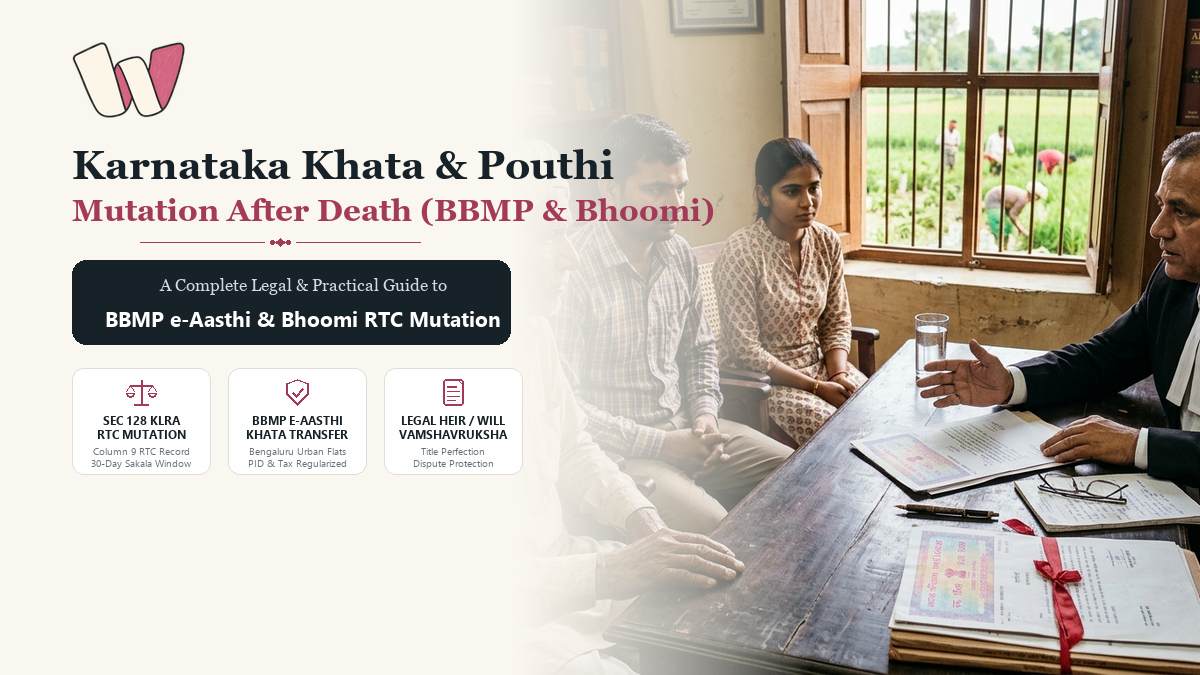
When a property owner passes away in Karnataka, the surviving family members face a critical legal task: mutating property records into their names. Whether the deceased owned an ancestral agricultural farm in Mandya, a coffee plantation in Kodagu, or a high-rise residential apartment in Bengaluru, updating ownership records is mandatory for paying property taxes, securing bank loans, and conveying marketable title.
However, Karnataka operates a dual-track land administration framework that confuses property owners and heirs across the state. Urban residential and commercial properties within Bengaluru fall under the jurisdiction of the Bruhat Bengaluru Mahanagara Palike (BBMP) and its digital e-Aasthi Khata portal. In contrast, agricultural, rural, and converted revenue land across Karnataka is administered by the State Revenue Department through the digital Bhoomi RTC (Record of Rights, Tenancy and Crops / Pahani) portal under the statutory process known vernacularly as Pouthi Khata (ಪೌತಿ ಖಾತೆ).
Failing to understand the statutory mechanics of these two systems leads to procedural rejections, family litigation, and frozen asset portfolios. In this comprehensive master guide, we examine the legal foundations of BBMP Khata Transfer and Bhoomi Pouthi Mutation under the Karnataka Land Revenue Act, 1964, examine how a registered Will simplifies succession, and outline the precise documentation required. To evaluate your family succession rights, consult our interactive succession calculator or review our will drafting checklist.
1. Karnataka Dual Land Administration: BBMP e-Aasthi vs Bhoomi RTC
To navigate succession smoothly in Karnataka, legal heirs must first identify whether their asset is an urban municipal property or a revenue land parcel. The administrative, procedural, and statutory rules governing these two categories are fundamentally distinct.
For urban properties located within the municipal boundaries of Bengaluru, the primary property record is the Khata. The word Khata translates to "account" in Kannada. It represents an assessment ledger showing who is primarily liable to pay property tax for a specific property identified by a unique Property Identification (PID) number. Following administrative modernizations, BBMP maintains these records digitally via e-Aasthi.
Conversely, all agricultural parcels, revenue lands, and converted layouts outside urban municipal corporations are governed by the Bhoomi portal (landrecords.karnataka.gov.in). Here, the definitive document is the RTC (Pahani). When an owner dies, updating Column 9 (Kabzedar / Occupant) and Column 10 (Ownership Details) of the RTC is termed Pouthi Khata Mutation.
Any person acquiring by succession, survivorship, inheritance, partition, purchase, mortgage, gift, lease or otherwise, any right as holder, occupant, owner, mortgagee, landlord or tenant of land or assignee of the rent or revenue thereof, shall report orally or in writing his acquisition of such right to the Prescribed Officer within three months from the date of such acquisition.
2. BBMP Khata Transfer After Death: Legal Grounds and Types
In Bengaluru urban properties, an existing Khata does not automatically transfer to surviving family members upon the owner's death. The legal heirs must initiate a formal Khata Transfer (ಖಾತಾ ವರ್ಗಾವಣೆ) application before the Assistant Revenue Officer (ARO) of the respective BBMP ward.
BBMP classifies property records into two primary categories that dictate the rights of the holder:
- A-Khata (Form A Register): Conferred on properties that hold legal conversion orders from the Deputy Commissioner, possess sanctioned building plans from BBMP/BDA, have paid all betterment charges, and comply fully with town planning bylaws. An A-Khata owner enjoys undisputed municipal recognition, can secure nationalized bank loans, and easily transfers title upon death.
- B-Khata (Form B Register): An administrative register maintained under Section 108A of the Karnataka Municipal Corporations Act for unauthorized developments, revenue site layouts, or buildings with plan deviations. While B-Khata holders can pay property tax and obtain basic municipal utilities, B-Khata does not constitute a certified property title. Upon death, a B-Khata can still be transferred to legal heirs for tax liability purposes, but converting it to A-Khata requires regularization and statutory penalties.
When an owner dies, BBMP recognizes two distinct routes for Khata Transfer:
- Testamentary Khata Transfer (Registered Will): Where the deceased owner executed a legally valid, registered Will bequeathing the property to a specific heir or legatee. BBMP issues a public notice in local Kannada and English dailies inviting objections within 30 days. If no caveat or civil suit is pending, the Khata Certificate is transferred directly to the designated beneficiary.
- Intestate Khata Transfer (No Will): Where the owner died without a testamentary disposition. Title transmission requires an official Vamshavruksha (Pedigree Tree) and Legal Heir Certificate. If multiple heirs inherit, BBMP enters all heirs as joint Khata holders unless other heirs execute and register a formal Relinquishment Deed (Release Deed) at the Sub-Registrar Office in favor of a single claimant.
3. Bhoomi Pouthi Khata Mutation: Statutory Mechanics under KLRA 1964
Outside municipal city limits, inheritance succession over agricultural and revenue lands is governed rigorously by Sections 128 and 129 of the Karnataka Land Revenue Act, 1964. The colloquial term Pouthi (ಪೌತಿ) derives from the Persian/Urdu administrative word for death or demise. Hence, Pouthi Khata denotes the inheritance mutation of a deceased holder's agricultural rights.
The statutory lifecycle of a Pouthi Khata mutation unfolds across several mandatory revenue checkpoints:
The legal heir, legatee under a Will, or surviving coparcener must report the demise to the Village Administrative Officer (VAO) or Taluk Tahsildar within three months. The intimation must be accompanied by the original Death Certificate, RTC extract, and genealogical proof.
Upon receiving the application, the Village Accountant enters the transaction in the statutory Mutation Register (Form 21). A public notice (Form 21 Notice) is mandatorily affixed at the Gram Chavadi (village community hall) and served individually on all recorded co-owners, adjoining holders, and known legal heirs.
Under Section 129(2) KLRA, interested parties have 30 days to lodge written objections. If zero objections are received, the Revenue Inspector certifies the mutation. If an objection is lodged (e.g., alleging a forged Will or suppressed daughter's share), the file is transferred to the Disputed Cases Register (Form 22) and adjudicated by the Assistant Commissioner under Section 136(2) KLRA.
Once certified, the Bhoomi digital database automatically updates Column 9 (Kabzedar) and Column 10 of the RTC. The name of the deceased is struck off, and the newly certified heirs or legatee appear on the official government ledger with a unique Mutation Order (MR) number.
4. Structural Comparison: BBMP e-Aasthi vs Bhoomi Pouthi Khata
The comparative matrix below outlines the critical differences between urban municipal Khata Transfer and rural revenue Pouthi Khata in Karnataka:
| Parameter | BBMP e-Aasthi Khata Transfer | Bhoomi Pouthi Khata (RTC) Mutation |
|---|---|---|
| Governing Statute | BBMP Act, 2020 / KMC Act, 1976 | Karnataka Land Revenue Act, 1964 (ss. 128, 129) |
| Applicable Territory | Bengaluru Urban Municipal Wards (198 Wards) | Agricultural & Revenue Land Across All Karnataka Districts |
| Primary Digital Portal | BBMP Sakala / e-Aasthi Municipal Portal | Bhoomi Portal (landrecords.karnataka.gov.in) |
| Official Document Updated | Khata Certificate & Khata Extract (PID Number) | RTC / Pahani (Column 9 Kabzedar & Column 10 Ownership) |
| Adjudicating Authority | Assistant Revenue Officer (ARO), BBMP | Village Administrative Officer (VAO) & Revenue Inspector (RI) |
| Statutory Service Timeline | 30 Working Days under Sakala Service Guarantee | 30 Days Public Notice Window + 15 Days Certification |
| Prescribed Government Fee | 2% of the Stamp Duty / Registered Property Value | Nominal Mutation User Fee (₹50 to ₹100 per Survey Number) |
| Legal Effect of Entry | Assessment of municipal property tax liability | Fiscal record of agricultural tenancy and land revenue |
5. Vamshavruksha and Legal Heir Certificate Requirements
Under Karnataka succession procedures, whenever an owner dies without leaving a registered Will, procuring a Vamshavruksha (ವಂಶವೃಕ್ಷ - Family Pedigree Tree) is mandatory. Neither BBMP nor the Revenue Department will process an intestate transfer without this foundational document.
The Vamshavruksha is applied for online through the Nada Kacheri Atalji Janasnehi Kendra (AJKS) portal. The legal heir must submit:
- Official Death Certificate of the deceased owner
- Aadhaar cards and identification proofs of all surviving family members
- Ration card, Family Tree Affidavit sworn before a Notary or Executive Magistrate
- Field inquiry report conducted by the local Village Accountant and Revenue Inspector
Under Hindu Succession Act, 1956 (governing Hindu, Jain, Sikh, and Buddhist owners), if a male owner dies intestate, his property devolves equally upon all Class 1 legal heirs: his widow, mother, sons, and daughters. Following the Supreme Court ruling in Vineeta Sharma v. Rakesh Sharma (2020) 9 SCC 1, married and unmarried daughters hold coparcenary rights equal to sons by birth.
Consequently, if a son attempts to apply for Pouthi Khata or BBMP Khata transfer excluding his sisters or mother, the excluded heirs can submit a formal objection during the 30-day notice period. The mutation will be summarily halted and sent to the Assistant Commissioner's court under Section 136(2) KLRA.
6. Registered Will vs Intestate Mutation: Why a Will Protects Title
The most effective instrument to eliminate bureaucratic delays, prevent extortionate objection notices, and avoid fractured joint ownership in Karnataka is executing a clear, registered Will.
Under Section 59 and Section 213 of the Indian Succession Act, 1925, every adult of sound mind has the legal right to dispose of their self-acquired and absolute property to any beneficiary of their choice. Testamentary succession completely overrides default intestate rules under the Hindu Succession Act or personal laws.
Consider the contrast between an intestate succession and a registered Will bequest in Bengaluru:
The property is splintered among all surviving Class 1 heirs. If the owner leaves a wife, mother, and two children, each receives an undivided 25% share. To sell the apartment or mortgage the farm, all four heirs must sign every deed. If any heir refuses or passes away, distant in-laws and cousins enter the title chain, freezing transactions for decades.
The testator bequeaths 100% of the flat or agricultural parcel to their surviving spouse or chosen child. Collateral relatives, married siblings, and in-laws cannot claim statutory shares. BBMP and Bhoomi officials verify the registered instrument, issue the standard 30-day notice, and enter the designated legatee as sole Khata holder.
7. Complete Step-by-Step Document Checklist
To avoid procedural rejections, assemble these mandatory documents before applying for Khata Transfer or Pouthi Mutation in Karnataka:
Issued by the Chief Registrar of Births and Deaths, BBMP health officer, or rural village panchayat secretary.
The primary registered document establishing how the deceased person acquired legitimate ownership.
Registered Will with witness details, or Nada Kacheri Tahsildar Family Pedigree Certificate showing all surviving legal heirs.
Up-to-date EC issued by Kaveri Online Services covering the property from the date of purchase up to the current date.
Previous BBMP Khata certificate or current Bhoomi RTC Pahani showing zero outstanding tax arrears.
If multiple legal heirs agree to release their shares in favor of one surviving heir, a registered Release Deed is mandatory.
8. Model Will Clause and Vamshavruksha Declaration Formats
To ensure seamless mutation under the Karnataka Land Revenue Act, 1964 and BBMP regulations, use these legally validated model clauses:
Note: Register this Will at the local Sub-Registrar Office under Section 18 of the Registration Act, 1908 to ensure seamless revenue recognition.
Note: Sworn on non-judicial stamp paper of prescribed Karnataka stamp duty value and submitted via the Nada Kacheri portal.
9. Mutation vs Title: Landmark Supreme Court Rulings
A widespread misconception across Karnataka is that having your name in Column 9 of a Bhoomi RTC or possessing a BBMP A-Khata certificate makes you the absolute, indefeasible owner of the land. The Supreme Court of India has firmly struck down this myth in multiple landmark judgments:
The Supreme Court held that an entry in revenue records does not confer title on a person. Revenue records and mutation entries are maintained exclusively for fiscal purposes to collect land revenue and do not decide substantive ownership rights.
The Apex Court reiterated that mutation of a property in revenue records neither creates nor extinguishes title to the property nor has it any presumptive value on title. Such entries enable the person in whose favor mutation is ordered only to pay the land revenue. Title can only be determined by a competent Civil Court based on valid conveyance deeds and testamentary instruments.
Therefore, while executing Pouthi Khata and BBMP Khata Transfer is indispensable for day-to-day property governance, safeguarding substantive title requires registered conveyance deeds and an unambiguous registered Will. When title disputes arise among legal heirs, revenue courts (Tahsildars, Assistant Commissioners, and Deputy Commissioners) have no jurisdiction to try title disputes; parties must institute a declaratory suit before a competent Civil Court.
Drafting an airtight Will protects your surviving family from bitter inheritance conflicts and ensures rapid mutation across Bengaluru and all Karnataka districts. You can draft your personalized legal Will online in under 15 minutes at WillDrafting.in. If you require expert representation for disputed mutations, caveat filings, or high-value estate planning, schedule a consultation with our experienced property lawyers at AMA Legal Solutions. Learn more about our specialized regional succession services at Kannada Will Format (ಉಯಿಲು) and our Land Mutation & Dakhil Kharij Service.