1. Cross-Border Matrix: DIFC vs ADJD vs Indian Will
Over 35 lakh Indians live in the UAE. Many families buy a flat in Dubai or Abu Dhabi. They hold local bank accounts, job gratuity, and company shares. At the same time, they own flats, land, fixed deposits, and mutual funds in India.
Planning your estate as a UAE expat involves two legal systems. You must deal with UAE civil laws and the Indian Succession Act 1925. Making the wrong choice can freeze your Dubai bank accounts. It can also cause years of High Court delay in India.
Should you pay for a costly DIFC Will, use the simple ADJD registry, or write an Indian Will? This guide explains the true fees, legal rules, and the two-will plan.
2. Interactive Cross-Border Decision Tool
Select your asset distribution, real estate location, and family requirements below. Get an instant diagnostic recommendation with clear fee comparisons and risk ratings.
ADJD gives full protection against Sharia estate distribution across the UAE for ~AED 950, while a separate Indian Will ensures your heirs avoid 2 years of High Court resealing in India.
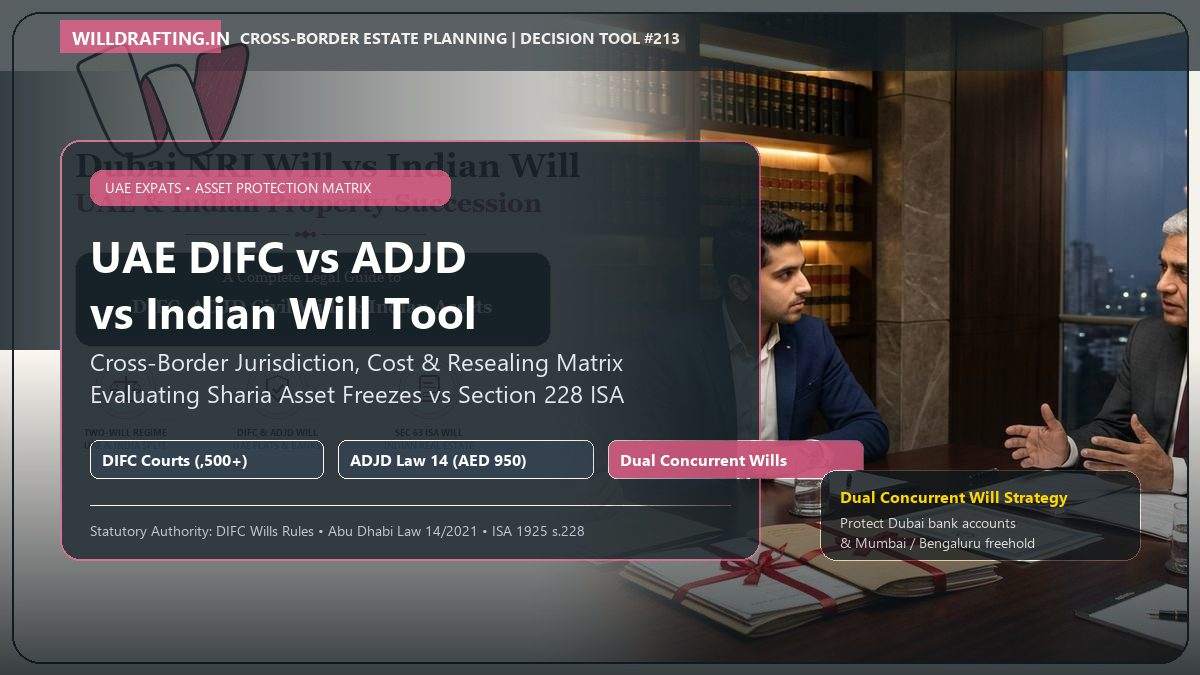
Visualizing jurisdiction options for Dubai and Abu Dhabi Indian expats: DIFC Courts, ADJD Non-Muslim Registry, and Indian Succession Act registration.
3. Registration Cost Comparison: DIFC vs ADJD vs India
Many Dubai law firms push DIFC wills without sharing all the facts. They charge high fees for a worldwide Will. But Abu Dhabi offers valid civil registration for far less money.
Official registry fee for a Full Will covering guardianship and all assets. Legal drafting fees by Dubai firms usually add another AED 5,000 to AED 10,000.
Official registration fee with Abu Dhabi Judicial Department is only AED 950. Includes bilingual Arabic translation and covers all 7 UAE emirates.
Drafted online or via senior estate advocate and registered before Sub-Registrar Office (SRO) in India. Covers all Indian properties, demat, and NRE accounts.
5. Section 228 ISA Trap: Why DIFC Wills Fail in India
Dubai law firms call DIFC wills worldwide wills. But this claim creates a trap for Indian property.
Indian land offices, housing societies, and sub-registrars do not accept foreign court orders directly. Under Section 228 of the Indian Succession Act 1925, your heirs must go to an Indian High Court. They must file a petition to reseal the foreign Will.
This court process takes 12 to 24 months. Heirs must pay high court fees and lawyer bills. The foreign paper must also get embassy stamps and legal translations.
A separate Indian Will avoids Section 228 completely. It lets your heirs claim Indian property without any delay.
6. The Dual Concurrent Wills Strategy (Gold Standard)
Top cross-border lawyers advise using two separate wills. This is the two-will plan.
- • Covers only assets in the UAE.
- • Covers your Dubai or Abu Dhabi flat, bank accounts, and car.
- • Names guardians for your young children.
- • Goes straight to UAE civil courts upon death.
- • Covers only assets in India.
- • Covers your flats, family land, NRE accounts, and mutual funds.
- • Signed in front of two adult witnesses.
- • Used directly in India without High Court resealing.
Most Indian Will drafts have a standard clause revoking all old wills worldwide. If you sign this draft, it cancels your UAE Will. Both wills must state that they do not cancel each other. They must work together in their own countries.
7. ADGM Courts vs DIFC vs ADJD: Jurisdiction Guide
Expats in the UAE have three places to register a Will.
The Abu Dhabi Judicial Department non-Muslim registry was set up under Abu Dhabi Law 14 of 2021. The process is online through video calls. It costs only AED 950 and works across all seven emirates. It is the top choice for most expats.
The DIFC Wills Service Centre runs on English common law in Dubai. All court steps are in English. It costs AED 10,000 to 15,000. It is often chosen by large business owners who want English-speaking courts.
ADGM Courts in Abu Dhabi also follow common law. They focus on trusts and corporate succession for wealthy families.
8. Master Comparison Table: UAE & Indian Estate Options
| Feature / Factor | DIFC Courts Will | ADJD Non-Muslim Will | Dual Concurrent Wills (Best) |
|---|---|---|---|
| Official Government Fee | AED 10,000 – 15,000+ | AED 950 (~₹21,000) | AED 950 + ₹15,000 |
| UAE Asset Protection | 100% Protected (DIFC) | 100% Protected (All 7 Emirates) | 100% Protected Across UAE |
| Indian Asset Execution | High Friction (Requires s. 228 High Court Resealing) | High Friction (Requires Indian Resealing) | Zero Friction (Direct SRO & Indian Probate) |
| Sharia Freeze Prevention | Yes, Immediate | Yes, Immediate | Yes, Immediate in UAE |
| Minor Guardianship Nomination | Yes (Interim & Permanent) | Yes (Interim & Permanent) | Yes (In UAE & India) |
| Probate Timeline in India | 12 – 24 Months Delay | 12 – 24 Months Delay | Direct (Zero Resealing Delay) |
Our High Court litigators handle Section 228 petitions, embassy consularization, and SRO mutation pan-India.
9. Step-by-Step SOP: Dual Cross-Border Will Execution
Follow these five simple steps to protect your family in the UAE and India:
List your assets. Keep your UAE flats and accounts separate from your Indian property, land, and demat funds.
Write an ADJD or DIFC Will for UAE assets. Name interim and permanent guardians for your young children.
Upload your draft to the ADJD portal. Complete video check via UAE Pass and receive your digital attested Will.
Draft your Indian Will under Section 63 ISA. Add a clear clause saying it does not cancel your UAE Will.
Sign your Indian Will before two adult witnesses. Register it at the Sub-Registrar Office in India.
10. Real Case Studies: Dubai, Abu Dhabi & Sharjah Expats
Situation: A senior executive in Dubai owned a marina flat and a 3-BHK apartment in Bandra, Mumbai. A local Dubai firm advised a single DIFC worldwide Will for AED 18,000.
Solution: Switched to an ADJD Will (AED 950) for Dubai + separate registered Indian Will. Saved AED 14,000 in UAE fees and avoided 18 months of High Court ancillary probate in Mumbai.
Situation: An Abu Dhabi business founder passed away unexpectedly. He had registered an ADJD Non-Muslim Will 6 months prior covering company shares and bank accounts.
Result: ADJD Civil Court issued probate in 14 working days. The commercial bank unfroze business operating accounts, allowing the family to continue salary payments without Sharia delay.
Situation: An Indian couple in Sharjah with two children (ages 4 and 7) frequently travelled internationally. They worried about custody if an accident occurred.
Result: Registered an ADJD guardianship declaration nominating the Dubai-based uncle as interim guardian and grandparents in Kerala as permanent guardians, eliminating custody uncertainty.
11. Cross-Border Recital Clauses & Document Checklist
"1. TERRITORIAL LIMITATION & SCOPE:
This Last Will and Testament applies exclusively to all my movable and immovable properties, assets, bank accounts, investments, and interests situated within the Republic of India.

2. RECIPROCAL NON-REVOCATION OF FOREIGN / UAE WILLS:
I hereby confirm that I have registered (or intend to register) a separate Last Will and Testament with the Abu Dhabi Judicial Department (ADJD) / Dubai International Financial Centre (DIFC) Wills Service Centre to govern my assets situated in the United Arab Emirates.

I expressly declare that this Indian Will does NOT revoke, cancel, amend, or superscribe my said UAE Will (or any other foreign testamentary instrument expressly limited to assets outside India). Both Wills shall operate concurrently as independent, complementary testamentary instruments within their respective territorial jurisdictions.

3. EXECUTORSHIP & SEPARATE TRANSMISSION:
I appoint [Name of Indian Executor], resident of [Address in India], as the sole Executor of this Indian Will. My Indian Executor shall have no administrative duties over my UAE estate, which shall be administered independently under the terms of my UAE Will."
12. Institutional Profile: Cross-Border Practice
WillDrafting.in is powered by AMA Legal Solutions. We help Indian families in Dubai, Abu Dhabi, and around the world protect their assets. Our advocates guide you on UAE wills, Section 228 High Court resealing, and Indian family property defense.
13. Frequently Asked Questions: UAE & Indian Wills
14. Statutory Authorities & Court Registry Portals
Official registries and statutory portals governing cross-border succession between the UAE and India:
Why Expats Need Two Wills
One Will for the UAE and one for India stops all frozen accounts and court delays. Each paper works fast in its own country.
Save Over 80% on Fees
ADJD registration costs just AED 950 and works across all seven emirates. You do not need to spend AED 15,000 on DIFC worldwide wills.
Keep Your Kids Safe
Naming guardians in your UAE Will ensures your relatives get custody fast. It prevents local care homes from stepping in.