- Statutory Reporting Duty (Section 109): Any person acquiring Bhumiswami rights over MP land by death, succession, partition, gift, or Will must report to the Patwari or Tehsildar within 6 months.
- Revenue Mutation Does Not Create Proprietary Title: The Supreme Court held in Jitendra Singh v. State of MP (2021) that Khasra and Khatauni entries are for fiscal revenue records only. They do not decide title ownership.
- Disputed Will Exclusion: Tehsildars and Naib Tehsildars have no jurisdiction to decide the validity of a contested Will. Disputed claims must be decided by a Civil Court decree.
- Mandatory Married Daughters Inclusion: Married daughters possess equal coparcenary rights by birth. They cannot be omitted from the Patwari Varisan Panchnama without a registered relinquishment deed.
1. MP RCMS Namantaran Framework Under Sections 109 & 110
In Madhya Pradesh, property mutation (नामांतरण) is governed by the Madhya Pradesh Land Revenue Code, 1959 (MPLRC). When a Bhumiswami (land title holder) passes away, their agricultural land, rural plots, or diverted holdings do not mutate automatically. The legal heirs must file for Fauti Namantaran (फौती नामांतरण) on the MP Revenue Case Management System (RCMS portal).
Section 109 of the MPLRC makes it mandatory for any person lawfully acquiring any right or interest in land as a Bhumiswami to report their acquisition to the Patwari or Tehsildar within 6 months. Failure to report may attract a penalty under Section 109(2).
Section 110 of the MPLRC directs the Tehsildar to register the application, issue a public proclamation (Ishtehar) inviting objections within 15 to 30 days, order an on-site field inquiry by the Halka Patwari (Varisan Panchnama), and enter the names of the lawful successors in the Field Register (Khasra Form P-II) and Record of Rights (Khatauni B-1).
2. Free MP RCMS Document Finder & Checker
Select your land type, family status, and succession category below. Get an instant, tailored Tehsil checklist, Patwari Panchnama instructions, and objection timeline.
- Death Certificate: Original or computerized certified death certificate of Bhumiswami from Nagar Nigam / Gram Panchayat.
- MP Bhulekh Khasra (P-II) & Khatauni (B-1): Certified computerized printout showing current deceased landholder name.
- Bhoo-Adhikar Avam Rin Pustika: Original land passbook for endorsement and re-issuance.
- Affidavit under Section 109: Notarized declaration of surviving legal heirs, relationship, and lack of adverse claims.
- KYC of All Legal Heirs: Samagra Family ID, Aadhaar card, and photographs of all heirs.
- Mauka Kabza (Field Inspection): Patwari verifies who is cultivating or occupying the agricultural parcel.
- Pedigree Tree (वंशावली): Ground verification of family tree to prevent omission of married daughters or minor grandchildren.
- 5 Village Panch Attestations: Signatures and thumb impressions of at least 5 respectable local villagers confirming heirship.
- Village Kotwar Endorsement: Formal confirmation by Kotwar that the deceased had no other undisclosed family members.
- Boundary & Adjoining Landholder Check: Notification to adjacent Khasra owners regarding easement or water rights.
- No Government Land Encroachment: Verification that the plot does not encroach on Charokhar, Nala, or Grazing commons.
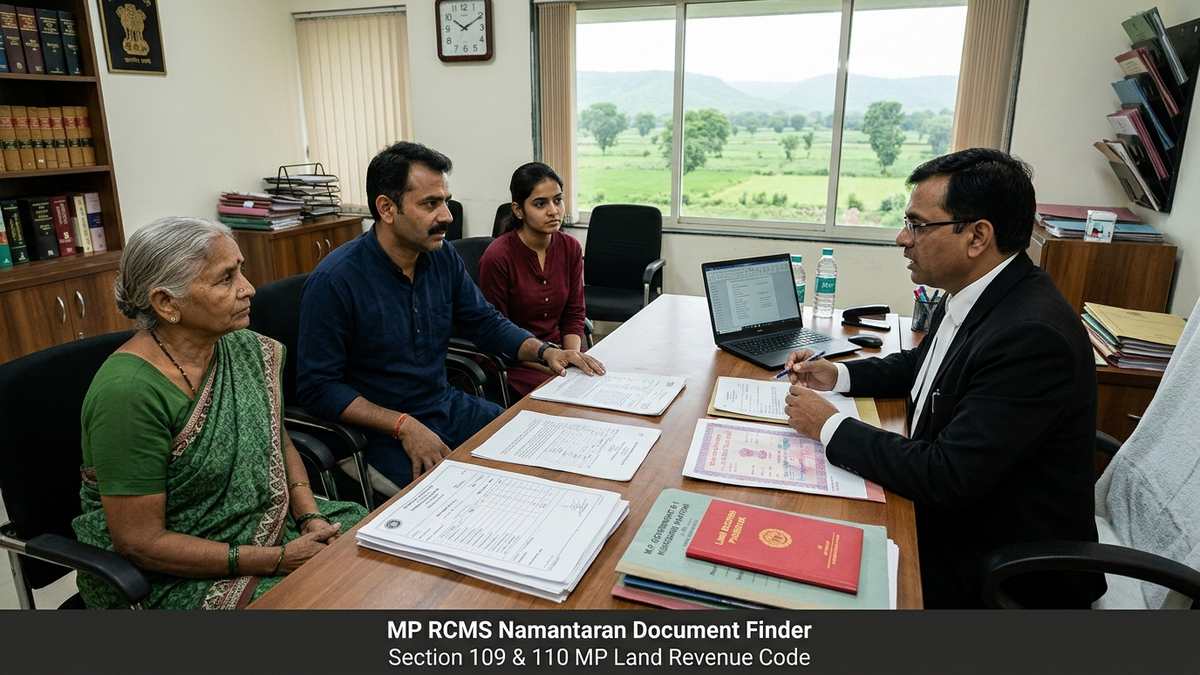
3. Fauti Namantaran SOP: Step-by-Step Tehsil Workflow
To secure an undisputed Khasra mutation upon the demise of a family landholder in Madhya Pradesh, follow this verified five-stage procedural roadmap:
Obtain the official death certificate from the Registrar of Births and Deaths (Nagar Nigam or Gram Panchayat). Update the deceased status in the Samagra Samajik Suraksha portal (samagra.gov.in) to link all surviving family members.
Submit an online application under the "नागरिक सेवाएं" tab on the Revenue Case Management System. Select district, tehsil, village, and Khasra numbers. Upload the death certificate, B-1 Khatauni, and Section 109 legal heir affidavit. Note down the unique RCMS Case Number.
The Reader / Tehsildar registers the case and issues a public proclamation (इश्तहार). A copy is affixed on the Tehsil notice board, Gram Panchayat Bhavan, and published on the RCMS portal for a 15 to 30 day objection window.
The Halka Patwari conducts a physical village inspection. The Patwari drafts the Varisan Panchnama in the presence of the village Kotwar and 5 local Panchs, certifying heirship and physical possession, and uploads it to the portal.
On the final hearing date, the Tehsildar passes the mutation order (नामांतरण आदेश). The MP Bhulekh land records database is updated, deleting the deceased's name and substituting the legal heirs as co-Bhumiswamis. A new Rin Pustika is generated.
4. Contested Will Mutation: Civil Court Jurisdiction
A common point of dispute in Madhya Pradesh occurs when one child or stranger seeks mutation over agricultural land citing an unprobated or unregistered Will, excluding other natural heirs. In such instances, revenue courts lack the authority to decide the outcome.
The MP High Court held that Revenue Courts under the MP Land Revenue Code are courts of summary jurisdiction. They have no jurisdiction to try and decide complex disputed questions of title, or the valid execution and attestation of a Will under Section 63 of the Indian Succession Act and Section 68 of the Evidence Act.
If any Class-I legal heir files a written objection before the Tehsildar challenging the testamentary instrument, the Tehsildar cannot record mutation on the basis of the disputed Will. The Tehsildar must either mutate the land among all natural heirs under ordinary succession or direct the propounder of the Will to obtain a declaratory decree from a competent Civil Court.
5. Patwari Varisan Panchnama: Ground Verification SOP
The Patwari Varisan Panchnama (वारिसान पंचनामा) is the core evidentiary pillar of any revenue mutation in Madhya Pradesh. A defective or one-sided Panchnama is the single largest reason for mutation orders being set aside in appeal by the Sub-Divisional Officer (SDO).
- Inclusion of All Daughters: The Panchnama must explicitly record all daughters (whether married or unmarried) with their marital status and current addresses.
- Signatures of Five Independent Panchs: The five Panchs must be independent resident landholders of the village who have no direct financial interest in the land.
- Village Kotwar Attestation: The village Kotwar acts as the official village watchman and must confirm that no minor or pre-deceased heir has been excluded.
- Physical Cultivation & Crop Verification: Confirmation of whether the land is currently under Rabi/Kharif crop cultivation and who is managing agricultural operations.
6. Tehsildar Hearing Timeline & Objection Resolution
Under the Madhya Pradesh Public Services Guarantee Act, 2010 (म.प्र. लोक सेवा गारंटी अधिनियम), uncontested mutation must be resolved within 30 working days. If an objection is raised, the matter enters the contested summary proceedings track:
| Stage | Statutory Action | Permissible Window | Remedy if Delayed |
|---|---|---|---|
| 1. Filing & Ishtehar | Public notice posted in village | 15 to 30 days | Complaint to Tehsildar |
| 2. Patwari Report | Panchnama uploaded to RCMS | 14 days from notice | Notice to Revenue Inspector |
| 3. First Hearing (पेशी) | Verification of exhibits & KYC | Within 30 days | First Appeal under Public Services Act |
| 4. Final Order | Tehsildar order on Khasra | 30 working days total | First Appeal to SDO (Sec. 44) |
| 5. SDO First Appeal | Appeal against illegal mutation | 45 days limitation | Second Appeal to Commissioner |
7. Married Daughters Rights in MP Land Revenue Records
For decades, local revenue authorities in Madhya Pradesh frequently omitted married daughters from Fauti Namantaran on the false premise that daughters forfeit rights in agricultural holdings upon marriage. This practice is entirely illegal.
The Supreme Court confirmed that daughters are coparceners by birth with rights equal to sons under Section 6 of the Hindu Succession Act. This applies fully to agricultural land governed by the MP Land Revenue Code.
Any mutation order passed by a Tehsildar that intentionally excludes married daughters without their registered relinquishment deed is vulnerable to being quashed by the SDO in appeal or by the High Court in a writ petition.
8. Legal Comparison: Fauti vs Will vs Partition
| Parameter | Fauti Namantaran | Will-Based Mutation | Partition (Batwara Sec 178) |
|---|---|---|---|
| Governing Section | Section 109 & 110 MPLRC | Section 109/110 & ISA 1925 | Section 178 MPLRC |
| Primary Trigger | Intestate death of Bhumiswami | Death with registered/unregistered Will | Co-sharers seeking independent title |
| Tehsildar Jurisdiction | Full summary power to mutate | Barred if natural heirs dispute Will | Power to divide holding & map Khasra |
| Key Risk Factor | Omission of married daughters | Stay by Civil Court in title suit | Dispute over road/irrigation access |
| Typical Duration | 30 to 45 working days | 30 days (if uncontested) or Civil Court | 60 to 120 working days |
9. Statutory Recital & Affidavit Formats for RCMS
Use these verified templates for filing before the Tehsildar or Naib Tehsildar in Madhya Pradesh. Click to copy directly into your legal file.
10. Practical Case Studies: Indore, Bhopal & Jabalpur
Two brothers mutated 8 hectares of farmland excluding their married sister. Our counsel filed an appeal before SDO Indore under Section 44 MPLRC. The mutation order was quashed, and the sister was added as an equal co-Bhumiswami.
A nephew produced an unregistered Will for a valuable diverted residential plot. We filed an objection under Section 110(3). Relying on the Murari Lal precedent, the Tehsildar rejected the Will mutation, directing the parties to Civil Court.
By submitting a verified Patwari Panchnama with Samagra KYC and non-encumbrance affidavits on Day 1, the family secured clean mutation and new Rin Pustika in 22 working days without any Tehsil delay.
11. Institutional Profile: MP Revenue Court Practice
Our specialized revenue litigation team represents Bhumiswamis, urban plot buyers, and legal heirs across Madhya Pradesh. We handle contested Fauti Namantaran, Section 178 Batwara partitions, Section 44 revenue appeals before Sub-Divisional Officers (SDO), revisions before the Board of Revenue Gwalior, and civil suits for declaration of title.
12. Frequently Asked Questions: MP RCMS Namantaran
13. Statutory Citations & Official MP Land Portals
- Madhya Pradesh Land Revenue Code, 1959 (Sections 109, 110 & 178)
- Hindu Succession Act, 1956 (Sections 6, 8 & 30)
- Indian Registration Act, 1908 (Section 17)
- MP Public Services Guarantee Act, 2010 (Section 3)
- Murari Lal v. State of MP (MP High Court on Will jurisdiction)
- Jitendra Singh v. State of MP (2021) (Supreme Court on mutation title)
- Vineeta Sharma v. Rakesh Sharma (2020) (Equal rights of daughters)
Why Report Within 6 Months?
Section 109 gives you 6 months to report any new land rights. Reporting early prevents fines. It keeps your name clear in village records so nobody can sell your land behind your back.
Simple Village Panchnama Rules
The Patwari must visit your land in person. Five respected villagers and the Kotwar sign the paper. They verify who owns the crop and confirm all sons and daughters are included.
How Our Lawyers Assist You
Our counsel drafts your Section 109 affidavits and checks your Khasra papers. If a relative files a false objection, we defend your rights in the Tehsil and SDO court.