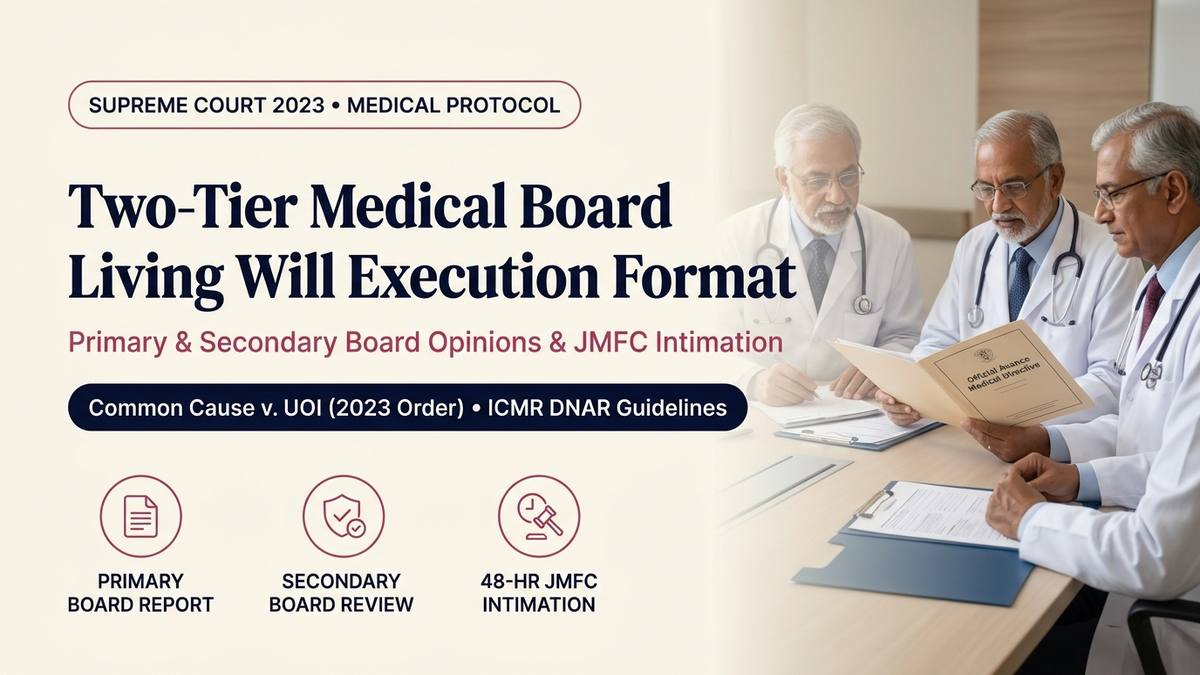
MANDATORY ASSET 1: PRIMARY BOARD REPORT
4. Primary Medical Board Certification Format
The treating doctor and two hospital experts write their first view within 48 hours. Copy or print this clear form for the ICU file:
PRIMARY MEDICAL BOARD CERTIFICATION FORMAT (2023 SC COMPLIANT)
PRIMARY MEDICAL BOARD CERTIFICATION & CLINICAL OPINION FORMAT
[Under Supreme Court of India Order dated 24 January 2023 in Common Cause v. UOI (MA No. 1699/2019) & ICMR Consensus Guidelines on DNAR]
Hospital Name & Registration No.: [Insert Hospital Name, City, Clinical Establishment Reg. No.]
Hospital Case / IPD / UHID No.: [Insert UHID / IPD Number]
Date & Time of Board Constitution: [DD/MM/YYYY at HH:MM Hours] (48-Hour Clock Starts)
PART A: PATIENT & ADVANCE MEDICAL DIRECTIVE DETAILS
1. Patient Full Name: [Patient Full Name], Age: [Age] Years, Sex: [M/F/Other]
2. Next of Kin / Appointed Surrogate Name: [Surrogate Full Name], Relationship: [Spouse / Child / Nominated Proxy]
3. Advance Medical Directive (Living Will) Status:
[ ] Executed on [Date] before Two Witnesses and Attested by [Notary Public / Gazetted Officer]
[ ] Verified against Copy Held by [Surrogate / Custodian / Family Physician / ABHA Record]
[ ] No Written Living Will Found (Proceeding under Next-of-Kin Informed Consent Route)
PART B: CLINICAL DIAGNOSIS & TERMINAL CONDITION ASSESSMENT
1. Primary Diagnosis & Comorbidities: [Detail advanced terminal illness / irreversible brain damage / multi-organ failure]
2. Patient Decision-Making Capacity: [Confirm patient is unconscious / comatose / lacks capacity to give contemporaneous consent]
3. Summary of Diagnostic Evidence & Prognosis: [List MRI/CT findings, GCS score, ventilator dependency, ICU course, and failed therapeutic trials]
4. Medical Futility Findings:
We, the members of the Primary Medical Board, have personally examined the patient and reviewed all ICU charts, laboratory reports, and imaging records. We hereby certify that:
(a) The patient suffers from a terminal and irreversible medical condition with no realistic possibility of recovery; AND
(b) Further escalation or continuation of artificial life-sustaining treatment (invasive mechanical ventilation / CPR / vasopressors / artificial nutrition) will not cure the condition and will only prolong the dying process and patient suffering.
PART C: PRELIMINARY CLINICAL OPINION (WITHIN 48 HOURS)
Based on our clinical examination and the patient's Advance Medical Directive dated [Date], the Primary Medical Board is of the preliminary opinion that [withholding / withdrawing] artificial life-sustaining treatment is medically appropriate and ethically justified under Common Cause (2023 Modified Order) and ICMR DNAR Guidelines, subject to confirmation by the Secondary Medical Board and informed consent of the appointed surrogate.
Mandatory Continuation of Palliative Care: Irrespective of withdrawal of life support, full palliative care, pain relief, sedation, oral/skin hygiene, and dignified comfort measures shall continue uninterrupted.
PART D: SIGNATURES OF PRIMARY MEDICAL BOARD MEMBERS
(Minimum 3 Doctors: Treating Physician + 2 Subject Experts with >= 5 Years Clinical Experience)
1. Treating Physician: Dr. [Full Name] | Qualification: [MD/MS/DM] | Experience: [XX] Yrs
NMC / State Medical Council Reg. No.: [Reg. No.] | Signature & Date/Time: ______________________
2. Subject Expert 1: Dr. [Full Name] | Specialty: [Critical Care / Neurology / Medicine] | Experience: [XX] Yrs
NMC / State Medical Council Reg. No.: [Reg. No.] | Signature & Date/Time: ______________________
3. Subject Expert 2: Dr. [Full Name] | Specialty: [Specialty] | Experience: [XX] Yrs
NMC / State Medical Council Reg. No.: [Reg. No.] | Signature & Date/Time: ______________________
Date & Time of Final Primary Opinion Submission: [DD/MM/YYYY at HH:MM Hours]
Compliant with Common Cause v. UOI (24 Jan 2023 Order) & ICMR DNAR Guidelines