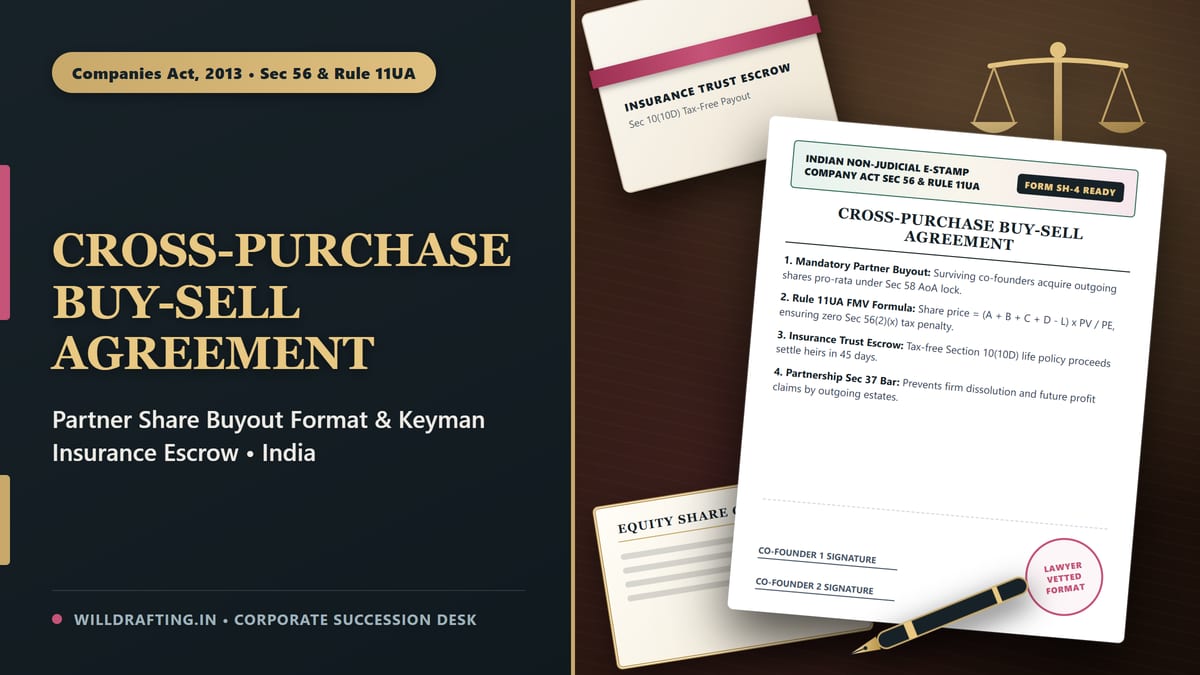
Cross-Purchase Buy-Sell Framework: Companies Act Sec 56 & 58, Rule 11UA FMV & Life Insurance Escrow
- Stops Unwanted Co-Owners: If a co-founder dies, shares pass to their spouse or kids by default. A Cross-Purchase pact lets survivors buy those shares fast.
- Must Match Your AoA: Under Section 58 of the Companies Act, 2013, share buyout rules bind a Private Limited company only when added to its Articles of Association.
- Tax-Safe Rule 11UA Pricing: Buying shares below Rule 11UA Fair Market Value triggers tax penalties under Section 56(2)(x) and Section 50CA.
- Avoids Keyman Tax Leakage: Direct Keyman payouts get taxed under Section 28(vi). A Life Insurance Trust Escrow keeps death payouts tax-free under Section 10(10D).
- Blocks Section 37 Claims: In a Partnership firm, this pact prevents automatic death dissolution under Section 42(c) and stops open-ended Section 37 profit suits.
1. Cross-Purchase Buy-Sell Agreement Rules in India
Picture three co-founders who own equal shares in a growing Private Limited company. If one founder passes away, their 33.3% stake passes to their spouse or children. Suddenly, the surviving partners must run the business with an heir who may lack industry skill or want fast cash dividends.
At the same time, the deceased founder's family holds illiquid private shares that earn zero salary and cannot be sold on an open market. Without cash, the surviving partners cannot buy the family out either. Both sides get trapped in a boardroom deadlock.
A Cross-Purchase Buy-Sell Agreement solves both problems at once. Each partner signs a binding promise while alive. If one partner dies, the surviving partners buy the outgoing shares pro-rata, and the deceased partner's estate agrees to sell at a fair formula price.
Generic templates copied from US websites fail in Indian courts. They miss Form SH-4 stamp duty rules under Section 56, AoA lock-in rules under Section 58, tax floor rules under Rule 11UA, and profit-share limits under Section 37 of the Partnership Act.
2. Buy-Sell Payout & Rule 11UA Tax Tool
Model a partner buyout for your Private Limited company, Partnership, or LLP. Check each survivor's share of the buyout cost, stamp duty, and Keyman tax risk.
Use Form SH-4 + AoA Pre-Emption. Remember: Transfer ban fails unless added to the AoA. Sets the minimum tax-safe floor under Sec 56(2)(x) and Sec 50CA.
3. Cross-Purchase vs Entity Buyback vs No Agreement
Co-founders often confuse a Cross-Purchase pact with a company share buyback under Section 68. Look at how the three options differ in India:
| Legal & Tax Factor | Cross-Purchase + Escrow | Company Buyback (Sec 68) | No Buy-Sell Agreement |
|---|---|---|---|
| Who Buys Shares? | Surviving partners pro-rata | Company redeems and cancels shares | Legal heirs inherit shares directly |
| Insurance Payout Tax | Tax-free under Sec 10(10D) | Taxable Keyman income (Sec 28(vi)) | No funding mechanism |
| Buyback Tax / Cap | No 25% Sec 68 annual cap | Capped at 25% of paid-up capital | N/A (Boardroom deadlock) |
| Transfer Instrument | Form SH-4 (0.015% stamp duty) | Form SH-8, SH-9, SH-11 ROC filings | Probate or Succession Certificate |
| Bank & Client Impact | Seamless continuity in 30-45 days | Slow solvency & ROC checks | Accounts frozen; Sec 37 profit suits |
4. Keyman Life Insurance Trust Escrow Mechanism
Many agents tell founders to buy a company-owned Keyman policy to fund a partner buyout. That creates a major tax trap. Under Section 10(10D)(b) and Section 28(vi) of the Income Tax Act, any payout from a Keyman policy is fully taxable as business income. If the cover is ₹3 Crore, roughly ₹90 Lakhs can vanish in tax before reaching the deceased partner's family.
Escrow Trustee Holds Policies
Each founder takes an individual term life plan assigned to an Irrevocable Insurance Escrow Trust. Premiums are NOT deducted as a Section 37(1) business expense.
Tax-Free Death Payout
When a partner passes away, the insurer pays 100% of the sum assured to the Escrow Trustee. Because it is not a Keyman policy, the sum is tax-free under Section 10(10D).
Cash for Signed Form SH-4
The Escrow Trustee pays the deceased partner's widow or heirs ONLY when they hand over signed Form SH-4 and share certificates to the surviving partners.
5. Rule 11UA Valuation Formula & Section 56(2)(x) Safety
Many online contracts let founders put a fixed price like “₹10 per face value share.” In India, that triggers severe double taxation. Under Section 56(2)(x), if surviving partners buy unquoted shares below their Rule 11UA Fair Market Value (FMV), the tax officer treats the discount as taxable income in the buyers' hands. At the same time, Section 50CA taxes the deceased partner's estate on the higher deemed FMV.
6. Companies Act Sec 56 & 58 and Partnership Sec 37
Signing a standalone Buy-Sell Agreement in a drawer is not enough. Three Indian statutes control whether a surviving partner can actually force the transfer:
V.B. Rangaraj Principle & Board Refusal
In V.B. Rangaraj v. V.B. Gopalakrishnan, the Supreme Court held that private share transfer limits bind the company only when placed in the Articles of Association. Section 58(1) lets the Board refuse outside transfers within 30 days if backed by the AoA.
Transmission First, Then Form SH-4 Sale
A company cannot transfer shares directly from a dead person. First, legal heirs transmit shares under Section 56(2). Then, heirs sign Form SH-4 stamped at 0.015% under Article 62 and lodge certificates within 60 days.
Stopping Post-Death Profit Claims
Under Section 42(c), a partnership ends at death unless agreed otherwise. Without a buyout option, Section 37 lets heirs demand future business profits or 6% interest. A valid buyout pact activates the Section 37 proviso bar.
Shakti Yezdani (2023 SC) Nominee Rule
In Shakti Yezdani v. Jayanand Salgaonkar (2023), the Supreme Court confirmed that a Form SH-13 nominee is only a caretaker. Pairing your Buy-Sell pact with a Will keeps the estate aligned and avoids family lawsuits.
7. Cross-Purchase Buy-Sell Agreement Format India
Below is our complete Cross-Purchase Buy-Sell Agreement draft for Private Limited co-founders and Partnership firms, incorporating Rule 11UA pricing, Insurance Escrow, and Section 56/58 compliance:
8. AoA Filing, Stamping & Closing SOP
Execute the Buy-Sell Agreement on appropriate state stamp paper (typically ₹200 to ₹500 for commercial agreements) with the company signing as Confirming Party.
Hold an Extraordinary General Meeting (EGM), pass a Special Resolution inserting the Buy-Sell pre-emption clause into the AoA, and file Form MGT-14 with the ROC within 30 days.
Issue individual term life policies for each founder and assign them to the Escrow Trustee. Record clearly that premiums are not claimed as Section 37(1) deductions.
Ask your Statutory Auditor or CA to issue an updated Rule 11UA valuation note after every annual balance sheet so insurance cover matches buyout value.
Update every co-founder's personal Will to name a clear executor authorized to sign Form SH-4 and receive escrow cash on behalf of family heirs.
Upon death, file death proof for Section 56(2) transmission, execute 0.015%-stamped Form SH-4 within 60 days, and release Escrow payout simultaneously.
9. Practical Case Studies: Bengaluru & Mumbai
33.3% Co-Founder Buyout Funded Tax-Free via Insurance Escrow
Three tech founders in Bengaluru held equal equity in a ₹12 Crore SaaS Private Limited company. Instead of buying company Keyman plans (which would have lost 30% to Section 28(vi) tax), they assigned ₹4 Crore term plans into an Irrevocable Escrow Trust and amended their AoA via Form MGT-14. When one founder passed away in a road accident, the Escrow Trustee paid his widow ₹4 Crore tax-free within 40 days against signed Form SH-4 transfer deeds.
Preventing Automatic Dissolution and 6% Profit Claims
Two brothers ran a registered partnership factory in Navi Mumbai. Their old deed had no death buyout clause. After reviewing Section 42(c) and Section 37 risks, they executed a Cross-Purchase Partnership Addendum backed by Rule 11UA asset valuation. The factory stayed operational without bank account freezes, and the surviving brother had a clear 24-month payment window for the family.
10. Legal Citations & Corporate Succession Desk
- Companies Act, 2013 ss. 44, 56, 58 & 72: Form SH-4 share transfers, private company AoA refusal powers, and nominee trust rules.
- Indian Partnership Act, 1932 ss. 37 & 42(c): Firm continuity upon death and statutory bar on subsequent profit claims.
- Income Tax Act, 1961 ss. 10(10D), 28(vi), 50CA & 56(2)(x): Keyman insurance taxability vs life insurance exemption and Rule 11UA FMV floor.
- Supreme Court Precedents: V.B. Rangaraj v. V.B. Gopalakrishnan (1992) and Shakti Yezdani v. Jayanand Salgaonkar (2023).
11. Frequently Asked Questions: Partner Buy-Sell Pacts
Why Write a Will Too?
A Buy-Sell pact sets the share buyer. A clear Will names your executor so your spouse and kids get the buyout cash fast without court delays.
Protect Your Co-Founders
Update your company AoA and add an Escrow Trust today. That keeps operations smooth and prevents unwanted outsiders on your board.
How Our Team Helps
Our lawyers align your Buy-Sell pact, AoA clauses, and personal Wills in one clean package. Note: this guide gives general info, not case advice.