Will Drafting for NRIs in Netherlands
The Netherlands has over 228,000 people of Indian heritage. This includes tech workers in Amsterdam and Eindhoven, as well as Surinamese-Hindustani families in Rotterdam and The Hague. Many own ancestral plots, farm land, flats, and bank funds across India. Under Section 5 of the Indian Succession Act 1925, Indian land and flats follow Indian law only. Dutch wills cannot transfer Indian land smoothly to your children. Our High Court lawyers draft clear Indian Wills. These protect your properties from Dutch forced share rules, align with EU rules, and give your family peace of mind.
Dutch Civil Code vs Indian Succession Law
- Dutch Legitieme Portie Forced Share: Book 4 of the Dutch Civil Code gives children a fixed money claim that cannot be cut out in a Dutch will. A separate Indian Will protects your Indian assets under Section 30 of the Hindu Succession Act.
- EU Brussels IV Choice of Law: Under EU rules, Dutch law applies by default if you live in the Netherlands. We draft clear clauses choosing Indian succession law for your Indian land.
- Avoid Mutual Revocation: Standard Dutch wills revoke past wills across the globe. Our lawyers add clear wording so your Dutch and Indian wills work side by side.
- Dutch Rechtbank Court Apostille: You do not need to fly to India. We help you sign on plain paper in the Netherlands and get an apostille sticker from your local Dutch court.
Netherlands NRI Estate Architecture & Legal Strategy Selector
Select your family estate profile in the Netherlands to inspect the exact statutory conflict, Lex Situs protection mechanism, and recommended cross-border legal instrument:
Dutch Civil Code: Ring-Fencing Against Legitieme Portie
Dutch Civil Code Book 4 (BW 4:63) grants children a statutory monetary claim (legitieme portie) equal to half of their intestate share. Indian expats in Amsterdam, Eindhoven, and Rotterdam who distribute Indian property unequally face potential monetary claims from disinherited heirs under Dutch law.
Under Section 5 of the Indian Succession Act 1925, succession to immovable property in India follows Indian law (Lex Situs). Section 30 of the Hindu Succession Act 1956 gives complete freedom to dispose of self-acquired property by Will. An Indian Will with Brussels IV choice-of-law recitals ring-fences Indian land against Dutch forced share calculations.
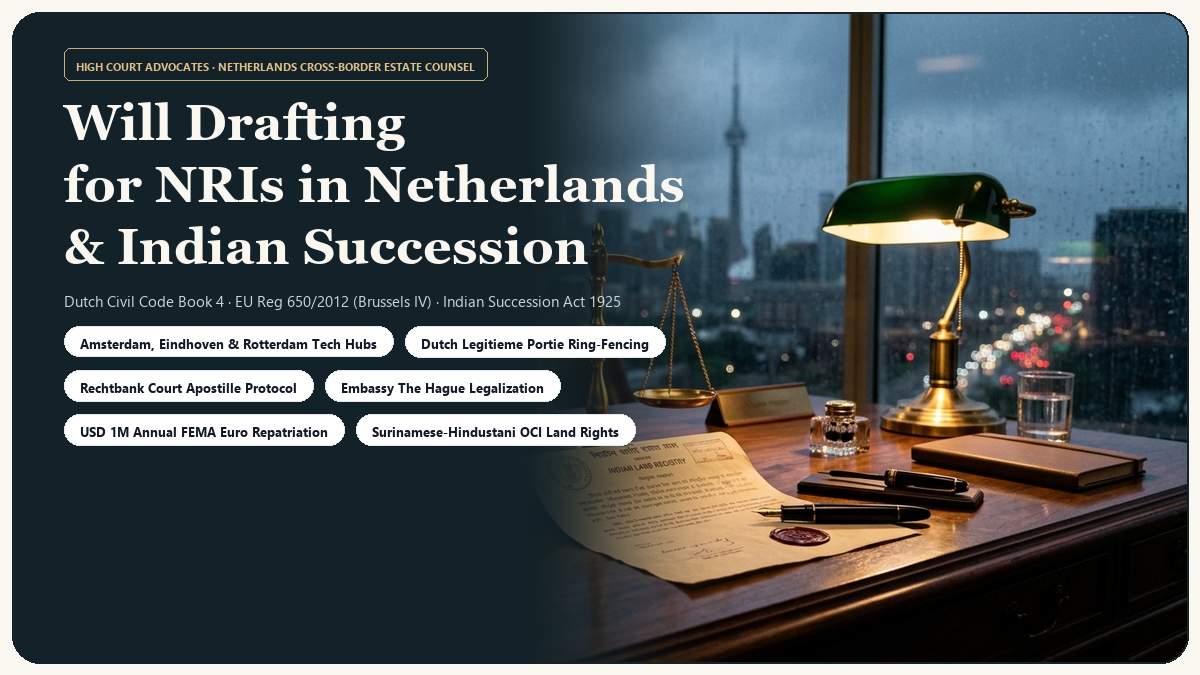
Visual Legal Framework: Netherlands-India Succession
How an Indian Will drafted by High Court advocates safeguards your immovable real estate, aligns with EU Regulation 650/2012, and enables swift revenue mutation across Indian states:
Dutch Succession Law vs Indian Succession Act 1925
Comparing estate distribution rules between the Dutch Civil Code (Burgerlijk Wetboek Book 4) and Indian statutory laws helps families prevent expensive probate litigation and protect their ancestral wealth:
| Succession Parameter | Dutch Law (Burgerlijk Wetboek & EU) | Indian Law (ISA 1925 & HSA 1956) | Cross-Border Solution |
|---|---|---|---|
| Governing Law for Indian Land | Burgerlijk Wetboek Book 4 & EU Reg 650/2012 | Indian Succession Act 1925 s. 5 (Lex Situs) | Indian law strictly controls all land, apartments, and farm plots located in India. |
| Forced Share vs Will Freedom | BW 4:63 fixes legitieme portie monetary claim for children | 100% testamentary freedom for self-acquired assets (s. 30 HSA) | A separate Indian Will insulates Indian assets from Dutch forced heirship claims. |
| EU Choice of Law (Brussels IV) | Habitual residence applies unless nationality law is chosen | Section 5 Lex Situs applies to Indian immovable land | Article 22 Brussels IV election aligns Dutch notarial wills with Indian Wills. |
| Signing & Execution Formalities | Dutch civil law notary deed registered in CTR register | Plain A4 paper signed before 2 adult witnesses (s. 63 ISA) | Execute on plain paper in Amsterdam or Eindhoven with zero Indian stamp duty. |
| Apostille & Legalization | Dutch District Court (Rechtbank) Hague Apostille | Embassy of India The Hague attestation or Hague Apostille | Apostilled Indian Wills are valid across all Indian state courts and land registries. |
| Surinamese & OCI Farm Land | No Dutch restrictions on foreign land ownership | FEMA Reg 3(1)(b) permits inheritance of agricultural land | OCIs in the Netherlands can legally inherit Indian farm parcels through a valid Will. |
| Probate & Municipal Mutation | Dutch Verklaring van erfrecht (Certificate of Inheritance) | Direct Tehsildar mutation or Indian High Court Probate (s. 228) | A separate Indian Will avoids multi-year foreign court resealing procedures. |
| Tax & Repatriation to Netherlands | Dutch erfbelasting (10% to 20%) & Successiewet 1956 | FEMA USD 1M annual transfer rule & s. 197 Form 13 TDS | Lower TDS certificates allow seamless Euro wire transfers to Dutch bank accounts. |
Copy-Pasteable Foreign Asset Ring-Fencing Clause
To prevent your Indian Will from clashing with your Dutch notarial testament, use this proven territorial ring-fencing clause in your Indian testamentary document:
"1. DECLARATION OF EXCLUSIVE TERRITORIAL JURISDICTION (LEX SITUS):
I hereby declare that this Last Will and Testament applies exclusively and solely to all my immovable properties (including agricultural land, farm plots, residential apartments, commercial buildings, and undivided coparcenary interests) and movable assets (including NRE, NRO, and FCNR bank accounts, shares, mutual funds, and fixed deposits) situated strictly within the territorial boundaries of the Republic of India.

2. NON-REVOCATION OF OVERSEAS AND DUTCH TESTAMENTS:
I expressly declare that this Will shall NOT revoke, modify, supersede, or impair any notarial will, public deed, or testamentary disposition executed by me in the Netherlands or elsewhere outside India concerning assets situated outside India. Both testaments shall operate independently and concurrently in their respective territorial jurisdictions.

3. ELECTION OF INDIAN LAW UNDER EU REGULATION 650/2012 (ARTICLE 22):
Pursuant to Article 22 of Regulation (EU) No 650/2012 of the European Parliament and of the Council (Brussels IV), I, being a citizen of India, hereby expressly choose the succession laws of the Republic of India to govern the succession of all my assets situated in India as a whole. Under Section 5 of the Indian Succession Act, 1925, succession to my immovable property shall be governed exclusively by the lex situs of India, to the exclusion of any statutory forced share (legitieme portie) under Book 4 of the Dutch Civil Code (Burgerlijk Wetboek)."
Statutory Compliance Note: Drafted under Section 5 and Section 63 of the Indian Succession Act 1925, Section 30 of the Hindu Succession Act 1956, and Article 22 of EU Regulation 650/2012. Prevents mutual cancellation between Dutch notarial wills and Indian wills while protecting Indian land from Dutch forced heirship claims.
1. The Lex Situs Doctrine & Section 5 of the Indian Succession Act
International law follows the rule of Lex Situs. This means the law of the land where the property sits controls that property. In India, Section 5 of the Indian Succession Act 1925 sets this rule into stone. Succession to Indian land and homes follows Indian law alone. It does not matter where you live or what passport you carry.
If you make a Dutch will in Amsterdam, Indian land offices cannot accept it right away. A Dutch will must go to court in the Netherlands first. Then it needs probate in an Indian High Court under Section 228 of the Act. This process takes 2 to 4 years. It also costs lakhs in court fees. A separate Indian Will removes this court delay. Your family can update land records with the local Tehsildar in a few weeks.
2. Overcoming Dutch Legitieme Portie with Section 30 HSA
Book 4 of the Dutch Civil Code gives children a fixed right called the legitieme portie. Under Article 4:63, children can claim half of their intestate cash share. Even if you want to leave your Indian assets to one child, Dutch law allows other children to ask for cash compensation from your total wealth.
Indian law gives you complete freedom. Under Section 30 of the Hindu Succession Act 1956, you can give your self-acquired land and flats to anyone you choose. No child can claim a forced share in your own property under Indian law. By writing a separate Indian Will, you keep your Indian flats, plots, and savings safe from Dutch forced share claims.
3. EU Regulation 650/2012: The Brussels IV Professio Juris Advantage
The Netherlands follows EU Regulation 650/2012, known as Brussels IV. Under Article 21, the default rule says the law of the place where you live governs your estate. If you live in Eindhoven or Rotterdam, this rule could drag your Indian land into Dutch court rules.
Article 22 gives you an easy way out. It lets you choose the law of your home country to govern your estate. When drafting your Indian Will, our High Court lawyers include formal choice of law clauses. This guarantees that Dutch courts and notaries respect Indian law for your Indian property.
4. Dutch Rechtbank Court Apostille & Embassy The Hague Protocol
Many NRIs in the Netherlands ask how to sign an Indian Will without flying to India. Under Section 63 of the Indian Succession Act 1925, a Will does not need stamp paper or court visits. You can print it on plain A4 paper and sign it before two adult witnesses.
To make your Dutch-signed Will fully bulletproof before Indian land clerks and courts, you have two clear options:
Pathway A: Dutch Rechtbank Apostille
Both India and the Netherlands belong to the Hague Apostille Convention. You sign your Will before a local Dutch notary. Then get an apostille sticker from your local District Court (Rechtbank) in Amsterdam, Rotterdam, or The Hague. Indian courts accept this directly.
Pathway B: Embassy of India, The Hague
You can book an attestation visit at the Embassy of India in The Hague (Buitenrustweg 2). Sign the Will before the consular officer with your Indian passport. This seal gives the paper undisputed legal weight under Section 85 of the Indian Evidence Act.
5. Surinamese-Hindustani Diaspora & OCI Farm Land Inheritance
The Netherlands has about 178,000 Dutch citizens of Indian descent from Suriname. Many of these families, along with tech workers who hold OCI cards, have ancestral property in Uttar Pradesh, Bihar, Punjab, and Gujarat.
Under FEMA rules, an OCI cardholder cannot buy new farm land in India. But the law allows an OCI to inherit farm plots, village houses, and plantation lands from family. To update land records (Khatauni) with the local Tehsildar, a clearly drafted Indian Will is essential proof of ownership.
6. Managing Dutch Erfbelasting & FEMA Capital Repatriation
Anyone living in the Netherlands must follow Dutch inheritance tax rules (erfbelasting). Rates run from 10% to 20% for spouses and children, and up to 40% for others. When heirs in the Netherlands inherit land or flats in India, cross-border tax planning protects your estate.
When selling inherited property, heirs can send up to 1 Million US Dollars each year from their NRO account to Dutch banks (ABN AMRO, ING, Rabobank). However, buyers in India may hold back 20% plus cess as tax under Section 195. Our lawyers help heirs get a lower tax certificate (Form 13) to save money.
Calculate Your Indian Capital Gains & Lower TDS Exemption
Estimate your capital gains tax on inherited Indian property and learn how to reduce Section 195 withholding tax using Form 13:
Protect Your Indian Heritage from Amsterdam, Eindhoven, or The Hague
Do not allow European forced heirship rules or uncoordinated wills to jeopardize your Indian properties. Work directly with AMA Legal Solutions High Court advocates to draft an ironclad, Lex Situs-compliant Indian Will on plain paper.
Frequently Asked Questions: Netherlands NRI Wills
Authoritative answers by High Court advocates on cross-border succession, Dutch Rechtbank apostilles, and Indian estate laws:
Does a Dutch notarial Will govern land and flats located in India?
No. Under Section 5 of the Indian Succession Act 1925, land and flats follow the Lex Situs rule. This means Indian law governs all Indian land. A Dutch will made before a notary in Amsterdam or The Hague does not transfer Indian land directly. It must go through court in the Netherlands first. Then it needs probate in an Indian High Court. That takes years. A separate Indian Will lets your heirs take title directly through local land offices.
How does the Dutch Civil Code forced share (legitieme portie) affect Indian assets?
Book 4 of the Dutch Civil Code (BW 4:63) gives children a money claim called legitieme portie. But Indian real estate follows Indian law. Under Section 30 of the Hindu Succession Act 1956, you have full freedom to give self-acquired land to anyone you choose. A separate Indian Will keeps your Indian assets safe from Dutch forced share claims.
How does EU Regulation 650/2012 (Brussels IV) protect my Indian estate?
Under Article 21 of Brussels IV, Dutch succession law applies by default to residents in the Netherlands. But Article 22 lets Indian citizens choose Indian law to govern their estate. Our lawyers add clear choice of law terms to your Indian Will. This stops Dutch courts from trying to split your Indian land under European rules.
How do I prevent my Dutch notarial Will from revoking my Indian Will?
Standard Dutch wills use broad words that cancel all past wills across the globe. To stop accidental cancellation, both papers must have clear clauses. Your Dutch will must govern assets in the Netherlands. Your Indian Will must govern only Indian land, bank accounts, and shares.
Can Dutch citizens of Indian origin (Surinamese-Hindustani and OCIs) inherit farm land in India?
Yes. Under FEMA Regulation 3(1)(b), OCIs can legally inherit farm plots, plantation lands, and houses from an Indian relative. Foreign citizens cannot buy new farm land in India directly. But inheriting through a valid Indian Will is 100% legal. A clear Will lets heirs update name records quickly before the local Tehsildar.
How do I get my Indian Will apostilled or attested in the Netherlands?
Both the Netherlands and India follow the Hague Apostille Convention 1961. You can sign your Indian Will on plain A4 paper before two adult witnesses in Amsterdam, Eindhoven, or Rotterdam. You can then get an apostille sticker from your local Dutch District Court (Rechtbank). You can also book a slot at the Embassy of India in The Hague. Indian courts accept both.
Is Indian stamp paper required when signing an Indian Will in the Netherlands?
No. Under the Indian Stamp Act 1899, a Will needs zero stamp duty. You can print your Indian Will on plain paper in the Netherlands. The paper becomes legal once you sign it before two adult witnesses who are not named as heirs.
How can heirs in the Netherlands repatriate property sale proceeds in Euros?
Under RBI FEMA rules, heirs can send up to 1 Million US Dollars abroad each financial year through an NRO bank account. Our lawyers help heirs get a Section 197 lower tax certificate (Form 13) and CA certificates (Form 15CA and Form 15CB) for smooth Euro wire transfers to Dutch banks.
Explore related NRI property services, probate counsel, and legal directory:
Authored by Advocate Anuj Anand Malik (Bar Council of Delhi). Reviewed for cross-border compliance with the Indian Succession Act 1925, Hindu Succession Act 1956, Dutch Civil Code (Burgerlijk Wetboek Book 4), and EU Regulation 650/2012 by the AMA Legal Solutions Private Client Group.