Indian Will Drafting for NRIs in Italy
Over 206,000 Indians live in Italy across Lombardy, Milan, Brescia, and Rome. Many families own farm land, homes, and bank deposits in Punjab and Haryana. Under Section 5 of the Indian Succession Act, 1925, Italian rules cannot transfer land in India. We help you draft a clear Indian Will. Our lawyers protect your land from Italian court claims. We also update your land records in India without any travel.
Italy NRI Estate Risks: Protecting Punjab & Haryana Lands
- Italian Forced Heirship Trap: The Italian Civil Code reserves shares for distant kin. A generic will triggers Italian court claims over Indian property.
- Punjab Jamabandi Bottlenecks: Halqa Patwaris freeze Intkal entries when an NRI passes away without a clear Indian Will. This invites partition lawsuits.
- Bank Account Freezes: In Sarbati Devi, the Supreme Court held that bank nominees are only caretakers. Accounts freeze without a valid testamentary Will.
Why Write an Indian Will Now?
You keep your farm and flats in India safe. Court battles in India take ten to twenty years. A valid Will lets your family take over without court fights. We help you write a clear Will. Your land stays secure. Your children get their rightful share in peace. You avoid heavy legal fees. Your family saves time and stress.
Who Needs This Legal Help?
Any Indian in Italy who owns land, a home, a shop, or a bank account in India. It also helps families with farm land in Punjab, Haryana, or Delhi. You can sign your Will right here in Italy. Two friends witness your signature. You do not need Indian stamp paper. We make the whole process fast and simple.
How Our Lawyers Help You
We draft your Will on plain paper. You sign it in Italy with two witnesses. You do not need to fly to India. We can also help get an apostille stamp from the local Italian court. Your papers stay 100% valid in Indian courts. Our team updates your land records directly with local revenue staff.
Interactive Italy NRI Succession Diagnostics
Select your asset profile to explore how Indian succession laws, Italian civil rules, and Hague apostille standards interact to protect your Indian properties:
Farmland Inheritance: Intkal & Jamabandi Mutation
Families in Milan, Brescia, or Verona own farm land in Jalandhar, Ludhiana, or Karnal. When an NRI passes away, local revenue staff freeze land mutation. Distant relatives may claim false rights.
Under Section 5 of the Indian Succession Act 1925, Indian land follows Indian law only. A valid Will gives the Tehsildar clear legal proof under Section 34 of the Punjab Land Revenue Act 1887.
- Check Tehsil Jamabandi, Khewat, and Khasra land numbers
- Draft clear gifts to stop family disputes over farm land
- Appoint a trusted person in India to handle land hearings
Calculating Capital Gains or TDS on Inherited Property in India?
Use our interactive calculators to compute capital gains tax, indexation relief, and Section 195 TDS on selling inherited assets.
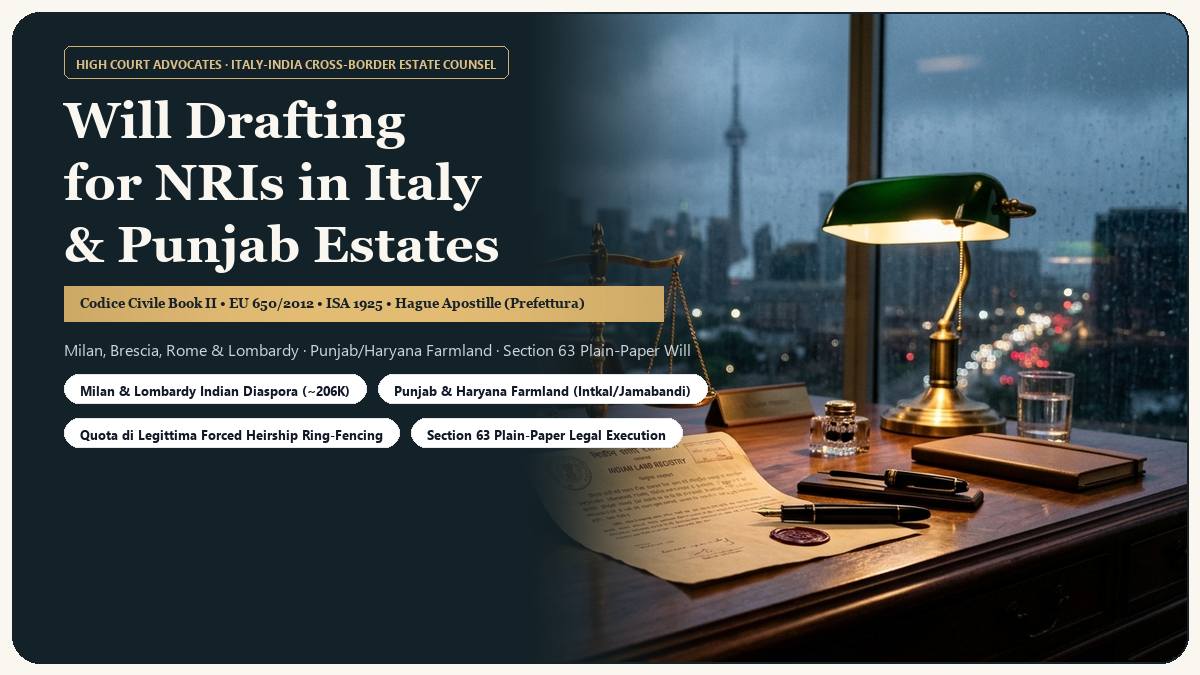
Visual Guide: Italy NRI Estate & Land Transmission
How an Indian Will drafted by High Court advocates shields your ancestral lands in Punjab and Haryana from Italian civil disputes, ensures smooth revenue mutation, and satisfies FEMA repatriation rules:
Italian Civil Code vs Indian Succession Act
Confusing Italian civil rules with Indian property laws leads to frozen revenue records and invalid testamentary clauses. Compare how both jurisdictions treat inheritance, forced heirship, and land:
| Legal Parameter | Italian Law (Codice Civile) | Indian Law (ISA 1925) | EU Succession Regulation |
|---|---|---|---|
| Governing Statute | Codice Civile Book II (Arts. 456-768) | Indian Succession Act 1925 (ss. 5 & 59) | EU Regulation 650/2012 (Brussels IV) |
| Immovable Property Rule | Applies to Italian assets only | Lex Situs: Indian law governs Indian land | Article 22 allows national law choice |
| Forced Heirship System | Mandatory Quota di Legittima for heirs | 100% Testamentary Freedom over self-acquired | Overridden by national law election |
| Farmland Inheritance | Italian acts invalid for Indian revenue | Punjab Land Revenue Act 1887 s. 34 Intkal | Recognizes third-country land sovereignty |
| Execution Formalities | Testamento Pubblico or Olografo | Plain A4 Paper before 2 witnesses (s. 63) | Accepts forms valid under place of signing |
| Apostille Recognition | Prefettura / Procura della Repubblica | Fully valid in India under Hague Convention | Direct cross-border enforcement in EU |
| Bank Nominee Ownership | Italian bank succession declaration | Nominee is custodian; Will gives title | Governed by account location rules |
4-Step Legal Roadmap for NRIs in Italy
Our High Court lawyers handle cross-border planning from start to finish. Follow this clear 4-step path to secure your Indian legacy peacefully:
Asset & Title Audit
We check your land records, Jamabandi papers, and bank details in Punjab or Haryana. We make sure all titles are clean and clear.
Advocate Will Drafting
Our High Court lawyers draft your Indian Will. We make sure Italian rules never touch your Indian assets. Your wishes stay final.
Remote Section 63 Signing
You sign your Will on plain A4 paper in Italy. Two adult friends sign as witnesses. We can also arrange an Italian apostille stamp.
Safe Deposit & Mutation
We keep your papers safe. Our local team in India presents your Will to the Tehsildar to update your land records smoothly.
Foreign Asset Ring-Fencing & Lex Situs Clause
A standard revocation clause in an Indian Will can accidentally cancel your Italian estate plans. Our lawyers include strict territorial ring-fencing terms to keep both jurisdictions completely separate:
“I hereby declare that this Last Will and Testament relates exclusively to my movable and immovable properties, agricultural lands, residential houses, and bank accounts situated within the territorial borders of the Republic of India. This instrument shall not revoke, alter, or impact any testamentary disposition or Will executed by me in Italy or elsewhere regarding assets situated outside India. I expressly declare that succession to my Indian estate shall be governed solely by the Indian Succession Act, 1925, and relevant state land laws, to the total exclusion of foreign forced heirship rules (quota di legittima).”
* Note: Our advocates customize this clause to ensure compliance with Article 22 of EU Regulation 650/2012, securing full legal harmony across Rome, Milan, and Indian High Courts.
Italy NRI Indian Will Checklist
Sub-Registrars and Halqa Patwaris verify these critical details:
- Punjab Jamabandi Details: Khewat, Khatoni, and Khasra parcel numbers clearly listed.
- Two Witnesses: Signed by two adult witnesses who are not named beneficiaries.
- Bank Account Schedules: Full IFSC, branch, and account numbers for NRE and NRO funds.
- Executor Appointment: Naming a trusted Indian resident to oversee revenue mutation.
Selling Inherited Property in India from Italy?
Calculate your capital gains liability, Section 195 TDS rates, and repatriation limits under RBI FEMA rules with our tools.
Punjab & Haryana Farmland Succession Protocol
Under Section 34 of the Punjab Land Revenue Act 1887, all land transfers must be recorded by the local Patwari. This process is called Intkal. When an Indian dies abroad without a Will, local officers freeze land mutation. Distant relatives can raise false claims. This leads to years of court fights.
A valid Indian Will stops all disputes. Our lawyers submit your Will to the Tehsildar. We update your Jamabandi records without you having to travel to India.
Frequently Asked Questions: Italy NRI Wills
Clear legal answers prepared by the WillDrafting Editorial Team and verified by High Court counsel at AMA Legal Solutions:
Does an Italian Will transfer agricultural land in Punjab or Haryana?
No. Under Section 5 of the Indian Succession Act 1925, Indian land follows Indian law only. Land officers in Punjab and Haryana reject Italian wills. You need an Indian Will to pass land to your heirs without court fights.
Can NRIs in Italy sign an Indian Will on plain paper?
Yes. Under Section 63 of the Indian Succession Act 1925, you can sign your Will on plain A4 paper. You do not need Indian stamp paper. You sign before two adult witnesses who are not heirs in the Will.
How does Italian forced heirship affect property located in India?
Italian civil law sets aside fixed shares for certain heirs. But Indian land follows Indian law. Under Section 59 of the Indian Succession Act, you have full freedom to give your self-made land to anyone you choose.
Can NRIs in Italy inherit farmland in India under FEMA regulations?
Yes. Under FEMA rules, Indian passport holders living in Italy have full legal rights to inherit farm land from an Indian resident. A clear Will stops land disputes and helps update revenue records.
Do I need an Italian Apostille from the Prefettura or Procura?
A Will signed on plain paper before two witnesses is valid under Section 63. But an Italian Notaio stamp and Procura apostille give strong legal proof. It makes your Will solid in Indian courts.
What happens to NRE and NRO bank accounts without a Will?
In the Sarbati Devi case, the Supreme Court ruled that a bank nominee is only a caretaker. Without a Will, banks in India freeze accounts. Your heirs must go to court to get the funds.
Can EU Succession Regulation 650/2012 protect my Indian assets?
Yes. Article 22 of EU Regulation 650/2012 lets Indian citizens choose Indian law for their estate. A separate Indian Will keeps both lands apart. It prevents cross-border clashes.
How does Jamabandi and Intkal mutation work without travelling to India?
Our High Court lawyers represent you before the Halqa Patwari and Tehsildar under Section 34 of the Punjab Land Revenue Act 1887. We present your Will so land records update smoothly without travel.
Explore related international hubs, legal guides, and complete directory indexes:
This cross-border legal guide is prepared under the Indian Succession Act 1925 (Sections 5, 59, 63), Punjab Land Revenue Act 1887 (Section 34), Italian Civil Code (Codice Civile Book II), and EU Succession Regulation 650/2012 (Article 22). Attestation standards conform to the 1961 Hague Apostille Convention. This content provides legal education and does not replace individualized advocate advice.