Indian Will Drafting for NRIs in DR Congo
Around 20,000 Indians live across Kinshasa, Lubumbashi, Goma, and Katanga province. Under the DR Congo Family Code, succession defaults to local rules at death. Without an Indian Will, Congolese court papers face huge delays in India. You can avoid this. A standalone Indian Will protects your flats, ancestral lands, and bank deposits. Our High Court lawyers draft clear Wills for peaceful asset transfer.
DR Congo NRI Estate Risks: Cross-Border Asset Protection
- Forced Heirship Under DRC Family Code: Articles 758 to 765 impose reserved shares for local heirs. Congolese courts or family councils cannot directly update Indian land records.
- Indian High Court Probate Delays: Indian land registries reject foreign Congolese court judgments. Getting ancillary probate in India takes years. It also requires certified French translations.
- Non-Hague Legalization Complexities: DR Congo does not issue Hague apostilles. Executing a standalone Indian Will prevents costly multi-embassy legalization hurdles.
Why Write an Indian Will Now?
You protect your flats and land in India. Court cases in India take many years to finish. A clean Will lets your heirs take over peacefully. We help you write a clear Will. Your wealth stays safe. Your family avoids long court fights.
Who Needs This Legal Help?
Any Indian in DR Congo who owns a flat, plot, bank balance, or mutual funds in India. It helps business owners, mining engineers, and trading families. You can sign your Will in DR Congo. Two adult friends witness your signature. You do not need Indian stamp paper.
How Our Lawyers Help You
We draft your Will under Indian law and DRC rules. You sign it in DR Congo with two witnesses. We guide you on Indian Embassy attestation. We also help your family update Indian land records. Our lawyers make the entire process simple and safe.
Interactive Succession Planner for NRIs in DR Congo
Select your legal concern below to evaluate DRC Family Code rules, Indian Embassy attestation steps, and drafting protocols under Indian law:
DRC Family Code vs Indian Succession Act Harmonization
Under Articles 758 to 765 of the DR Congo Family Code (Code de la Famille), forced heirship rules protect certain family shares. If you live in Kinshasa or Lubumbashi, local succession rules apply by default. A Will made only in DR Congo causes long delays in India. Indian land offices do not accept foreign Congolese court orders directly.
Section 5 of the Indian Succession Act follows the lex situs rule. Indian land and flats follow Indian law. Section 59 grants you full testamentary freedom over Indian assets. A separate Indian Will protects your properties. It keeps your Indian estate free from foreign court delays.
Essential Verification Checklist
Key legal checks for NRIs in DR Congo before signing your Will:
- State your residence in Kinshasa, Lubumbashi, or Goma clearly
- Keep Congolese business assets separate from your Indian estate
- Elect Indian Succession Act 1925 for all assets situated in India
Configure Your DR Congo-India Estate Blueprint
Answer 3 quick questions to receive a personalized legal action summary for your Indian properties and investments:
Indian Real Estate & Commercial Property Protection Plan
For flats, commercial offices, and plots in Mumbai, Ahmedabad, Delhi NCR, or Bengaluru, your Will needs exact deed details and municipal tax IDs.
- List sale deed registration numbers, plot boundaries, and survey IDs
- Ring-fence Indian flats to avoid Congolese court probate bottlenecks
- Name an India-resident executor for prompt property tax mutations
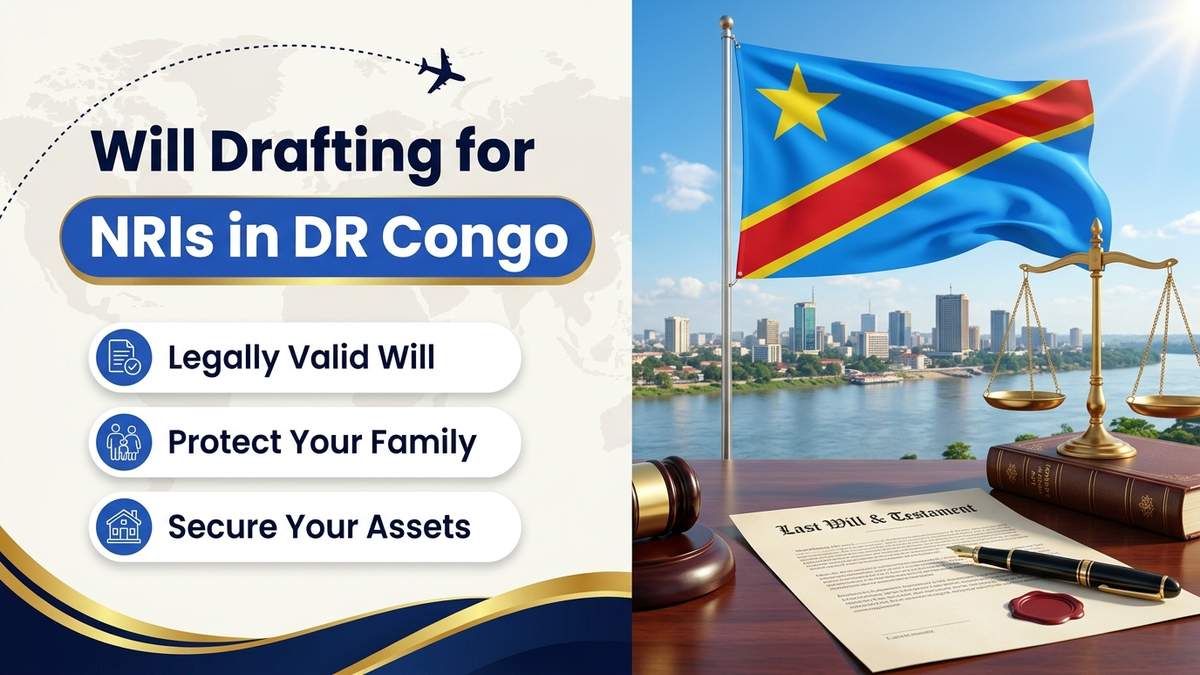
Visual Legal Framework: DR Congo-India Succession
How an Indian Will drafted by High Court advocates safeguards your cross-border assets, harmonizes the DRC Family Code with the Indian Succession Act, and enables swift asset transmission:
DR Congo vs Indian Succession Law: Key Differences
Failing to ring-fence Indian assets exposes your family to Congolese probate delays, translation costs, and conflicting court jurisdictions. Compare how succession operates across both legal frameworks:
| Legal Parameter | DR Congo Law (Code de la Famille) | Indian Succession Act, 1925 | Dual-Will Ring-Fencing |
|---|---|---|---|
| Default Governing Succession Law | DRC Code de la Famille via Domicile (Articles 758-765) | Indian Succession Act, 1925 applies to Indian land (Lex Situs) | Explicit territorial clause ensures Indian law governs Indian assets |
| Forced Heirship & Reserved Shares | Strict réserve héréditaire protects statutory family portions | Zero forced heirship; 100% testamentary freedom under Section 59 | Ring-fencing isolates Indian real estate from Congolese estate claims |
| Will Execution Formalities | Authentic notarial deed, holographic, or public will before court | Plain A4 paper signed before two adult witnesses (Section 63) | Signed in DR Congo on plain paper with optional Indian Embassy attestation |
| Legalization & Apostille Framework | Non-Hague country; requires Congolese MFA & Indian Embassy seals | Two adult attesting witnesses make the Will valid under Section 63 | Consular attestation at Embassy of India in Kinshasa provides total proof |
| Bank & Demat Asset Transmission | Requires Congolese court judgment or family council homologation | Sarbati Devi rule applies; nominee acts only as interim trustee | Direct transmission via Will without waiting for Indian court orders |
| Immovable Property Mutation | Foreign DRC court orders not recognized by Indian Sub-Registrars | Revenue mutation under state land laws and municipal corporation rules | Fast Tehsildar and municipal property tax transfer across India |
| Inheritance Tax & Capital Gains | Local Congolese estate duties and municipal tax clearances | Zero inheritance tax in India; Section 197 lower TDS on property sale | Full tax transparency for Section 197 TDS and Form 15CA/15CB remittance |
| Court Probate Requirement | Tribunal de Grande Instance probate or family council approval | Probate mandatory only in Mumbai, Kolkata, Chennai (Section 57/213) | Parallel settlement in DRC and India without reciprocal court delays |
Legal 4-Step DR Congo NRI Will Roadmap
Our High Court lawyers handle the entire cross-border succession lifecycle. Follow this 4-step path to secure your Indian wealth:
Asset Schedule & Title Audit
We review your sale deeds, tax receipts, bank accounts, and demat folios in India. We verify every property detail with care.
DRC Family Code Ring-Fencing
Our lawyers draft your Will with clear territorial clauses. We elect Indian law and protect your Congolese assets from conflict.
Plain-Paper or Embassy Signing
You print the draft on plain paper. You sign before two adult witnesses in DRC. We guide you on Indian Embassy attestation.
Executor Briefing & Mutation SOP
We give your executors in India clear steps for land mutation, bank account claims, and RBI fund repatriation.
Copy-Pasteable DR Congo-India Ring-Fencing Clause
Without a clear territorial clause, cross-border court orders cause delays. Our advocates structure clean clauses to protect and isolate your Indian property:
“I, [Testator Full Legal Name], residing in [City, Democratic Republic of the Congo], holding [Indian / Foreign] Passport No. [Passport Number] [and OCI Card No. [OCI Number]], hereby declare that this Last Will and Testament shall govern exclusively all my immovable and movable properties, bank accounts, fixed deposits, demat folios, mutual funds, and assets situated in the Republic of India. In accordance with Section 5 and Section 59 of the Indian Succession Act, 1925 (lex situs principle), the succession, administration, and distribution of my Indian estate shall be governed strictly by the laws of India. This Will is executed as an autonomous testamentary instrument and shall not revoke, cancel, or supersede any separate Will executed by me in the Democratic Republic of the Congo regarding my Congolese assets.”
* Note: If you hold foreign citizenship or an OCI card, our High Court advocates customize this clause to preserve Indian succession autonomy under international private law.
DR Congo-India Execution Checklist
Essential steps to ensure full validity across DR Congo and India:
- Two Adult Witnesses: Sign in the presence of two witnesses who are not named as heirs in the Will.
- No Indian Stamp Paper: Execution on plain A4 paper is 100% valid under Section 63 of the Indian Succession Act.
- Indian Embassy Attestation: Consular attestation at the Embassy of India in Kinshasa provides official proof.
- Schedule Identification: List exact survey numbers, flat unit numbers, and bank account IFSC details.
Calculate Inherited Property Capital Gains Tax
Estimate indexation benefits, Section 54 deductions, and capital gains tax liability before selling inherited Indian real estate.
NRI Property Sale TDS & Repatriation Calculator
Calculate Section 195 withholding tax, Section 197 lower TDS certificates, and Form 15CA/15CB outward remittance quotas.
Cross-Border Taxation & Fund Repatriation
Neither India nor DR Congo levies estate duty on inherited assets. You inherit Indian assets tax-free. But selling real estate later brings capital gains tax. Indian buyers must deduct tax under Section 195. Our legal team helps you get a Lower TDS Certificate under Section 197. This saves you from high tax cuts upfront.
Under RBI rules, heirs can transfer up to 1 million USD per year to DR Congo. You use an NRO bank account with Form 15CA and Form 15CB. Our advocates coordinate with chartered accountants to ensure full compliance with RBI regulations and tax filings.
Frequently Asked Questions: NRIs in DR Congo
Clear legal answers prepared by the WillDrafting Editorial Team and verified by cross-border advocates at AMA Legal Solutions:
Does the DR Congo Family Code apply to my assets in India?
Under Articles 758 to 765 of the DR Congo Family Code, local succession rules apply to residents. But Section 5 of the Indian Succession Act follows the lex situs rule. This means Indian land and flats follow Indian law. Having a separate Indian Will ensures Indian law governs your Indian wealth without cross-border delay.
Can NRIs in DR Congo execute an Indian Will on plain paper?
Yes. Under Section 63 of the Indian Succession Act, you can sign your Will on plain A4 paper. You do not need Indian stamp paper while living in DR Congo. You only need two adult witnesses who watch you sign. Your witnesses must not be heirs named in the Will.
Is an apostille valid in DR Congo for Indian property matters?
DR Congo is not a party to the 1961 Hague Apostille Convention. Therefore, apostilles cannot be issued in DR Congo. For official validation, you can get consular attestation at the Embassy of India in Kinshasa. You can also legalize documents through the DRC Ministry of Foreign Affairs and the Indian Embassy.
Why should NRIs in Kinshasa avoid a single worldwide Will?
A single worldwide Will causes court delays. A Congolese court judgment from Kinshasa or Lubumbashi is not accepted directly by Indian land offices. Indian courts require ancillary probate under Section 228 with certified French-to-English translations. Two separate Wills let both estates settle fast without court roadblocks.
How can Indian mining and business families protect ancestral property in India?
Many Indian families in Kinshasa, Lubumbashi, and Kolwezi own ancestral homes or commercial plots in Gujarat, Maharashtra, Punjab, and Delhi NCR. A clear Indian Will names your specific share. It lists all legal heirs. It also gives your executor power to complete municipal mutations and property tax transfers.
How are Indian NRE, NRO, and Demat accounts claimed from DR Congo?
Bank and depository nominees act only as temporary caretakers under the Supreme Court Sarbati Devi ruling. Nominees do not own the money. A clear Indian Will names your true heirs. This lets your family claim bank funds and shares quickly without a civil court succession certificate.
Does DR Congo or India levy inheritance tax on inherited estates?
Neither country levies inheritance tax. India ended estate duty in 1985. But selling inherited Indian land later brings capital gains tax. Under Indian tax laws, heirs can obtain a Lower TDS Certificate under Section 197 to avoid high tax deductions.
How can heirs in DR Congo repatriate inherited property sale funds?
Heirs first update land records using the Will. When selling, they obtain a Lower TDS Certificate under Section 197 to avoid 20% tax deduction. Under RBI rules, heirs can transfer up to 1 million USD per financial year to DR Congo using an NRO account and Form 15CA and Form 15CB.
Explore related NRI legal services, statutory guides, and the complete directory index:
This cross-border legal guide is prepared under the Indian Succession Act, 1925, the DR Congo Family Code (Law No. 87-010 as amended in 2016), the Foreign Exchange Management Act (FEMA), 1999, and the Diplomatic and Consular Officers (Oaths and Fees) Act. Judicial authorities referenced include lex situs under Section 5/59 and the Supreme Court ruling in Sarbati Devi. This content provides legal education and does not replace personalized advocate counsel.