Ultra-HNI Estate & Family Office Blueprint: Irrevocable Trusts, HoldCos, Cross-Border FEMA & Asset Ring-Fencing
- Beyond Retail Wills: Retail wills require public court probate in presidency cities, invite contested suits, and leave business assets vulnerable to personal creditor claims.
- Irrevocable Trust Shield: Assets transferred into an irrevocable private trust become immune to commercial insolvency under Section 32A of the IBC.
- Tax-Neutral Settlement: Section 47(iii) and 56(2)(x) of the Income Tax Act ensure that transfers of shares and properties to relatives via trust incur zero capital gains.
- SEBI Open Offer Exemption: Transfers of promoter shares to private family trusts enjoy general exemptions under SEBI SAST Regulation 10(1)(a)(ii).
- Cross-Border FEMA Harmony: Harmonize Indian assets with foreign holdings under RBI LRS limits and Overseas Investment Rules 2022 without Black Money Act exposure.
Zero Tax on Transfer
Move your shares and land for free. Section 47 protects family gifts. No capital gains tax applies. We make sure all papers stay valid.
Safe from Debts
Keep business loans away from your home. Creditors cannot touch trust assets. Your family stays secure. Your wealth is safe.
No Court Probate
Skip slow High Court probate cases. The trust continues on its own. Successor trustees step in fast. No waiting for court orders.
Keep Family Peace
Stop sibling fights before they start. A family charter sets clear rules. All heirs know their share. Everyone stays united.
1. We Check Your Assets
We list all land, flats, bank accounts, and company shares. We check loan guarantees. We review your family goals.
2. We Plan the Shield
We pick the best trust or holding setup for you. We make sure it is tax-free. We check all FEMA rules.
3. We Draft the Papers
Our senior lawyers draft your trust deed and family rules. We update company articles. We make terms crystal clear.
4. We Register Your Trust
We handle the Sub-Registrar Office filing. We complete share transfers. We hand you the final papers.
1. Institutional Legal Framework: Private Trusts & HoldCos
High-net-worth founders, promoters, and family business dynasties in India face complex legal challenges. When family wealth exceeds ₹50 Crore, relying solely on a testamentary Will creates severe structural vulnerabilities. A simple Will takes effect only upon death, requires cumbersome probate in High Courts under Section 213 of the Indian Succession Act, and offers zero protection against business liabilities during the founder's lifetime.
Our institutional practice structures comprehensive estate architecture through the Indian Trusts Act, 1882 and the Companies Act, 2013. By establishing an Irrevocable Discretionary Private Family Trust, the founder legally divorces asset ownership from personal identity. Under Sections 5 and 6 of the Indian Trusts Act, trust assets vest in professional or family trustees for designated beneficiaries, creating an impenetrable legal barrier.
Under Section 47(iii) of the Income Tax Act, 1961, the transfer of capital assets, whether equity shares in operating companies or valuable immovable properties, to an irrevocable trust is expressly exempt from capital gains tax. Simultaneously, Section 56(2)(x) exemptions apply when all named beneficiaries are lineal relatives, making the entire restructuring exercise completely tax-neutral.
In the landmark ruling of Shakti Yezdani v. Jayanand Salgaonkar (2023 SC), the Supreme Court held that corporate share nominees are merely temporary custodians. Nominees have no beneficial title. Establishing an institutional private trust guarantees that equity transmission follows your governance blueprint rather than contested nominee claims.
2. Interactive Ultra-HNI Advisory Fee Calculator
Big law firms charge open-ended hourly retainers exceeding $500 per hour with zero predictability. Our family office practice operates on transparent, milestone-linked fixed retainers. Use this calculator to estimate your bespoke project scope and timeline.
3. Multi-Tiered Family Office Succession Matrix
An institutional family office structure separates assets into dedicated legal silos. This ring-fences commercial operating risks from family living wealth and real estate. Explore the four primary tiers below:
Promoter equity in active manufacturing, fintech, or service entities carries operational risks. We structure a Core Investment Company (CIC) or dedicated equity holding trust. The trust holds operating shares, immunizing them against director personal guarantee attachments under Section 32A of the IBC.
4. Trust vs Family HoldCo Governance & Tax Analysis
Promoters frequently debate whether to consolidate family wealth inside a Holding Company (HoldCo) or an Irrevocable Private Family Trust. The table below analyzes both options under Indian corporate and tax jurisprudence:
| Structuring Dimension | Irrevocable Private Trust | Corporate HoldCo (CIC) |
|---|---|---|
| Governing Legislation | Indian Trusts Act, 1882 | Companies Act, 2013 & RBI NBFC Norms |
| Capital Gains on Asset Transfer | Exempt under Section 47(iii) | Taxable unless qualifying under Sec 47(iv)/(v) |
| Creditor & Insolvency Shield | Absolute (Protected under IBC Sec 32A) | Vulnerable if promoter pledged shares |
| Confidentiality & Privacy | 100% Private (No public registry) | Public (MCA filings, RoC balance sheets) |
| Probate Exemption upon Death | Immediate continuity via successor trustees | Requires share transmission & probate in presidency towns |
| Annual Regulatory Compliance | Minimal (Trust ITR filing only) | Heavy (Statutory audits, AGMs, RoC forms) |
| Recommended Best Practice | The Institutional Hybrid Model: Hold operating businesses inside a Corporate HoldCo, while 100% of the HoldCo shares are owned by an Irrevocable Private Family Trust. This delivers commercial flexibility with flawless creditor ring-fencing. | |
Original Trust Deed
Printed on non-judicial stamp paper. Signed by settlor and trustees. All pages initialed. Clean execution.
ID Proof Papers
PAN cards and Aadhaar cards. Required for all parties. Self-attested copies ready. Two passport photos.
Two Adult Witnesses
Independent adult witnesses present. Original IDs with them. Watch parties sign. Complete official proof.
SRO Challan Receipt
Online fee receipt paid. Appointment slip booked. Fast-track biometric verification. Done in one visit.
Voting Power Stays Intact
Trustees vote as a single bloc. No split voting on company boards. Full promoter control remains.
No Open Offer Under SEBI
Regulation 10 exempts family trusts. No public buyout needed. Clean transfer of listed shares.
Table F Transmission Rules
Update company articles. Ensure seamless board succession. Avoid disputes with minority partners.
Keyman Insurance Escrow
Company buys Keyman cover. Funds clear bank debts. Liquid cash for business continuity.
5. Institutional Retainer Deliverables & Roadmap
Our ultra-HNI advisory team manages the entire execution lifecycle over a 12-week institutional roadmap. Every milestone is led directly by Senior Partners:
- Complete asset cataloging across real estate, shares, and foreign holdings
- Reviewing personal guarantees, pledge agreements, and loan covenants
- Confidential interviews with founder and key family heirs
- Designing Trust vs HoldCo legal blueprints with tax neutrality analysis
- SEBI SAST open offer exemption structuring under Regulation 10
- Cross-border FEMA compliance review for NRI and foreign resident children
- Drafting Irrevocable Discretionary Trust Deeds with protective powers
- Drafting Family Constitution, Council Charters, and Dispute SOPs
- Drafting Companies Act AoA amendments and Table F share transmission clauses
- Supervising trust deed registration at local Sub-Registrar Offices (SRO)
- Executing off-market Demat share transfers to trust accounts
- Handing over institutional Family Office Governance Binder to Board
6. IBC Section 32A Ring-Fencing & Wealth Defense
In modern Indian commercial law, promoters face severe personal exposure. When a company borrows from consortium lenders, founders routinely execute personal guarantees. If the business encounters insolvency, lenders invoke personal insolvency under Part III of the Insolvency and Bankruptcy Code, 2016 (IBC).
To shield family living assets from business collapse, timing is paramount. Assets settled into an Irrevocable Private Trust while the promoter is fully solvent, with no overdue debts or impending litigation, are legally immune to resolution professional attachment. Under Section 32A of the IBC and settled Indian jurisprudence, trust properties do not form part of the promoter's personal liquidation estate.
Furthermore, our partners structure executive life insurance policies under Section 6 of the Married Women's Property Act, 1874 (MWPA). A policy taken under the MWPA creates an immediate, non-revocable statutory trust in favor of the wife and children. By statute, neither the husband, his commercial creditors, court receivers, nor the Income Tax Department can touch the policy proceeds.
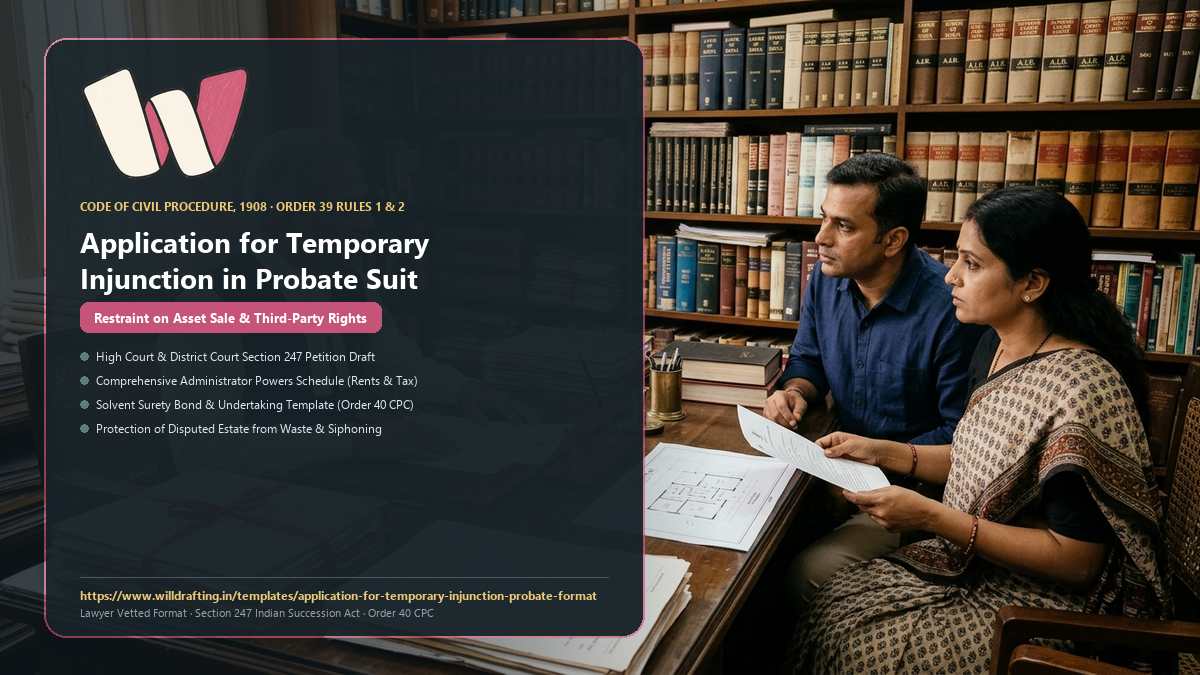
If rogue relatives or estranged branches attempt to sell, mortgage, or create third-party rights over high-value family estates before succession is resolved, our litigation partners file urgent Temporary Injunction Petitions under Order 39 Rules 1 and 2 CPC and seek appointment of an Administrator Pendente Lite under Section 247 of the Indian Succession Act to preserve the corpus intact.
The Settlor hereby absolutely, irrevocably, and unconditionally assigns, transfers, and conveys unto the Trustees the Scheduled Trust Assets TO HAVE AND TO HOLD the same in Trust for the sole and exclusive benefit of the Specified Beneficiaries. Neither the Settlor, nor any of his creditors, bankruptcy trustees, or commercial claimants shall possess any right, lien, or power of revocation over the Trust Estate. All distributions shall remain at the sole, absolute discretion of the Independent Board of Trustees, strictly immune from personal guarantee attachments or insolvency proceedings under the Insolvency and Bankruptcy Code, 2016.
Annual LRS Limits
Send up to 250,000 USD each year. Every family member gets this limit. Use it for foreign investments.
RNOR Tax Holiday
Returning NRIs get two tax-free years. Foreign income is not taxed in India. Plan gifts early.
Schedule FA Filings
Declare all foreign bank accounts. Report overseas shares in your ITR. Stay 100% compliant with tax laws.
DTAA Double Tax Relief
Avoid paying tax twice. Claim tax treaty credits in India. Keep your global wealth secure.
Family Trustees
Senior family members manage decisions. They know family values. They protect living needs.
Independent Trustees
Respected legal or financial experts. They provide neutrality. They help settle disputes calmly.
Protector Role
The founder can act as Protector. Veto power over big asset sales. Complete peace of mind.
Corporate Trustees
Institutional trust companies. Continuous governance across decades. No reliance on single individuals.
7. Cross-Border FEMA & Multi-Jurisdiction Rules
Most modern ultra-HNI families are cross-border by nature. Founders reside in India, while adult children may be citizens or green card holders in the United States, United Kingdom, Singapore, or Canada. This geographical spread introduces severe cross-border legal friction under FEMA and foreign tax codes.
Under the Foreign Exchange Management Act, 1999 (FEMA) and the FEMA (Overseas Investment) Rules, 2022, Indian resident parents cannot freely gift foreign securities or offshore holdings without adhering to strict reporting norms. Remittances from India are governed by the RBI's Liberalised Remittance Scheme (LRS), capped at $250,000 per financial year per individual.
For returning NRIs, Section 6(6) of the Income Tax Act provides a vital 2-year tax shelter as a Resident but Not Ordinarily Resident (RNOR). During this RNOR window, foreign interest, dividends, and capital gains remain immune from Indian income tax, providing a unique golden window to settle offshore trusts or gift securities tax-free.
Our advisory harmonizes Indian domestic trusts with offshore structures in Singapore or the Dubai International Financial Centre (DIFC). We eliminate double taxation risks under Double Tax Avoidance Agreements (DTAA) while ensuring total compliance with Schedule FA foreign asset disclosures.
1. Simple Will
Works only after death. Needs court probate. Relatives can contest it. Offers zero asset protection. High court fees apply.
2. Irrevocable Private Trust
Works during your life. No court probate needed. Protects assets from bank debts. Completely private. No family fights.
3. Family Holding Company
Best for running group firms. Pools cash and dividends. Governed by company law. Shares can sit inside a private trust.
Clear Voting Rules
Decide who votes on big deals. Set clear board seats. Keep leadership smooth. Avoid deadlocks.
Fair Dividend Payouts
Set annual cash shares. Ensure non-working heirs receive fair payouts. Prevent fights over profits.
Private Mediation
Resolve fights in private. Elder counsels step in first. Keep family disputes out of public courts.
Next-Gen Training
Prepare children for future roles. Define entry rules for business. Foster family unity and pride.
8. Family Constitution, Council & Dispute Protocols
Eighty percent of family business wealth dissolves by the third generation. The cause is rarely commercial failure; it is internal sibling warfare, divergent expectations, and ambiguous decision-making rules. A Family Constitution is the foundational charter that safeguards multi-generational peace.
In the landmark ruling of Kale v. Dy. Director of Consolidation (1976 SC), the Supreme Court held that family arrangements must be upheld to maintain family peace and avoid protracted litigation. We translate family values into legally enforceable contracts by mirroring the Constitution in the company Articles of Association (AoA) and Shareholders Agreements (SHA).
A robust Family Constitution drafted by our practice establishes:
- Family Council Governance: Rules for voting, entry of next-generation spouses, and qualifications required for executive board appointments.
- Dividend vs Growth Allocation: Formulaic dividend policies providing liquidity for non-working branch members while funding business reinvestment.
- Private Dispute Resolution Protocol: Mandatory confidential mediation by trusted elder counsels before any party can approach court or NCLT tribunals.
Total Privacy
Trust deeds are private. No public MCA records. No online balance sheets. Complete family discretion.
Instant Succession
Successor trustees take charge fast. No waiting for wills. No court disputes. Smooth family transition.
Creditor Shield
Company debts stay away. Section 32A protects your home. Trust assets stay safe. True legal peace.
Zero Tax Leaks
Transfer assets tax free. Section 47 exempts trust gifts. No capital gains tax. 100% tax neutral.
Pre-IPO Structuring
Move equity before listing. Lock in low values. Protect family shares early. Enjoy smooth IPOs.
Founder Share Control
Retain board control. Vote shares as a unit. Avoid minority disputes. Build your business safely.
Next-Gen Support
Fund children education easily. Set up medical emergency pools. Provide steady living allowances.
Fixed Retainer Pricing
Pay transparent fixed retainers. No costly hourly bills. Work directly with partners. Total clarity.
9. Case Studies: Tech Unicorns & Family Empires
Review how our senior counsels have resolved complex multi-generational structuring challenges for prominent Indian business promoters:
A technology founder preparing for an institutional IPO held 42% personal equity. Our practice established an Irrevocable Discretionary Trust, transferred 30% equity under Section 47(iii) exemption, and obtained SEBI SAST Regulation 10 open-offer exemption. The founder successfully ring-fenced family wealth prior to public listing.
Three branches of a third-generation industrial family deadlocked over plant modernization. We drafted a binding Family Constitution, restructured the holding entity into dual share classes (voting equity for operational leaders, preferred fixed dividend shares for non-executive heirs), and prevented public NCLT oppression litigation.
Proven Court Experience
Our partners argue in High Courts. We draft deeds that stand trial. No legal loopholes. Full safety.
No Billable Hours
We charge set fees. You know your costs on day one. No bill shock. Pure transparency.
Direct Partner Access
Work directly with senior counsel. No junior associates. Fast turnarounds. Reliable advice.
Complete Discretion
All talks stay under legal privilege. Strict non disclosure terms. Your estate stays private.
100% Tax Neutral
No gift tax leaks. No capital gains tax. Full Section 47 benefits. Valid tax certificates.
Zero Creditor Risk
Personal guarantees cannot attach trust land. Safe under Section 32A. Your family home is safe.
Seamless SRO Filing
We handle all stamp papers. We attend the Sub Registrar Office. Quick and stress free.
Generational Unity
Keep children united. Stop inheritance disputes. Preserve your family name for decades.
10. Senior Partner Profile & Counsel Credentials
Advocate Anuj Anand Malik leads the private client and family office practice at AMA Legal Solutions. He has structured private family trusts, corporate succession blueprints, and cross-border estates exceeding ₹500 Crore in cumulative asset value. His team bridges complex corporate tax laws, SEBI regulations, and Indian trust jurisprudence to provide ironclad generational protection.
1. Book a Call
Contact our team online. Set a private talk. All talks stay protected. Full privacy guaranteed.
2. Share Your Goals
List your key assets. Share your family wishes. We review all papers. We find the right setup.
3. Approve the Draft
Our partners write your deed. We check every clause. You review the draft. Total peace of mind.
4. Register and Relax
We attend the registry office. We complete all filings. Your family wealth stays safe forever.
11. Confidential Partner Legal Retainer Booking
Take the first proactive step to insulate your family dynasty against creditor risks, tax leaks, and contested court disputes. Request a direct consultation with our Senior Estate Planning Partner:
Schedule Your Comprehensive Family Office Diagnostic
Our Senior Partners personally review your entity holding structures, existing wills, and personal guarantee liabilities under non-disclosure agreements before recommending an optimal trust or holding company architecture.
Company Promoters
Founders with over ₹25 Crore equity. You need to protect your shares. We keep your voting control intact.
Real Estate Owners
Families with multiple plots and buildings. You want to avoid family partition suits. We divide land peacefully.
Cross-Border Families
Parents with NRI children in the US or UK. You must follow FEMA rules. We handle all cross-border taxes.
Business Dynasties
Third-generation family businesses. You want to stop sibling disputes. A clear family constitution protects peace.
Relying on a Simple Will
A simple Will leads to court probate delays. Heirs fight in High Courts. A private trust avoids this risk.
Bank Nominee Confusion
Nominees are not legal owners. The Supreme Court confirmed this rule. Only a trust ensures true inheritance.
Personal Loan Guarantees
Business defaults risk family homes. An irrevocable trust ring-fences your wealth before lenders take action.
FEMA Reporting Lapses
Foreign bank accounts face heavy penalties if not reported. We ensure strict Schedule FA disclosures in your tax return.
Is a Trust Tax-Free?
Yes. Section 47 exempts gifts to family trusts. You pay zero capital gains tax when transferring shares.
Can Creditors Attach Assets?
No. Irrevocable trusts protect assets from creditors under Section 32A of the IBC. You must set it up while solvent.
How Long Does it Take?
Setting up a full family trust takes 6 to 12 weeks. We draft, verify, and register everything with local authorities.
12. Frequently Asked Questions: Family Office Law
Find clear answers to critical legal and tax questions regarding ultra-HNI wealth governance in India: