Muslim Wasiyat & Sharia Estate Planning Lawyers
Standard Indian Will templates fail for Muslims. Under the Muslim Personal Law (Shariat) Application Act, 1937, a Muslim cannot bequeath more than one-third of their net estate without legal heir consent. Using secular templates can make your Will void in court. Our High Court advocates draft genuine Sharia-compliant Wasiyats and structure lifetime Hiba transfers. This protects your spouse and daughters from future court battles.
The One-Third Limit & Bequest to Heir Trap
- Violating the 1/3rd Wasiyat Cap: Indian succession templates let users bequeath 100% of assets. For Muslims, any bequest exceeding one-third of the net estate is void without heir consent.
- Sunni Ban on Bequests to Legal Heirs: Under Sunni law, leaving a Wasiyat bequest to a legal heir without post-demise consent of all other heirs is completely void in court.
- Unpaid Mahr and Debts Neglected: Sharia mandates clearing funeral costs and unpaid Mahr before calculating estate shares. Ignoring this causes probate and mutation disputes.
Explore Sharia Estate Planning Scenarios & Rights
Indian civil courts interpret Muslim succession through Shariat rules and High Court precedents. Select your family situation below to see the governing rule, legal remedy, and recommended document:
The One-Third Disposable Estate Limit under Shariat
Common Legal Pitfall
A Muslim testator wants to bequeath all property to one relative or a charitable trust, unaware of testamentary caps.
Governing Shariat Mechanism & Indian Law
Under the Muslim Personal Law (Shariat) Application Act, 1937 and Section 118 of Mulla Mahomedan Law, a Muslim can bequeath at most one-third of net assets. Debts, funeral expenses, and unpaid Mahr must be cleared first. Any bequest beyond one-third is void unless all legal heirs consent.
- Deduct funeral expenses and unpaid Mahr to calculate true net estate
- Limit non-heir and charitable bequests to a maximum of 33.33%
- Record written heir consent if any legacy crosses the one-third cap
Visual Legal Framework: Muslim Wasiyat vs Lifetime Hiba
How an ironclad Wasiyat and lifetime Hiba strategy drafted by High Court advocates protects your family, satisfies Sharia Faraid principles, and secures clear land records:
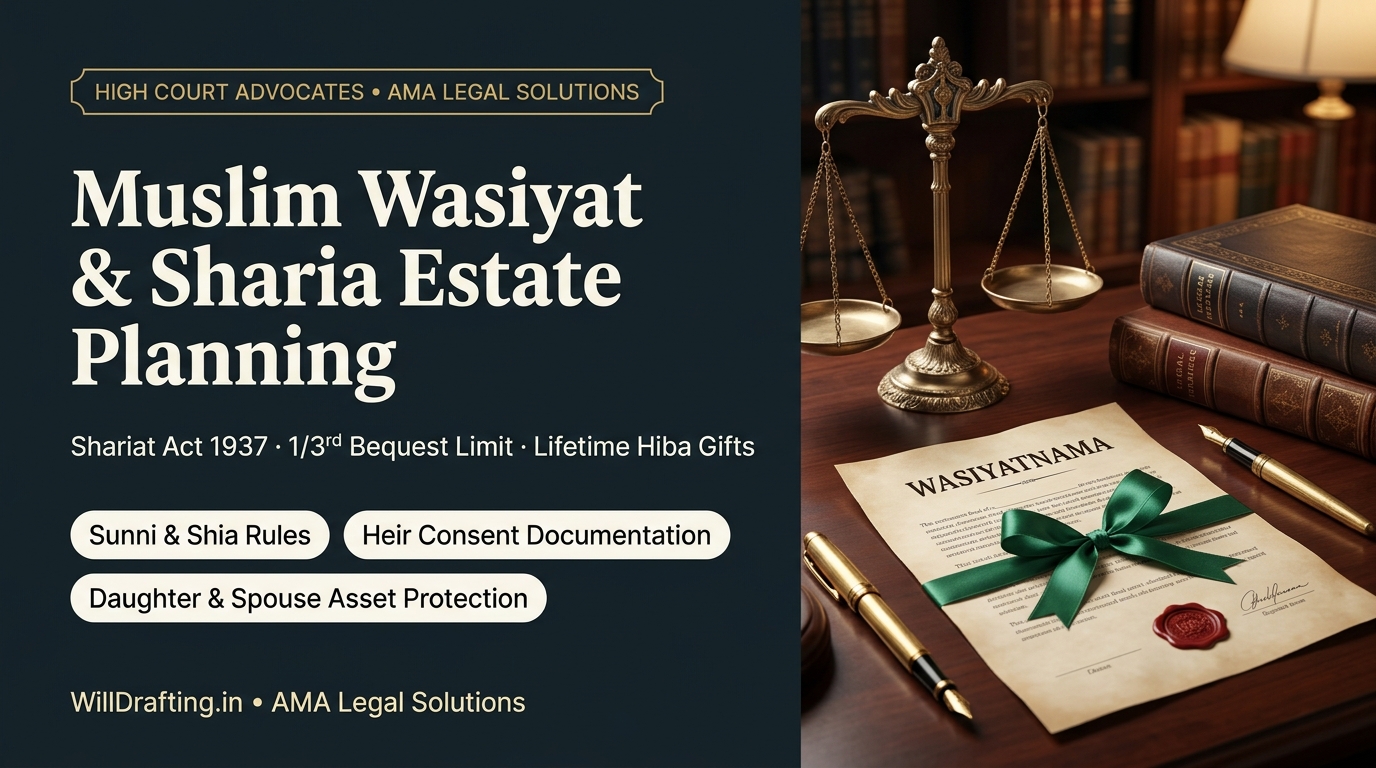
Wasiyat vs Lifetime Hiba: Statutory Comparison Table
Choosing the wrong legal instrument can leave your family home open to unexpected claims by distant relatives. Compare how Indian courts evaluate a Sharia Wasiyat, a Lifetime Hiba Gift, and a generic Indian Succession Act Will:
| Legal Parameter | Testamentary Wasiyat (Muslim Will) | Lifetime Hiba (Inter Vivos Gift) | Generic Indian Succession Act Will |
|---|---|---|---|
| Governing Statute | Shariat Application Act 1937 & Mulla Mahomedan Law | Transfer of Property Act 1882 s. 129 & Mahomedan Law | Indian Succession Act 1925 s. 59 (Hindu/Secular) |
| Disposable Estate Limit | Strictly capped at 1/3rd of net estate | 100% of property can be gifted during lifetime | 100% allowed (Void for Muslims under Shariat) |
| Bequest to Existing Legal Heir | Sunni: Void without post-death consent; Shia: Valid up to 1/3 | 100% valid to any child, spouse, or non-relative | Allowed freely without requiring co-heir consent |
| Timing of Legal Heir Consent | Sunni: Only after death; Shia: During life or after death | No heir consent required during lifetime transfer | No consent mechanism exists in standard templates |
| Daughter & Wife Protection | Limited; 2/3rds remains subject to residuary agnate claims | Complete; transfers 100% unencumbered title immediately | Fails in court if challenged by omitted Sharia heirs |
| Compulsory SRO Registration | Optional under law, but highly recommended for title security | Immovable gift registered under Registration Act s. 17 | Optional under Section 18 of Registration Act 1908 |
| Probate in Presidency Towns | Exempt under Section 213(2) of Indian Succession Act | Not applicable; inter vivos transfer effective at once | Mandatory for Hindu/Parsi wills in Mumbai/Kolkata/Chennai |
Statutory 4-Step Sharia Estate Planning Protocol
Our High Court succession advocates guide Muslim families through a proven 4-step protocol. We ensure religious integrity, compliance with Indian law, and lasting peace of mind:
Debt & Mahr Clearance
We calculate the true net estate by accounting for funeral charges, third-party liabilities, and unpaid prompt or deferred Mahr owed to the surviving wife.
Faraid Share Audit
Our legal team maps Quranic Sharers and Residuaries under Sunni or Shia rules. We ensure any testamentary bequest remains strictly within the one-third cap.
Advocate Legal Drafting
We draft customized Wasiyat recitals with clear asset boundaries, or structure separate post-demise heir consent deeds to satisfy High Court requirements.
SRO Filing or Hiba Delivery
We handle biometric registration at the local Sub-Registrar office for Wasiyats, or execute registered Hiba deeds with actual delivery of physical possession.
Essential Sharia-Compliant Wasiyat Clause Structure
In Ghulam Mohammad v. Ghulam Husain, the Privy Council established that testamentary bequests exceeding one-third are invalid without heir consent. A legally sound Muslim Will must state debt discharge and clear one-third boundaries:
"WHEREAS I am a Muslim governed by Muslim Personal Law (Shariat) Application Act, 1937 in matters of testamentary succession;

I HEREBY DIRECT that upon my demise, my Executor shall first pay and discharge all my funeral and deathbed expenses, followed by all my lawful debts, including any outstanding Prompt or Deferred Mahr (dower) payable to my surviving wife;

AND I FURTHER DIRECT that out of the net balance of my estate remaining after such payments, a portion not exceeding one-third (1/3rd) in value shall be bequeathed to [Name of Legatee / Institution] as specified in Schedule 'B' hereunder;

PROVIDED ALWAYS that the remaining two-thirds (2/3rds) of my net estate shall devolve upon my legal heirs strictly in accordance with the Quranic shares and residuary entitlements prescribed under Mahomedan Law; and any bequest herein in excess of the said one-third limit or in favor of an heir shall take effect only upon obtaining the express written consent of all other surviving legal heirs."
Statutory Notice: Under Section 2 of the Shariat Act, 1937 and Section 118 of Mulla Mahomedan Law, testamentary power is limited to 1/3rd of the net estate after debt and Mahr clearance. Bequests beyond this cap require post-demise heir consent.
Sharia Drafting Checklist
Civil courts closely examine Muslim Wills during title challenges:
- Mahr Acknowledgment: Clear statement of paid or pending dower to prevent widow property retention.
- One-Third Valuation: Mathematical proof that bequests to non-heirs do not exceed 33.33% of net assets.
- Heir Consent Framework: Documentation identifying all legal heirs and recording post-demise consent.
- Independent Attestation: Signed by at least two competent adult witnesses not benefiting under the Will.
Need to Calculate Quranic Faraid Shares Before Drafting?
Use our free statutory calculator to evaluate Sharer and Residuary shares under Sunni Hanafi and Shia Ithna Ashari rules.
Daughter & Spouse Inheritance Protection under Shariat
Under default Sunni Faraid rules, an only daughter inherits one-half of the estate, while multiple daughters share two-thirds. A surviving wife receives one-eighth when children exist. The remaining portion passes to distant agnatic residuaries, such as paternal uncles or male cousins.
To safeguard their home for their wife and daughters, Muslim fathers execute lifetime gifts (Hiba or Hiba-bil-Iwaz). Under the Supreme Court ruling in Hafeeza Bibi v. Shaikh Farid (2011), a Muslim has absolute freedom to gift up to 100% of their property during their lifetime. Our advocates prepare ironclad Hiba deeds with complete delivery of possession. This protects your family home from distant relative claims.
Frequently Asked Questions: Muslim Will & Sharia Law
Authoritative legal answers prepared by the WillDrafting Editorial Team and verified by High Court succession counsel at AMA Legal Solutions:
Can a Muslim in India bequeath 100% of their property through a Will?
No. Under the Muslim Personal Law (Shariat) Application Act, 1937 and Mulla's Mahomedan Law, a Muslim can bequeath at most one-third of their net property through a Wasiyat. The remaining two-thirds must pass to legal heirs according to Quranic Faraid rules, unless all heirs consent after death.
Can a Sunni Muslim leave a Wasiyat bequest to an existing legal heir?
Under Sunni Hanafi law, a bequest to any legal heir (such as one particular child or spouse) is void unless all other legal heirs consent after the testator passes away. Consent given during the testator's lifetime is not binding in Sunni personal law.
How does Shia law differ from Sunni law regarding bequests to legal heirs?
Under Shia Ithna Ashari law, a testator can bequeath up to one-third of the estate to any legal heir without needing the consent of other heirs. Consent for bequests exceeding one-third can be given either during the testator's lifetime or after death.
How can a Muslim father protect his wife and daughters from distant relatives?
Under default Sunni rules, daughters and wives do not inherit the whole estate, and distant agnatic residuaries (like brothers or uncles) inherit the remainder. To protect a wife and daughters, a father can gift property during life via Hiba or Hiba-bil-Iwaz. Lifetime gifts have no one-third limit.
Is probate of a Muslim Will mandatory in Indian High Courts?
No. Under Section 213(2) of the Indian Succession Act, 1925, Mahomedan Wills are exempt from mandatory probate across India, including Mumbai, Kolkata, and Chennai. However, registering the Wasiyat with the local Sub-Registrar provides strong proof and prevents forgery claims.
Does an oral gift (Hiba) of immovable property require mandatory registration?
In Hafeeza Bibi v. Shaikh Farid (2011), the Supreme Court held that an oral Hiba is valid if it fulfills offer, acceptance, and delivery of possession. Under Section 129 of the Transfer of Property Act, oral Muslim gifts are exempt from Section 123. Still, a registered deed prevents municipal record disputes.
How does unpaid Mahr affect the distribution of a deceased Muslim's estate?
Unpaid prompt or deferred Mahr is an unsecured debt under Muslim personal law. Debts must be paid out of the estate before any Wasiyat bequest or Faraid inheritance is calculated. A widow can retain possession of her late husband's property until her Mahr debt is paid.
What happens if a Muslim marries under the Special Marriage Act, 1954?
If a Muslim registers their marriage under the Special Marriage Act, 1954, succession is governed by the Indian Succession Act, 1925 rather than Shariat law. The individual gains complete testamentary freedom to bequeath 100% of their property to anyone without the one-third limit.
Explore statutory templates, calculators, and estate planning services:
This legal guide is prepared under the Muslim Personal Law (Shariat) Application Act, 1937, Mulla's Principles of Mahomedan Law, the Transfer of Property Act, 1882, and the Indian Succession Act, 1925. Judicial authorities cited include Ghulam Mohammad v. Ghulam Husain (54 All 98 PC), Khajoorunissa v. Rowshan Jehan (2 Cal 184 PC), and Hafeeza Bibi v. Shaikh Farid (2011 5 SCC 654). This content provides statutory education and does not replace individualized advocate counsel.