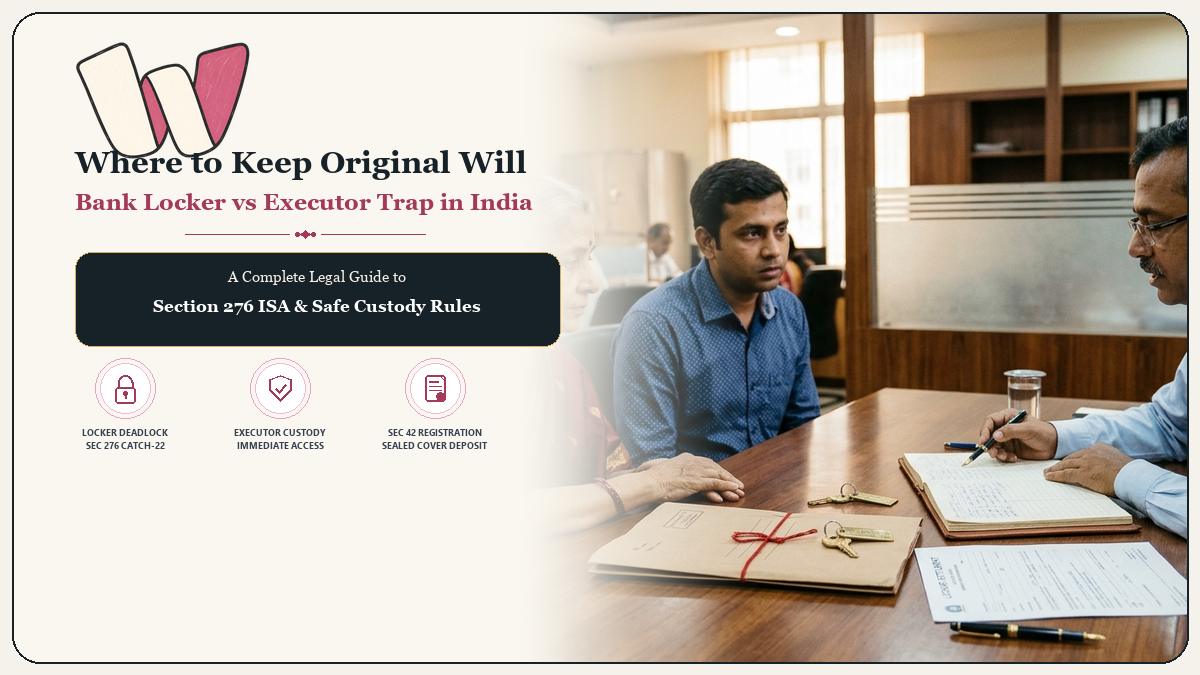
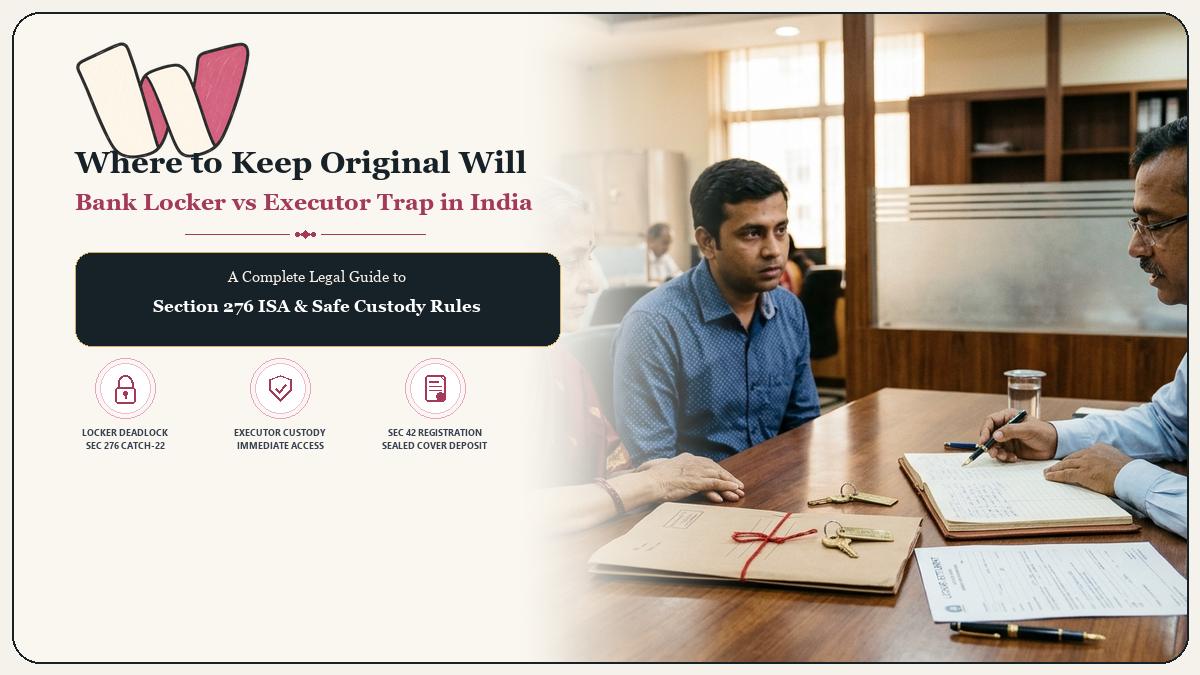
- Original Will Is Mandatory: Under Section 276 of the Indian Succession Act, 1925, courts require the Original Will to grant Probate. A photocopy or scan is rarely accepted without high-stakes secondary evidence hearings.
- The Bank Locker Catch-22: If you place your only original Will in a sole un-nominated bank locker, the bank will freeze it upon death. The bank demands Probate to open the locker, but the court demands the Original Will to grant Probate.
- Court Commissioner Required: Breaking this locker deadlock forces your grieving family to petition the court for an Inventory Commissioner, wasting 6 to 18 months and incurring heavy court expenses.
- Executor Custody Is Best: Section 211 names the Executor as your legal representative. Entrusting an original copy to your Executor ensures immediate accessibility upon demise.
- Official Government Deposit: Section 42 of the Registration Act, 1908 allows you to deposit your Will in a sealed cover inside the District Registrar fireproof safe for lifelong protection.
You have taken the responsible step of writing your Will. You signed it before two reliable witnesses. You paid the drafting fees. Perhaps you even registered it at the Sub-Registrar office. Now comes the most overlooked question in Indian estate planning: where to keep original will safely in india?
Most people instinctively take the signed original Will, place it inside an envelope, and drive straight to their bank. They lock it inside their bank locker. They hand the key to their spouse. They feel sure their family wealth is safe. They ask themselves: should i keep my original will inside my bank locker india?
What they do not realize is that this single instinct creates what succession advocates call the Bank Locker Catch-22 Trap. By locking the only original copy inside a personal bank locker, you may by accident paralyze your family for years. In this complete guide, we explain what happens if original will is locked inside deceased bank locker, examine RBI circulars, review court precedents, and analyze the five best storage options. To prepare your estate plan correctly, review our interactive will checklist or calculate legal heir shares using our free succession calculator.
1. The Great Bank Locker Trap: Section 276 Catch-22 Stalemate
Why is storing an original Will in your own sole bank locker so hazardous in India? The answer lies in a direct clash between Indian banking protocol and Indian succession court rules.
When an individual passes away, the bank branch receives notice of the death. The bank immediately freezes the safe deposit locker. If the locker was held in a single name without nomination, the bank stops all access. No family member can insert a key. The bank refuses to open the locker door. The branch manager adheres strictly to internal audit rules: "Produce a Probate of the Will, Letters of management, or a Succession Certificate from a civil court."
Your family visits an estate lawyer to file a petition for Probate. But here, the civil court enforces Section 276 of the Indian Succession Act, 1925. Section 276 demands that every probate petition must have the Original Will annexed to it. The court registry will not number the petition without the physical paper. It must see the original document first.
This creates a total legal deadlock:
"We cannot open this locker or release any papers to legal heirs without a court-issued Probate of the Will."
"We cannot grant Probate or issue court orders without inspecting and retaining the Original Will on our record."
Result: Your family cannot satisfy the bank without the court, and cannot satisfy the court without the bank. Assets remain frozen while mortgage bills, maintenance dues, and family fights grow.
To break this stalemate, your family cannot file a standard probate suit. They must file an urgent court application before the District Judge or High Court under Section 151 of the Code of Civil Procedure (CPC) read with Section 239 of the Indian Succession Act, requesting the appointment of a court official called an Inventory Commissioner.
2. legal Custody Mandates: Indian Succession Act & Evidence Rules
To understand why the physical original document matters so much, one must look at evidentiary standards under Indian law. In civil hearings, documentary proof is governed by the rules of primary evidence under Section 64 of the Indian Evidence Act, 1872 (now Section 57 of the Bharatiya Sakshya Adhiniyam, 2023).
A Will is a unique legal instrument. It speaks only after the person who wrote it has passed away. Because the maker cannot enter the witness box to verify their signature, courts examine Will papers with deep caution. Under Section 63 of the Indian Succession Act, the original signature of the maker and the signatures of the two attesting witnesses must be proved.
Every application for probate or letters of management must distinctly set forth the execution of the Will, and the petitioner must produce and annex the original Will instrument for court review and custody.
A copy or draft of a lost or destroyed Will can only be probated if the petitioner proves beyond doubt that the original existed, was unrevoked at death, and was lost through misfortune. If an original Will was in the custody of the deceased and cannot be found after death, Indian law presumes the deceased revoked and destroyed it.
Indian law presumes revocation when an original cannot be traced. Therefore, keeping your original paper in a safe and known place is vital. If heirs cannot find the original paper, relatives can raise objections. They can argue you tore or burnt the document to revoke it.
3. RBI Revised Locker Guidelines: Nominee Access vs Executor Rights
Many individuals believe adding a bank locker nominee solves the entire custody problem. Nomination helps in basic cases. But it creates a grave risk if the locker nominee is different from your named Executor.
Under the Reserve Bank of India (RBI) Revised Master Directions on Safe Deposit Lockers (Circular RBI/2021-2022/86 DOR.LEG.REC/40/09.07.005/2021-22), clear protocols govern what happens when a locker hirer dies:
- Sole Locker With Nominee: If a sole locker hirer dies with a valid nomination on file, the bank allows the nominee access to remove contents after drawing up an inventory in the presence of two independent witnesses. The bank does not insist on Probate or a Succession Certificate.
- Sole Locker Without Nominee: If there is no nominee, the bank cannot release contents to legal heirs without a formal court decree, a succession certificate, or a court commissioner order.
- Joint Locker (Either or Survivor): If the locker is held jointly with an "Either or Survivor" mandate, the surviving hirer can access the locker freely upon providing notice of death.
Upon the father's death, the elder son visits the bank. Under RBI rules, the bank lets the son clear the locker as nominee. What if the son opens the box and sees a Will that leaves the house to his sister? There is a grave risk. He may hide or destroy the paper. Once destroyed, the daughter cannot produce the original in court under Section 276.
As settled by the Supreme Court in Sarbati Devi v. Usha Devi (1984) and reaffirmed in Ram Chander Talwar v. Devinder Kumar Talwar (2010), a nominee is merely a temporary custodian, not an owner. But if a hostile nominee destroys the physical paper before anyone inspects it, proving its contents in court becomes an uphill battle.
4. Court Inventory Commissioner: Procedure to Unlock Deceased Lockers
If your family finds itself trapped because the only original Will is locked inside an un-nominated bank locker, what is the exact legal procedure to recover it? The family must petition the court to appoint an Inventory Commissioner.
In cases such as Ritu Sharma v. State before the Delhi High Court, families faced this exact deadlock. The court recognized that without the original Will, probate hearings could not move forward. The court therefore established a standard five-step relief mechanism:
The proposed executor or legal heirs file a court petition under Section 151 CPC and Section 239/267 of the Indian Succession Act before the District Judge or High Court.
The court appoints an advocate as Local Commissioner to visit the bank branch and inspect the safe deposit locker.
The Commissioner, branch manager, bank lawyer, and all legal heirs gather at the vault. The locker is unlocked or drilled open. An exhaustive inventory list of all jewellery, cash, and documents is drafted and signed by everyone present.
If Will documents are found, the Commissioner places them in a sealed envelope and deposits them directly with the Registrar of the Court. Non-Will assets are locked back inside the locker.
Once the original document is in official court custody, the court registry numbers the main probate petition under Section 276, and notice is issued to all legal heirs.
This procedure resolves the Catch-22, but it is slow and costly. The family must pay court commissioner fees (often ₹30,000 to ₹75,000). They must pay advocate hearing fees and locker drilling charges. The process takes months. Grieving families face needless stress and court delays.
5. The 5 Best Places to Store Your Original Will in India
To avoid the bank locker trap, where should you keep your original Will? Here is an clear analysis of the five best safe custody options in India, ranked from most recommended to least recommended.
Under Section 211 of the Indian Succession Act, the Executor is your legal representative. Under Section 222, only the named Executor can petition for Probate. Handing an original copy directly to your Executor in a sealed envelope ensures that the very person tasked with proving the Will has immediate physical custody upon your demise.
Under Section 42 of the Registration Act, 1908, any Will maker can deposit their Will in a sealed cover with the District Registrar. The cover is stamped with your seal, inscribed in Book No. 5, and placed in the Registrar's fireproof safe. When you pass away, Section 45 allows your executor or heirs to apply. The Registrar opens the cover in their presence. The officer copies the text into official registers. The original paper is handed over to court when ordered.
Many law firms maintain fireproof document vaults for client papers. The firm logs each file under strict security. It releases the papers only upon getting an official death certificate. This allows a quick and smooth start to probate court steps.
If you prefer a bank locker, do not keep it in your sole name. Open or convert the locker into a joint locker. Run it with your spouse or named Executor under an 'Either or Survivor' rule. Under RBI rules, if one hirer dies, the survivor keeps full access. The surviving co-hirer can open the locker on their own without any court order.
You can keep the original in a fireproof safe at home. Place it in your master bedroom or study. Share the digital key or safe code with your spouse and Executor. Put this information in a sealed Letter of Instructions.
6. Storage Location Comparison: Access Speed, Security & Costs
The table below provides a complete comparison of all primary Will custody mechanisms in India:
| Custody Option | Access Speed Post-Demise | Court Order Required? | Tamper Protection | secrecy |
|---|---|---|---|---|
| named Executor Custody | Immediate (within 24 hrs) | No court order needed | High (sealed envelope) | Complete during lifetime |
| District Registrar (Sec 42) | 1 to 3 weeks (legal opening) | No court order (SRO petition) | Maximum (Govt fireproof safe) | 100% secret |
| Estate Law Firm Vault | Immediate (upon death certificate) | No court order needed | Very High (professional log) | Protected by privilege |
| Joint Locker (Either/Survivor) | Same day (survivor access) | No court order needed | High (bank vault) | Co-hirer can view contents |
| Fireproof Home Safe | Immediate (if key available) | No court order needed | Moderate (risk of fire/theft) | High (if code kept secret) |
| Sole Un-Nominated Bank Locker | 6 to 18 months delay | Mandatory Court Commissioner | Frozen by Bank | Requires multi-party search |
7. Model Clauses: Document Custody & Letter of Instructions
To remove ambiguity regarding where your original papers are stored, incorporate these legal templates into your estate plan:
Tip: Include this clause to prevent claims that a missing copy implies revocation.
Keep this letter separate from the Will itself and give a signed copy directly to your Executor.
8. Practical Checklist: Protecting Your Original Will from Loss
To ensure your estate plan executes smoothly without court commissioner petitions, follow this five-point practical safety checklist:
Sign two original copies before the same witnesses on the same day. Hand one to your Executor and keep one in your home safe.
Always complete will registration under the Registration Act. While optional, registration creates an official government record in Book 4 that disproves false claims of forgery.
Never leave an original Will as the sole document inside a personal locker without nomination. If using a locker, make it joint with 'Either or Survivor' mode.
Scan high-resolution PDFs of the signed and registered Will and upload to your personal DigiLocker. Share access instructions in your Document Locator Sheet.
Connect your Executor with a dedicated probate lawyer or property succession counsel to handle property mutation and defend against potential challenges through a will fight lawyer.
9. Securing Professional Will Guidance
Writing a valid Will is only half the task. Storing the physical paper safely is just as vital. Proper custody ensures your family avoids bank red tape and court delays.
WillDrafting.in helps you secure your family assets with ease. You can draft your legal Will online in minutes using our self-serve platform at WillDrafting.in. For complex family estates or high-value assets, you can speak with experienced advocates at AMA Legal Solutions.
Popular Searches Related to Will Custody & Bank Lockers
- where to keep original will safely in india
- bank locker catch 22 original will
- section 276 indian succession act probate original will
- can bank locker be opened without probate in india
- what happens if original will is lost in india
- rbi bank locker rules death of locker holder
- section 42 registration act deposit of wills sealed cover
- executor custody of original will india
- inventory commissioner for bank locker high court
- registered will vs duplicate original copy