- Shares Never Expire: Old share papers from 1980 or 1990 still give you valid equity ownership. They include all bonus shares and stock splits.
- No Posthumous Demat: You cannot open a Demat account for a late parent. You cannot move shares into a dead person name.
- SEBI Transmission Route: Under SEBI Circular SEBI/HO/MIRSD/MIRSD_RTAMB/P/CIR/2022/65, legal heirs must file Form ISR-5 with the company share registrar (RTA).
- SEBI ISR Suite: The transmission pack needs Form ISR-1 for KYC, Form ISR-2 for bank verification, Form ISR-4 for service requests, and Form ISR-5 for transmission.
- 120-Day Letter of Confirmation: When approved, the RTA issues a Letter of Confirmation (LOC) valid for 120 days. The heir gives this letter to their broker to credit shares to Demat.
- IEPF Recovery: If dividends were unpaid for seven straight years, shares move to the Investor Education and Protection Fund (IEPF). Heirs must file Form IEPF-5 to get them back.
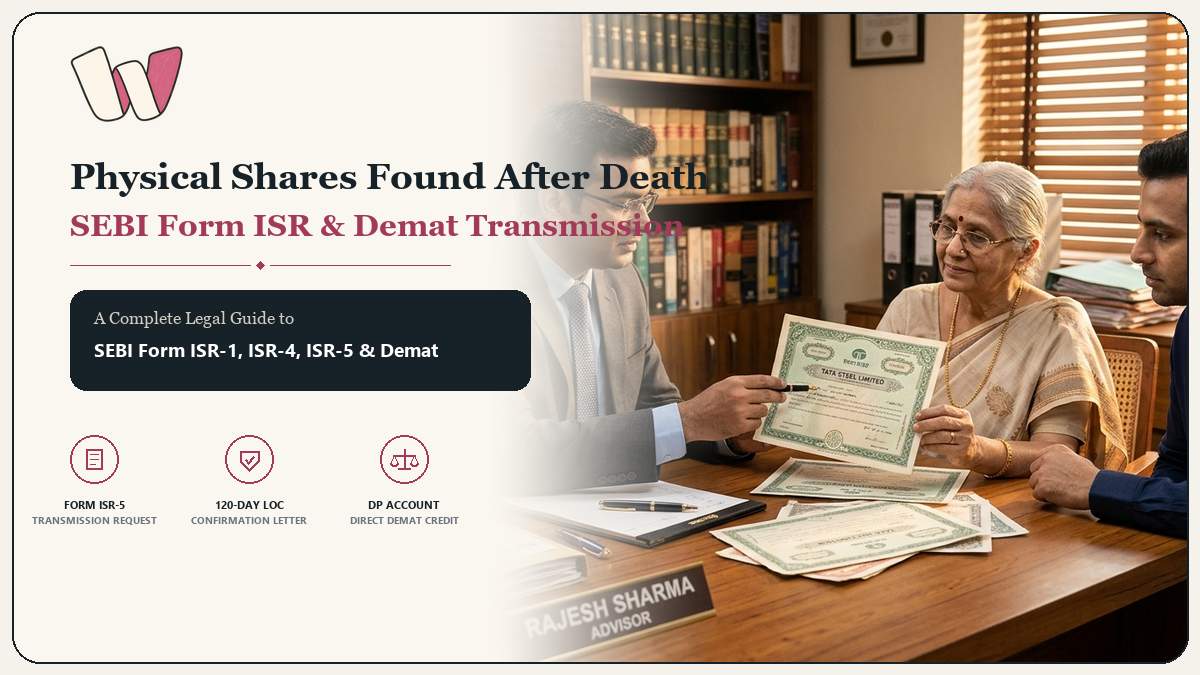
Families across India often find old paper share certificates while cleaning an old home. You may find them in a late father wooden desk, an iron safe, or a grandfather steel trunk. These papers often show shares of famous companies like Reliance, Tata, MRF, L&T, or State Bank of India bought in 1985 or 1992.
The original paper might show only 100 shares bought for 10 Rupees each. But over thirty years, stock splits and bonus issues multiply that holding. That small paper may now be worth 30 Lakh Rupees, 60 Lakh Rupees, or even more. Families face an urgent question: how do legal heirs claim old physical share certificates of a deceased parent and move them to Demat?
Many people think you simply hand the paper certificates to a local broker. That does not work. In this guide, we explain SEBI rules, show how to use Forms ISR-1 to ISR-5, trace bonus shares, and help legal heirs claim their family wealth. To check your family legal shares right now, use our free succession calculator or check our will drafting checklist.
1. Found Old Physical Shares in a Trunk: Can You Still Claim Them?
The short answer is yes. Old physical share certificates do not expire. Under Section 46 of the Companies Act, 2013, a share certificate is legal proof of title. Even if the paper looks old, torn, or yellow, your family still owns that equity. A company cannot cancel your shares just because years have passed.
However, you cannot sell physical shares on stock exchanges today. SEBI rules mandate that all listed shares must be in Demat mode to trade. Also, when the original owner has died, legal ownership must first pass to the lawful heirs. You must complete this transmission step before anyone can sell or transfer the shares.
A share transfer is a sale or gift between living persons. It requires a stamped transfer deed. In contrast, transmission of shares takes place by law when a shareholder dies. No stamp duty applies when shares pass to legal heirs.
2. SEBI Demat Rules and the RTA Transmission Process
On April 1, 2019, SEBI stopped the transfer of shares in physical form. Many people got confused and thought old paper shares became invalid. That is not true. SEBI only stopped physical sales between third parties. Transmission of shares to lawful heirs continues as usual.
Here is the most critical rule that most investors miss: You cannot convert physical shares into Demat in the name of a deceased person.
You cannot open a Demat account for someone who has passed away. If you try to do that, depository rules treat it as identity fraud. Instead, the shares must go straight to the legal heir.
To make this simple, SEBI issued Circular No. SEBI/HO/MIRSD/MIRSD_RTAMB/P/CIR/2022/65 on May 18, 2022. Under this circular:
- The company Registrar and Share Transfer Agent (RTA) will not issue new paper certificates in the heir name.
- The RTA reviews the transmission papers sent by the legal heir using standard SEBI forms.
- Once approved, the RTA issues a Letter of Confirmation (LOC) under Form ISR-4.
- This Letter of Confirmation is valid for 120 days from the date of issue.
- The heir gives this Letter of Confirmation to their own stockbroker (DP) along with a Demat Request Form (DRF).
- The depository then credits the shares straight into the heir active Demat account.
Check stock splits, bonus issues, and face value changes over time.
Find the share registrar like Link Intime or KFintech from company records.
Send Form ISR-1, bank Form ISR-2, Form ISR-4, and Transmission Form ISR-5.
The RTA approves your claim and sends you a Letter of Confirmation.
Give the letter to your broker to get shares credited into your Demat.
3. How Old Shares Multiply: Tracking Splits and Bonus Shares
When you hold an old paper share, do not just count the number written on it. Blue-chip Indian companies often issue bonus shares. They also split share face values from 10 Rupees to 2 Rupees or 1 Rupee.
For example, take 100 shares of Reliance Industries bought in 1990 at face value 10:
- In 1997, a 1:1 bonus made 100 shares into 200 shares.
- In 2005, the firm demerged into separate firms like Reliance Energy and Reliance Capital.
- In 2009, another 1:1 bonus made 200 shares into 400 shares.
- In 2017, a 1:1 bonus turned 400 shares into 800 shares.
- In 2024, a 1:1 bonus turned 800 shares into 1,600 shares.
That single 100-share paper certificate now stands for 1,600 shares of Reliance. At current prices, it is worth more than 40 Lakh Rupees. You also get shares in demerged companies plus years of cash dividends. You can check these corporate changes by writing to the company RTA.
4. The SEBI ISR Forms: Forms ISR-1, ISR-2, ISR-4, and ISR-5
SEBI has created simple, standard forms for all paper share services. These forms make it easy for heirs to claim shares:
| SEBI Form | Name of Form | What It Does and Papers Needed |
|---|---|---|
| Form ISR-1 | KYC Details Form | Registers PAN, home address, email, phone number, and bank account with a cancelled cheque. |
| Form ISR-2 | Bank Signature Form | Your bank branch manager signs and stamps this form to verify your signature and bank details. |
| Form ISR-4 | Service Request Form | Used to ask the RTA for a 120-day Letter of Confirmation to credit shares to your Demat. |
| Form ISR-5 | Transmission Request Form | The main form used by heirs to claim physical shares after the death of the original owner. |
| Form SH-13 / ISR-3 | Nomination Choice | Appoints a nominee under Section 72 of the Companies Act or opts out of nomination using Form ISR-3. |
Make sure the bank account in Form ISR-1 matches your Demat bank account. Even a small error in your name spelling can make the RTA raise objections.
5. Value Limits: Legal Heir Certificate vs Succession Certificate
When a parent dies without naming a nominee on their shares, the RTA needs proof of heirship. SEBI sets two simple value limits based on the market price of the shares on your claim date:
For physical shares worth up to 5 Lakh Rupees per company, SEBI does not ask for a court order. The legal heir can submit:
- Original certified death certificate of the parent.
- Legal Heir Certificate or Family Tree from the local Tehsildar or revenue office.
- Notarized Indemnity Bond from all heirs on stamp paper in Form Annexure D format.
- No Objection Certificate (NOC) or signed release deed from other heirs who do not claim the shares.
If the market value of shares in a company is more than 5 Lakh Rupees, SEBI rules require a court order under the Indian Succession Act, 1925:
- Succession Certificate from a Civil District Court under Section 372 of the Indian Succession Act, listing the company name, folio, and share count.
- Probate of Will or Letters of Administration with Will attached, from a High Court or District Court if your parent left a valid Will.
Getting a Succession Certificate from court can take six to twelve months. It also costs court fees. But if your parent left a registered Will that names who gets the shares, you avoid family disputes and legal delays.
6. Have Shares Moved to IEPF? Unpaid Dividends and Government Custody
If physical shares stayed in a cupboard for many years, dividend cheques were likely mailed to an old home address and returned unpaid.
Under Section 124(6) and Section 125 of the Companies Act, 2013:
- If a dividend stays unpaid for seven years in a row, the company sends that money to the government IEPF fund.
- Also, all shares that have unpaid dividends for seven years in a row move straight to the IEPF Demat account.
If that happened, the company RTA no longer holds your shares in their active list. You will find that the shares now sit with the IEPF Authority.
To get these shares back, heirs must follow a two-step path. First, you prove transmission with the company RTA. Second, you file an online claim in Form IEPF-5 on the MCA V3 portal. You also submit an indemnity bond and proof papers. Learn more about our legal recovery service at IEPF Unclaimed Shares & Bank Recovery.
7. Comparison: Physical Shares vs Demat Shares Inheritance
This table compares what happens when you inherit physical paper shares versus modern electronic Demat shares in India:
| Feature | Physical Paper Shares | Electronic Demat Shares |
|---|---|---|
| Where to Apply | You must apply to each company RTA separately for every stock. | You apply to a single stockbroker (DP) for the whole portfolio. |
| Forms Needed | SEBI Forms ISR-1, ISR-2, ISR-4, and Transmission Form ISR-5. | Simple Demat transmission form, death certificate, and client master list. |
| Nominee Speed | Nominees were rarely updated on paper folios, so manual checks take time. | A registered nominee gets portfolio credit within 7 to 14 days. |
| How Shares Arrive | RTA sends a 120-day letter, which you take to your broker for Demat credit. | Direct electronic credit into the heir Demat account. |
| Risk of IEPF Transfer | High risk because old postal addresses caused dividend cheques to bounce. | Very low risk because dividends credit straight to your bank account. |
| Time Taken | 3 to 9 months (or over 12 months if court succession or IEPF applies). | 2 to 4 weeks under standard depository rules. |
8. Model Will Clause and Checklist for Physical Shares
To protect your own family from paperwork delays, your Will should mention your physical share folios clearly:
Note: You can add this clause into your legal Will on WillDrafting.in to protect your heirs from court delays.
- Original Certificates: Check that you have original certificates. If lost, file an FIR and ask for duplicate certificates in Form ISR-4.
- PAN-Aadhaar Link: Ensure the heir PAN card is linked with Aadhaar as required by SEBI rules.
- Bank Seal: Make sure the bank branch manager signature, bank seal, and employee code on Form ISR-2 are clear.
- Name Matching: If the name spelling on the share paper differs slightly from the death certificate, make a notarized name affidavit.
- Active Demat: The legal heir must have an active Demat account with a SEBI-registered broker before applying.
9. How a Registered Will and Matching Nomination Prevents This Delay
The best step you can take is to move all physical shares into Demat during your lifetime. But if you or your aging parents still hold paper certificates, drafting an airtight Will is essential.
A registered Will overrides general succession rules. When a valid Will names who gets the shares, that heir can claim transmission smoothly. They do not have to chase distant relatives for NOCs or wait months for family agreements.
Drafting an airtight Will takes less than 15 minutes. You can draft your legal Will online right now using our guided platform at WillDrafting.in. If you need bespoke advocate consultation or estate structuring for high-value physical share folios and IEPF recovery, schedule an appointment with our senior legal team at AMA Legal Solutions.