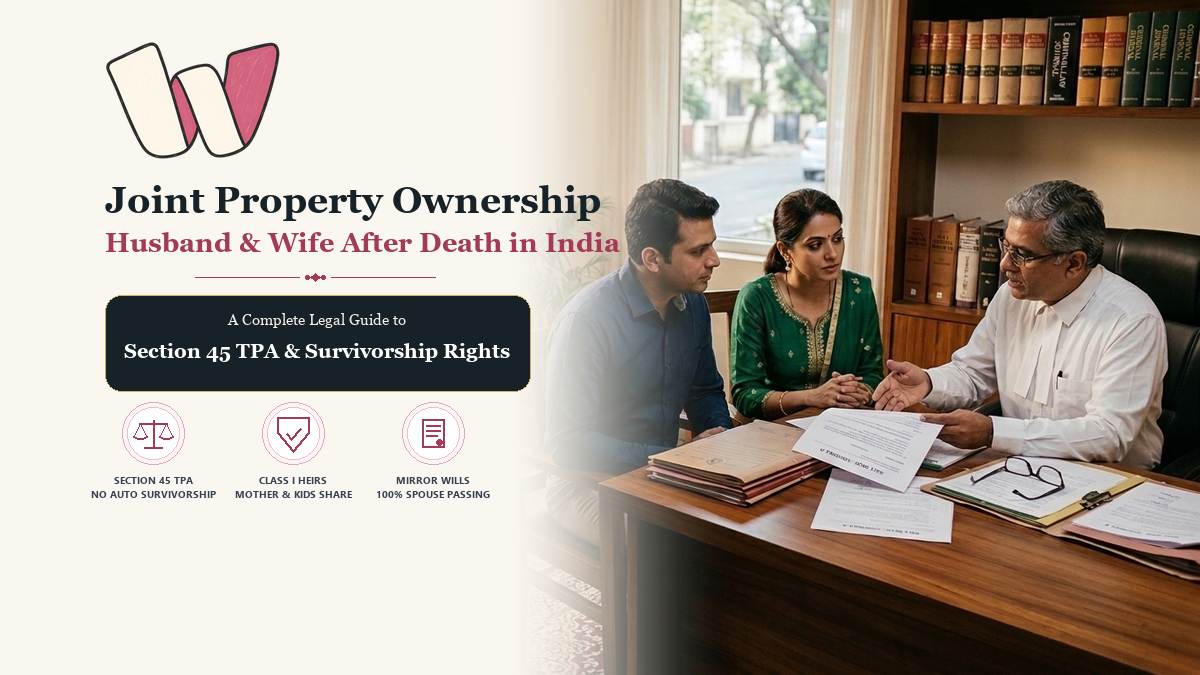
- No Automatic Survivorship: In India, buying a flat jointly with your spouse does not mean the survivor gets full ownership automatically upon death.
- Tenancy-in-Common Rule: Section 45 of the Transfer of Property Act, 1882 presumes co-owners hold distinct shares. Each spouse owns a separate 50% share.
- Class 1 Legal Heirs: When a husband dies without a Will, his 50% share gets split equally among his mother, wife, and children under the Hindu Succession Act.
- The 50% Flat Trap: Your mother-in-law and children become legal co-owners of your home. You cannot sell or mortgage the flat without their registered consent.
- Society Nominee Myth: The Supreme Court has ruled that a housing society nominee is merely a trustee, not the beneficial owner of the flat.
- Mirror Wills Solution: Married couples must execute reciprocal Mirror Wills to ensure the surviving spouse becomes the sole 100% owner without delays.
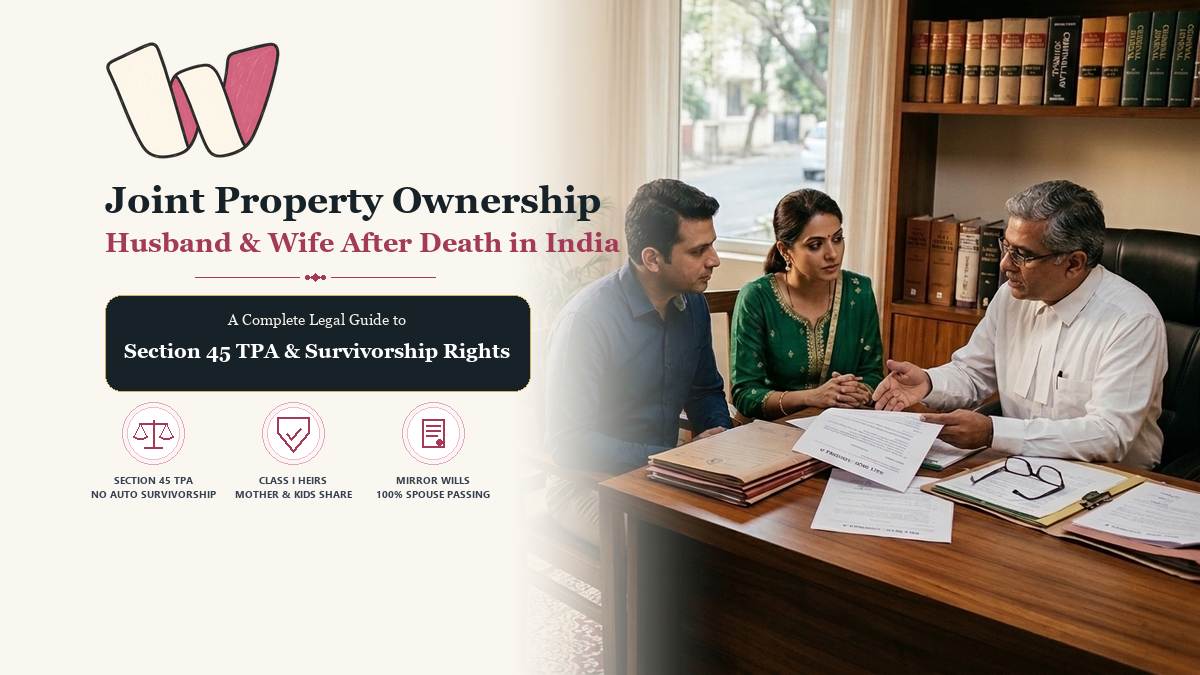
Most married couples in India buy their dream home jointly. When registering the flat, both husband and wife sign the sale deed. They take a joint home loan and open joint bank accounts. They assume that if one spouse dies, the other automatically becomes the sole owner of the house.
This is one of the biggest property myths in India. In Indian law, marriage does not create an automatic right of survivorship for real estate. When a joint owner dies without leaving a Will, their half of the home does not go straight to the spouse. Instead, it enters general succession law.
As a result, in-laws and children become legal co-owners of your family home. You cannot sell the flat, lease it, or take a mortgage without their consent. In this guide, we break down Section 45 of the Transfer of Property Act, explain how Class 1 succession works, and show how married couples can protect their home with mutual Mirror Wills. To calculate your family members' legal shares right now, visit our free succession calculator or review our will drafting checklist.
1. Does a Surviving Spouse Automatically Own the Joint Flat?
The short answer is no. Under Indian property and succession laws, a surviving husband or wife does not automatically gain 100% ownership of a jointly held property.
In countries like the United Kingdom and the United States, property law recognizes joint tenancy with right of survivorship. In that system, when one joint tenant dies, their share automatically merges into the surviving owner. But India follows a different legal framework.
Unless your registered title deed contains an explicit contract stating otherwise, Indian law treats co-owners as tenants-in-common. Each co-owner holds a separate, undivided share in the property. If your sale deed simply lists both names, each partner owns 50% of the asset.
When one co-owner dies, their 50% share does not pass to the co-owner. It belongs to their legal estate. If the deceased spouse did not write a legal Will, that 50% share must be distributed according to personal inheritance laws.
Where immovable property is transferred for consideration to two or more persons, each co-owner acquires a distinct undivided share proportional to the consideration paid. In the absence of evidence of separate contributions, they are presumed to hold equal, separate shares as tenants-in-common.
2. Section 45 Transfer of Property Act: Tenancy-in-Common Default
To understand joint property rights, you must examine Section 45 of the Transfer of Property Act, 1882. This section sets the rules for how co-owners hold title in India.
Under Section 45, if two people buy land or a flat together, their ownership shares reflect the money each contributed toward the purchase price. If the deed does not mention specific payments, the law presumes both hold equal shares. For a husband and wife, this means a 50-50 split.
Indian courts have repeatedly confirmed that Indian law favors tenancy-in-common over joint tenancy. In the landmark case of Mohd. Noor v. Mohd. Ibrahim (1994) 5 SCC 562, the Supreme Court explained that the principle of survivorship does not apply to co-owners unless created by clear words in the deed.
Because there is no automatic survivorship, the deceased spouse's 50% share remains distinct. Upon death, that 50% share does not transfer to the surviving spouse. It passes to the deceased person's statutory heirs under intestate succession.
3. The 50% Joint Flat Trap: How In-Laws and Children Co-Own Your Home
What happens in real life when a married person dies without a Will? Let us look at a standard Indian family scenario.
Suppose Rohit and Priya buy an apartment in Pune worth 1.2 Crore Rupees. Both names are on the sale deed. Each owns an undivided 50% share. Rohit passes away suddenly in an accident without leaving a Will.
Rohit is a Hindu male. His property succession is governed by Section 8 of the Hindu Succession Act, 1956. Under Section 8, when a Hindu male dies intestate, his property is divided equally among all his Class 1 legal heirs.
Rohit leaves behind four Class 1 legal heirs:
- His surviving wife, Priya
- His elderly mother
- His young son
- His young daughter
Rohit's 50% share is divided into four equal parts of 12.5% each. Here is how the total flat ownership is divided after his death:
50% original share plus 12.5% inherited share
Class 1 heir equal share in deceased son's half
Class 1 heir equal share in father's half
Class 1 heir equal share in father's half
This situation catches thousands of families off guard. When Priya wants to sell the flat to move closer to her workplace, the buyer's lawyer asks for title clearance. The bank demands signatures from the mother-in-law. If family relations sour, the mother-in-law or siblings can block the sale entirely.
For Christian and Parsi couples, the Indian Succession Act, 1925 applies. Under Section 33, a Christian widow receives one-third of her deceased husband's property, while two-thirds goes to his lineal descendants. In all communities, dying without a Will splinters family property.
4. Comparison: Joint Ownership Realities vs Popular Myths
The table below compares common myths against actual legal realities under Indian property laws:
| Ownership Issue | Popular Public Myth | Legal Reality Under Indian Law |
|---|---|---|
| Surviving Spouse Ownership | Spouse automatically becomes 100% owner of flat | Spouse keeps 50%; deceased 50% splits among Class 1 heirs |
| Housing Society Nomination | Nominee gets full legal title and ownership of flat | Nominee is merely a trustee; legal heirs remain true owners |
| Joint Bank Account Mode | Either-or-Survivor rule applies to the house deed | Banking mandates do not apply to real estate title deeds |
| Home Loan EMI Liability | Co-heirs must pay EMI if they get a property share | Bank holds surviving co-borrower 100% liable for entire EMI |
| Sale of Joint Flat | Surviving spouse can sell flat independently anytime | Sale impossible without registered NOC/release from all heirs |
| Complete Asset Protection | Buying jointly is enough estate planning for life | Couples must execute registered Mirror Wills to protect title |
5. Supreme Court Precedent on Society Nominee vs Legal Heirs
Many couples tell us: "My husband added my name as the 100% nominee in our housing society records. Does that make me the owner?"
The answer is an emphatic no. Nomination is not a Will. A nomination simply allows the cooperative housing society or bank to hand over administrative custody without getting sued. It does not transfer beneficial title.
The Supreme Court held that nomination does not confer any beneficial interest on the nominee. A nominee is only an authorized hand to receive property from the institution. The property belongs to the lawful heirs of the deceased under succession law.
The Supreme Court ruled that a cooperative housing society must transfer shares into the nominee's name for administrative management. However, this transfer does not make the nominee the absolute owner. The nominee holds the flat as a trustee for all legal heirs under personal succession law.
Even if the housing society issues a new share certificate in the widow's name, she cannot give clear market title to a buyer. A prospective buyer's title advocate will inspect the chain of title, identify the deceased husband's Class 1 heirs, and demand their signatures.
6. Outstanding Home Loan EMI and Bank Mortgage Liability
When a joint owner dies, the surviving spouse often faces a double shock: legal heir claims on one side, and aggressive bank loan recovery on the other.
When you take a joint home loan, both spouses sign as co-borrowers. Banking agreements contain a clause of joint and several liability. This means the bank does not care about inheritance percentages. The bank has the legal right to collect 100% of the monthly EMI from the surviving borrower.
Consider the unfair reality: The surviving spouse pays the full EMI every month from their salary. Meanwhile, the mother-in-law or distant relatives own 12.5% to 37.5% of the property's equity without paying a single rupee toward the loan balance.
If the surviving spouse defaults on the EMI, the bank can issue a demand notice under the SARFAESI Act, 1902 and auction the flat. To prevent this, every couple should pair their joint property purchase with a home loan term insurance plan and reciprocal Mirror Wills.
7. Step-by-Step Procedure for Property Transmission and Mutation
If a joint co-owner has passed away without a Will, the surviving spouse must complete these six formal legal steps to regularize title:
Collect original certified copies of the death certificate from the local municipal corporation or registrar of births and deaths.
Apply before the local Tehsildar or revenue authority for a legal heir certificate listing all surviving Class 1 heirs.
If the mother-in-law and adult children agree to give up their shares to the surviving spouse, execute a registered Relinquishment Deed at the Sub-Registrar Office.
Clear the outstanding home loan through loan insurance or restructure the loan in the survivor's sole name, collecting an NOC and original title deeds.
Submit the death certificate, registered Relinquishment Deed, and indemnity bond to the housing society to transfer the share certificate.
Submit mutation papers before the municipal corporation to update the Khata, Patta, or property tax records in the survivor's name.
8. Sample Joint Tenancy and Mirror Will Clauses for Married Couples
To prevent property disputes and protect your family, use these legally tested clauses:
Note: Incorporate this clause during the drafting of your purchase deed or conveyance deed before registration.
Note: Both spouses should draft matching reciprocal Wills to ensure complete mutual protection.
9. How a Registered Will and Matching Nomination Prevents This Trap
The cleanest and most affordable way to protect your spouse is to execute reciprocal Mirror Wills. You do not need expensive court battles or stressful family negotiations.
In a Mirror Will arrangement, both husband and wife draft matching Wills. The husband wills his 50% share of all properties to the wife if he dies first. The wife wills her 50% share of all properties to the husband if she dies first. Both Wills name the children as ultimate beneficiaries if both spouses pass away together.
When you have a registered Will, Section 8 of the Hindu Succession Act does not apply. Testamentary succession completely overrides intestate rules. Your mother-in-law and extended family members cannot claim any share in the flat. The surviving spouse becomes the sole, undisputed 100% owner.
Drafting an airtight Will takes less than 15 minutes. You can draft your legal Will online right now using our guided platform at WillDrafting.in. If you need bespoke advocate consultation or estate structuring for high-value properties, schedule an appointment with our senior legal team at AMA Legal Solutions. Learn more about our specialized packages for married couples at Mirror Wills for Couples.