- Zero Personal Debt: Legal heirs do not pay credit card bills from their own pocket. You do not pay personal loans from your own salary.
- Limited to Inherited Assets: Under Section 50 and 52 CPC, recovery is capped strictly at the net value of assets left behind.
- No Pious Debt: Section 6(4) of the Hindu Succession Act ended the old rule requiring sons to clear a father loans.
- Zero Estate Means Full Write-Off: If the deceased left no property or funds, the bank must write off 100% of the loan.
- Co-Borrowers Remain Liable: A family member pays only if they signed the loan contract as a co-borrower or guarantor.
- Harassment is Prohibited: Under RBI rules, recovery agents cannot call between 7 PM and 8 AM or threaten family members.
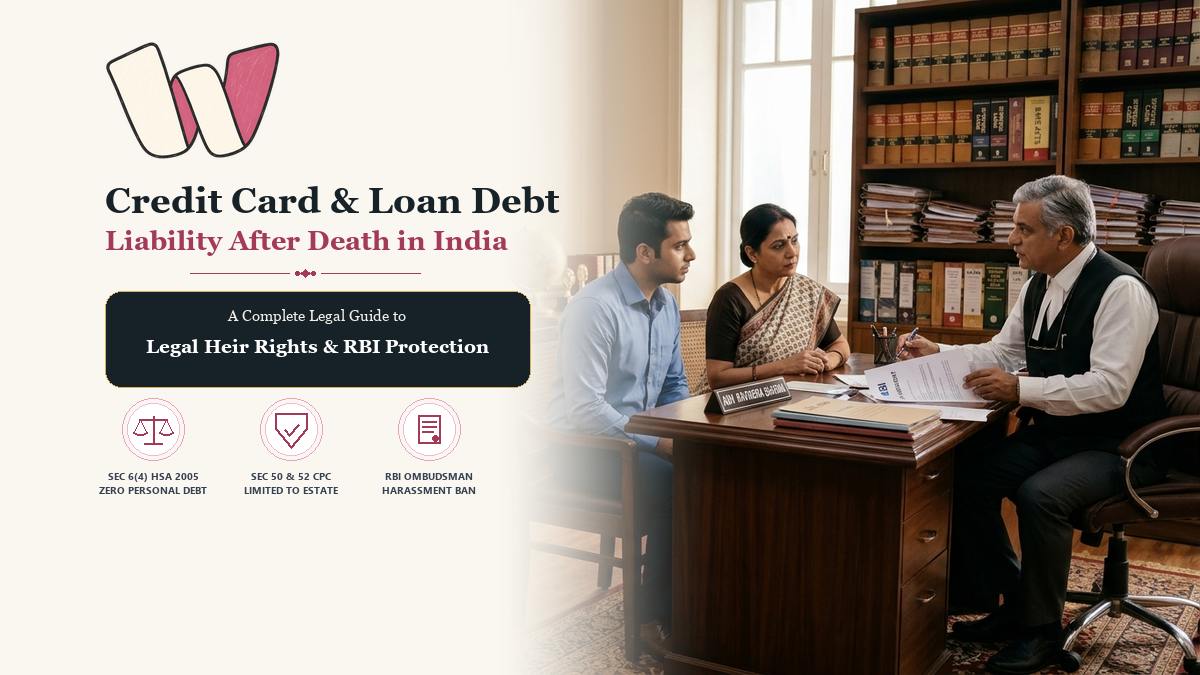
Losing a family member brings deep grief. But for many Indian families, that grief is broken by loud phone calls from debt collectors. Recovery agents call widows, sons, and daughters. They demand quick payment of eight to ten lakh rupees for credit cards or personal loans taken by the deceased.
Collection agents often make false legal claims. They claim that children must clear a father debts. They threaten to seize family gold, attach salary accounts, or send police to the home. Under heavy stress, many families take costly loans or sell personal jewelry to pay debts they do not legally owe.
Indian law protects you from this abuse. Under the Hindu Succession Act, the Code of Civil Procedure, and RBI rules, legal heirs have zero personal liability for unsecured debts. In this legal guide, we explain debt rules after death. We show what banks can and cannot touch. We also share a ready legal notice to stop recovery harassment. You can also calculate family inheritance shares using our free succession calculator or use our will drafting checklist.
1. Who Pays Credit Card and Personal Loan Debt After Death?
The core rule of Indian debt law is simple. A borrower personal liability ends when they pass away. Debts do not pass down by bloodline. You do not inherit a parent or spouse unsecured loans just because you are their heir.
When a person dies, their debts attach only to their legal estate. The estate includes the cash, land, flats, cars, and funds left behind by the deceased. Lenders have a legal right to seek repayment only from those specific estate assets.
If the deceased person left zero estate, the loan cannot be recovered. The bank cannot demand money from the surviving spouse, children, or parents. The bank must treat the unpaid balance as a bad debt and write it off.
Where a decree is executed against a legal heir of a deceased person, it can only be enforced against the property of the deceased that has come into their hands. The legal heir is never personally liable beyond the value of that inherited property.
2. Secured vs Unsecured Debt: The Complete Legal Liability Matrix
To understand what happens to a loan after death, you must check the loan type. Indian banking law divides loans into two main groups: secured debts and unsecured debts.
In a secured loan, the borrower pledges an asset as security. In an unsecured loan, the bank lends money based only on income proof and credit scores, without taking any collateral. The table below outlines how each debt type is handled after death:
| Loan Category | Underlying Collateral | Legal Heir Personal Liability | Bank Lawful Recovery Remedy |
|---|---|---|---|
| Credit Card Bills | None (100% Unsecured) | Zero personal liability | Claim from estate; write off if estate is zero |
| Personal Loans & BNPL | None (100% Unsecured) | Zero personal liability | Claim from estate; write off if no assets exist |
| Home Loans | Mortgage on Flat or Land | Limited to property value | Auction flat under SARFAESI if EMIs stop |
| Vehicle / Car Loans | Hypothecation on Vehicle | Limited to vehicle value | Repossess and auction the hypothecated car |
| Gold Loans | Pledged Gold Ornaments | Zero personal liability | Auction gold jewelry to recover loan balance |
| Co-Signed / Guaranteed Loans | Personal Guarantee Deed | Full personal liability | Recover from surviving co-borrower or guarantor |
As shown in the matrix above, credit card bills, personal loans, and buy-now-pay-later credit lines carry no collateral. The bank cannot seize family assets or force relatives to pay. If the deceased left no assets, the recovery effort stops completely.
3. The Abolition of Pious Obligation: Section 6(4) Hindu Succession Act
Bank recovery agents often tell sons that Hindu religion requires them to clear a deceased father debts. They use the ancient idea of pious obligation to guilt family members into paying.
Under old Hindu law, a son had a spiritual duty, known as Putra Rina, to clear his father debts. Lenders could sue the son or seize joint family property to recover dues.
However, Parliament abolished this rule. Through the Hindu Succession (Amendment) Act, 2005, Section 6(4) became law. The statute states that no court can hold a son, grandson, or great-grandson liable for a father debts based on pious obligation.
After the commencement of the Hindu Succession (Amendment) Act, 2005, no court shall recognize any right to proceed against a son, grandson, or great-grandson for the recovery of any debt contracted by his father, grandfather, or great-grandfather solely on the ground of the pious obligation under Hindu law.
Today, the rule of pious obligation is dead in Indian law. A son or daughter has zero religious or civil duty to pay a deceased parent credit card bill or personal loan from their own income.
4. CPC Section 50 & 52: The Statutory Shield Protecting Family Assets
Sections 50 and 52 of the Code of Civil Procedure, 1908 (CPC) protect Indian families from creditor claims.
Section 50(2) states that when a court decree is executed against a legal heir, they are liable only up to the value of the property inherited from the deceased. If the deceased left assets worth two lakh rupees, a bank cannot recover more than two lakh rupees, even if the loan balance is twenty lakh rupees.
Section 52 explains how creditor claims work. A bank can only attach and sell property that belonged to the deceased borrower. The bank cannot touch:
- The surviving spouse personal bank accounts or monthly salary
- A wife Stridhan, including her personal gold and wedding jewelry
- The children self-acquired properties, salaries, or savings
- Properties held in joint names where survivorship applies through a valid Will
- Life insurance proceeds protected under Section 6 of the Married Women Property Act (MWPA)
If a bank files a civil suit, the heirs only need to show what assets they received. Once they account for those assets, the court dismisses any personal claim against them.
5. Co-Borrower, Guarantor, and Add-on Credit Card Rules
There are only two legal situations where a family member must pay a loan after death:
If a spouse or child signed the loan contract as a joint co-borrower, they are independently liable under banking contract clauses. The bank can seek repayment from the surviving co-borrower because of their own signature, not because they are an heir.
Under Section 128 of the Indian Contract Act, 1872, the liability of a guarantor matches that of the principal debtor. If a family member signed a guarantee deed, the death of the borrower does not release the guarantor. The bank can enforce the guarantee against the guarantor personal assets.
What about add-on credit cards? An add-on cardholder is an authorized user who shares the primary cardholder credit limit. Unless the add-on user signed an agreement taking on direct personal debt, they are not personally liable. The primary cardholder estate remains solely responsible.
Always check if the personal loan or credit card carried insurance. Many lenders bundle credit shield or loan protection plans. When a borrower dies, the insurance firm settles the full balance directly with the bank.
6. RBI Fair Practices Code: Strict Rules Against Recovery Agent Harassment
The Reserve Bank of India sets strict rules for debt collection. Under the RBI Fair Practices Code for Lenders, banks and NBFCs are strictly responsible for their collection agents.
The RBI code sets firm limits on debt recovery:
- Permitted Calling Hours: Agents may only call or visit between 8:00 AM and 7:00 PM. Calls at night or early morning are strictly illegal.
- Ban on Abuse and Threats: Agents cannot use foul words, physical threats, or public shaming.
- Privacy Protection: Agents cannot call friends, neighbors, employers, or relatives to share loan details.
- Bereavement Respect: Harassing a family right after a death breaks both RBI rules and civil law.
- Written Authorization: Every agent must carry an official bank ID card and an authorization letter.
If collection agents break these rules, the lending bank faces heavy RBI penalties. Agents can also be prosecuted under the Bharatiya Nyaya Sanhita for criminal intimidation.
7. Step-by-Step Guide to File an RBI Ombudsman Complaint
If bank recovery agents continue to call or threaten you for a deceased relative loan, follow these four steps to stop them:
Send a formal letter by registered speed post and email to the bank manager. Attach a copy of the death certificate.
Warn the bank that legal heirs have zero personal liability under Section 52 CPC and Section 6(4) HSA. Demand an immediate stop to calls.
If calls continue, file a written complaint with the bank Grievance Redressal Officer and Principal Nodal Officer detailing agent abuse.
If the bank fails to resolve your grievance within 30 days, file an online complaint at cms.rbi.org.in under the Integrated Ombudsman Scheme, 2021.
The RBI Ombudsman can order the bank to stop recovery, direct the lender to write off the balance, and award compensation for harassment.
8. Copy-Paste Legal Reply Notice to Stop Bank Recovery Agents
You can copy, customize, and send this model legal reply notice to any bank, collection agency, or recovery firm calling your family:
Tip: Send this notice via Registered Speed Post with Acknowledgment Due (RPAD) and keep a photo of the postal receipt. Also email a copy to the bank official grievance redressal email address.
9. How a Registered Will and Asset Inventory Prevents Harassment
The best way to protect your family from unfair debt claims is to create a clear estate plan during your lifetime. When a person dies without a Will, relatives often do not know what assets or debts exist. This leaves them open to recovery agent tricks.
A registered Will solves this challenge in three ways:
- Clear Asset Inventory: A Will lists all your assets and debts. Your heirs know what you own and owe, preventing false claims.
- Ring-Fencing Wealth: You can give specific assets to your spouse or children, ensuring smooth title transfer.
- Appointing an Executor: Naming an executor ensures that estate debts and funeral costs are paid in line with Sections 320 to 325 of the Indian Succession Act, 1925.
Writing a valid Will takes less than 15 minutes. You can draft your legal Will online today at WillDrafting.in. If you have questions about estate debts, succession certificates, or property transfers, book a consultation with our legal team at AMA Legal Solutions. You can also review our step-by-step estate guide at Will Drafting Checklist.
Zero Debt Inheritance
You do not inherit credit card debt. You do not inherit personal loans. Debt dies with the borrower if no estate exists.
No Personal Payment
Never pay from your own salary. Never sell your own gold. A bank can only ask for what the deceased left behind.
Stop Agent Calls
Send our model notice by speed post. If calls continue, file an RBI complaint online. Agents must stop calling you.