Executive Summary: Cancelling a Gift Deed in India
Transferring family real estate to a child in the hope of affectionate lifetime care is an emotional tradition in India. However, when children neglect or abandon their elderly parents after securing property title, senior citizens often face acute hardship. Indian law provides specific statutory remedies to reverse these transfers.
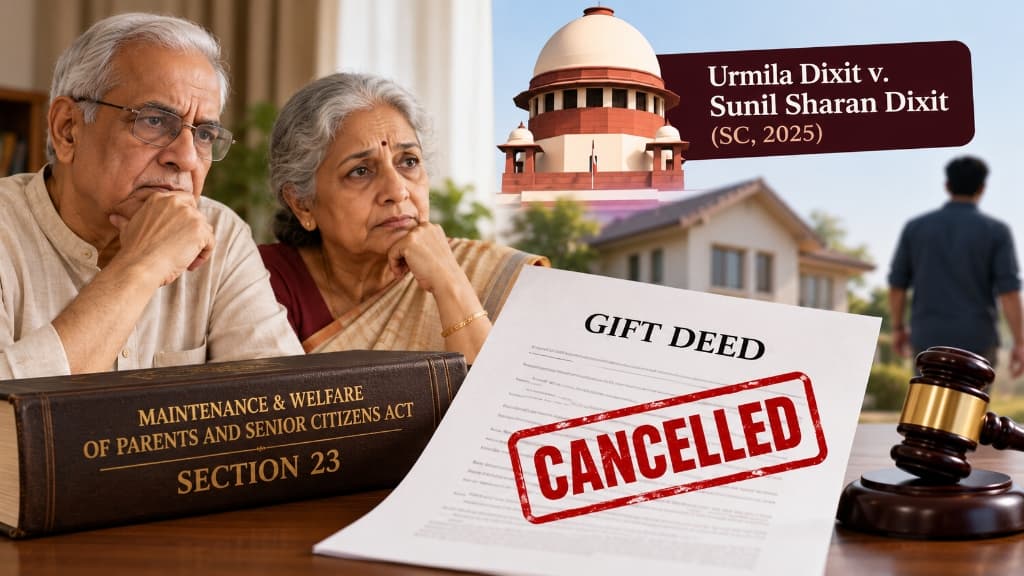
Under Section 23 of the Senior Citizens Act 2007, Maintenance Tribunals can declare a gift deed void if the child neglects maintenance conditions.
The Supreme Court in Urmila Dixit (2025 INSC 20) held that maintenance conditions need not be inside the deed; contemporaneous written notes count.
Pure unconditional gift deeds with only oral promises cannot be cancelled under Section 23 as affirmed in Sudesh Chhikara (2022) .
A Will avoids court battles altogether. Parents retain 100% control for life, pay ₹0 stamp duty, and can change beneficiaries anytime.
1. Section 23 Explained: Senior Citizens Act Protection
The Parliament of India enacted the Maintenance and Welfare of Parents and Senior Citizens Act, 2007 (MWPSC Act) to ensure dignified living and economic security for elders. The cornerstone protection for family properties is codified under Section 23(1) .
Section 23 creates a unique legal mechanism known as a statutory deeming fiction . Under normal property jurisprudence, once a gift deed is registered, it cannot be unilaterally cancelled. However, Section 23 overrides ordinary property laws to safeguard vulnerable senior citizens.
The transferor must be a senior citizen (aged 60 years or older) or a parent at the time of property transfer.
The gift deed or settlement must have been executed after the commencement of the Act in that respective state.
The transfer must be subject to the condition that the transferee child provides basic amenities and basic physical needs.
The child fails or refuses to provide such care, shelter, medical treatment, or basic physical needs.
2. Supreme Court Ruling: Urmila Dixit v Sunil Sharan Dixit
On January 2, 2025 , the Supreme Court of India delivered a monumental judgment in Urmila Dixit v. Sunil Sharan Dixit & Ors. ( 2025 INSC 20 , Civil Appeal No. 10927 of 2024). The Division Bench, comprising Hon'ble Justice C.T. Ravikumar and Hon'ble Justice Sanjay Karol (judgment authored by Justice Karol), resolved a long-standing controversy regarding conditional gift deeds.
The appellant mother, Urmila Dixit, executed a registered gift deed transferring her residential house to her son. Simultaneously, a contemporaneous written promissory note ( Vachan Patra ) was signed by the son, expressly promising to maintain and look after his parents for life.
Following the registration, the son began mistreating the mother and completely stopped providing for her basic medical and daily needs. The mother petitioned the Maintenance Tribunal under Section 23. Both the Tribunal and the District Collector declared the gift deed void. The Single Judge of the High Court affirmed this order. However, the Division Bench of the High Court reversed it, adopting a hyper-technical view that the maintenance condition was not written inside the gift deed itself.
In Sudesh Chhikara v. Ramti Devi (2022 INSC 1277) , the Supreme Court had ruled that Section 23 cannot be invoked if the gift deed was completely unconditional and there was zero written agreement. The Urmila Dixit ruling harmonizes this by confirming that contemporaneous side agreements or Vachan Patras fulfill the condition requirement, protecting parents who did not insert the clause into the deed itself.
3. When Can a Gift Deed Be Cancelled vs Irrevocable?
Under Section 126 of the Transfer of Property Act, 1882 (TPA), the general principle of Indian property law is that a completed gift cannot be revoked at the mere will of the donor. Once accepted by the donee and registered, it transfers legal ownership permanently.
However, Indian law recognizes four distinct legal avenues where a gift deed can be revoked or declared void:
4. Maintenance Condition Clause: Free Sample Drafting
If you are a parent considering a gift deed or settlement deed, you must never sign a standard template drafted by property brokers. To ensure protection under Section 23 of the MWPSC Act, 2007, ensure this exact lawyer-approved covenant is incorporated into the deed.
Itemizes medical treatment, food, clothing, and dignified treatment so courts can readily measure breach.
Guarantees the parent cannot be locked out or evicted by the child or incoming daughter/son-in-law.
Authorizes the Maintenance Tribunal to summarily void registration and evict the child upon default.
5. Visual Blueprint: Gift Cancellation Roadmap
The diagram below illustrates the comprehensive statutory architecture of gift deed cancellation in India, capturing the legal stages from gift deed execution to Maintenance Tribunal voiding under Section 23.
Featuring Supreme Court precedent Urmila Dixit v. Sunil Sharan Dixit (2025 INSC 20) .
6. How Parents File Before the Maintenance Tribunal
Cancelling a gift deed under the Senior Citizens Act does not require an expensive civil suit in District Court. The proceeding is conducted before the specialized Maintenance Tribunal presided over by the Sub-Divisional Magistrate (SDM/SDO).
7. Key Evidence Required to Cancel a Gift Deed
Maintenance Tribunals conduct summary proceedings, making documentary evidence decisive. Parents must present concrete records across four specific evidentiary pillars to withstand appellate scrutiny.
Aadhaar card, voter ID, passport, or birth certificate demonstrating the parent was at least 60 years old when executing the gift deed.
Certified registered gift deed with express maintenance covenants, or contemporaneous written promissory notes ( Vachan Patra per Urmila Dixit ).
Bank statements showing child contributes zero funds, medical bills paid by parents, utility receipts, or police complaints regarding physical harassment.
Certified copy of the Gift Deed, Index II extract, property tax challans, and mutation records verifying the property was self-acquired.
8. Three-Tier Appeals: Tribunal, Collector, High Court
When a Maintenance Tribunal passes an order voiding a gift deed, aggrieved children frequently attempt to stall eviction by filing appeals. Understanding the jurisdictional hierarchy ensures parents are prepared for every stage of litigation.
9. Procedural Timeline: From Notice to Possession Recovery
Section 5(6) of the Act establishes an expedited timeline to prevent elderly parents from enduring prolonged civil trials. The table below charts the realistic procedural lifecycle from initial notice to full physical repossession.
10. Four Complex Scenarios: Daughters-in-Law & Third Parties
Property disputes involving senior citizens often intersect with other matrimonial and property laws. Here is how Indian courts handle four frequent conflict scenarios.
Daughters-in-law often claim a "shared household" right under Section 17 of the Protection of Women from Domestic Violence Act, 2005. In S. Vanitha v. Deputy Commissioner (2020) , the Supreme Court held both Acts must be harmonized. However, an estranged spouse cannot defeat an elderly parent's right to shelter and dignity in self-acquired property.
If the child sells the property before the parent files a petition, Section 23(2) allows enforcement of maintenance rights against transferees who had notice. However, bona fide purchasers for value create heavy litigation hurdles, illustrating why gifting away title during life is risky.
Where parents executed a standard registered gift deed without any maintenance clause or contemporaneous agreement, Section 23 cannot be invoked per Sudesh Chhikara (2022) . The parent's remedy shifts to seeking monthly maintenance under Section 9 or filing a civil suit for undue influence.
When property is jointly held by husband and wife, but only one parent executed a gift deed of their undivided share, the surviving spouse retains their independent 50% undivided ownership. The child cannot dispossess the surviving mother from the joint marital home.
11. Why a Will is Safer Than a Conditional Gift Deed
While the Supreme Court's Urmila Dixit ruling provides historic protection, consider the emotional reality: an elderly mother had to fight her own son through four layers of courts all the way to the Supreme Court of India to reclaim her home.
Executing a Gift Deed surrenders your ownership title today. Even with Section 23, you must endure tribunal hearings, hire advocates, produce medical receipts, and prove you are being neglected.
A legally structured Will keeps you the absolute master of your property until your last breath. Pay ₹0 stamp duty, collect all rental income, and change beneficiaries anytime without asking permission from anyone.
14. Official Legal Citations & Statutory References
This guide is authored under the authoritative supervision of senior advocates at WillDrafting.in, strictly complying with the following statutory provisions and constitutional precedents: